The Biggest Mistake Multi-Dog Owners Make (How to Fix them)

There’s a particular kind of chaos that only multi-dog households understand. It’s the jostling at the back door when you arrive home, the jealous nudge when one dog gets more pats than the other, and the split-second escalation over a dropped piece of kibble. For all the laughter and love that comes with sharing your home with more than one dog, there are real challenges that require more than good intentions to solve. The good news? Most of those challenges aren’t about the dogs being difficult—they’re about structure, or the lack of it. With the right introductions, consistent routines, proper grooming care, and professional support where it’s genuinely needed, a multi-dog home can be one of the most rewarding environments for dogs and owners alike.
Here in Queensland, where outdoor lifestyles and dog-friendly culture are part of everyday life, many Brisbane families are navigating exactly this. At Paddington Pups, we’ve worked with thousands of multi-dog households over our 15+ years serving the Brisbane community. What follows is the practical guidance we share with those families every day.
What’s the Best Way to Introduce a New Dog to Your Existing Pack?
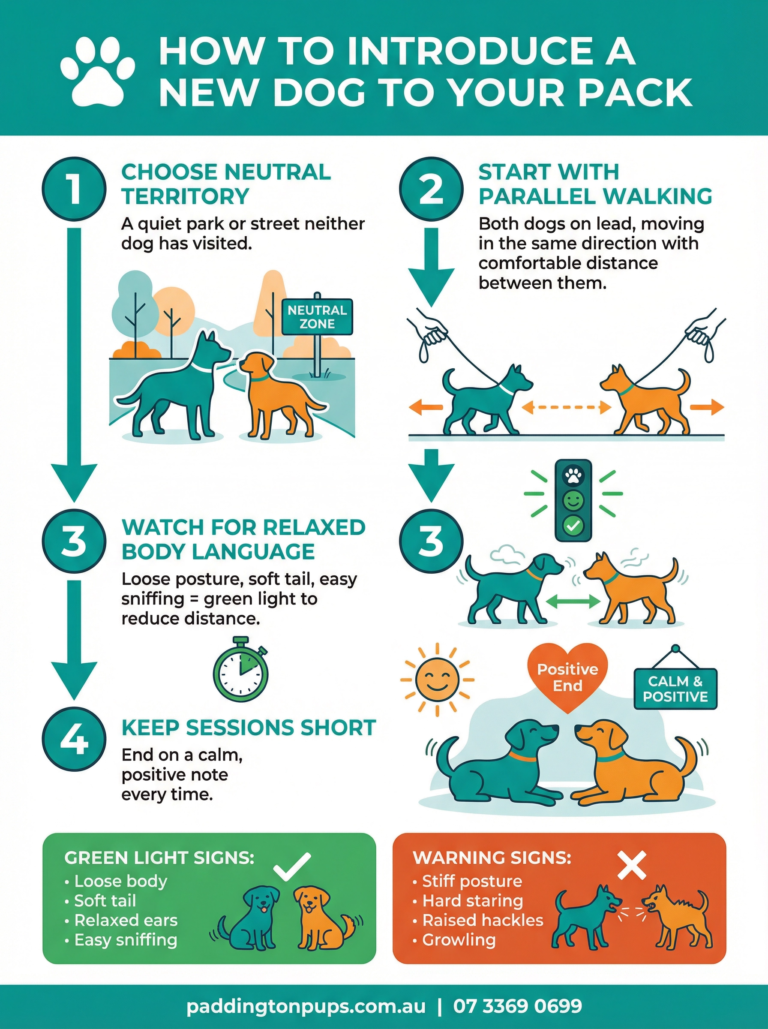
The single biggest predictor of long-term harmony in a multi-dog home isn’t breed compatibility or size—it’s how the introduction is handled. Get it right and you set the foundation for a confident, relaxed relationship. Rush it, and you can create anxiety patterns that take months to unwind.
Why Does Neutral Territory Matter So Much?
Dogs are territorial by nature, and your home—your yard, your lounge room, your fence line—belongs to your existing dog. Introducing a newcomer on that turf immediately puts your resident dog on the defensive, even if they’re generally social and friendly. A 2020 study in Applied Animal Behaviour Scienceconfirmed that introductions in neutral locations result in more positive social interactions and fewer instances of aggression. Choose a completely neutral location: a quiet park, a stretch of footpath neither dog has visited, or an open space away from home. Let them meet on equal footing before either steps through the front door.
How Should You Stage the First Few Meetings?
Think of introductions as a series of short, positive interactions—not one long test of compatibility. Start with parallel walking, where both dogs are on lead and moving in the same direction with a comfortable distance between them. This lets them take in each other’s presence without the pressure of direct contact. As relaxed body language emerges, you can gradually reduce the distance and allow brief, controlled interactions. Keep sessions short. Calm endings matter more than long ones. End the interaction before either dog becomes overstimulated or stressed.
What Body Language Should You Watch For?
Learning to read what your dogs are telling you will save you from a lot of preventable conflict. Signs of stress or overstimulation include stiff, rigid posture, hard staring, raised hackles, growling, and a tightly tucked tail. These aren’t signs of a bad dog—they’re clear communication that a dog needs more space or more time. Loose, wiggly bodies, relaxed ears, and easy sniffing are signs the interaction is going well. When in doubt, slow down. A shorter, positive session is always better than pushing through tension and ending on a difficult note.
How Do You Build a Daily Routine That Works for More Than One Dog?
Structure isn’t just useful in a multi-dog home—it’s essential. Dogs are creatures of habit, and consistent routines reduce the uncertainty that triggers competition, anxiety, and conflict. When dogs know what to expect and when to expect it, the household settles.
Should Each Dog Have Their Own Space?
Yes, and this is non-negotiable in a well-functioning multi-dog household. Every dog needs a place they can go to decompress without being bothered—a crate, a bed in a quiet corner, a designated room. These aren’t punishments; they’re refuges. When dogs can opt out of interaction and have that choice respected, they’re actually more confident and relaxed during shared time. If your dogs are regularly squabbling, it’s worth asking whether they each genuinely have somewhere to retreat.
How Do You Handle Feeding Without Conflict?
Food is one of the most common flashpoints in multi-dog homes, and the simplest fix is separation. Feed dogs in different rooms or at opposite ends of a large space, each with their own bowl. Once feeding is finished, remove all bowls before they’re brought back together. This eliminates the potential for resource guarding and ensures each dog can eat at their own pace without feeling threatened.
| Routine Area | Recommended Approach | Why It Helps |
|---|---|---|
| Feeding | Separate spaces, individual bowls, consistent times | Eliminates food guarding and resource competition |
| Exercise | Daily walks and structured play—together and separately | Meets individual needs; reduces pent-up energy |
| Training | Short sessions with each dog individually | Builds focus and reinforces manners without distraction |
| Downtime | Designated rest spaces for each dog | Reduces overstimulation and conflict |
How Much Exercise Do Multiple Dogs Really Need?
More than most owners anticipate, particularly in Brisbane’s warmer months when a good run can happen year-round. High-energy or working breeds that don’t get adequate exercise will find their own outlets—usually destructive ones. The trap in multi-dog homes is assuming the dogs exercise each other. They do provide enrichment and play, but that doesn’t replace structured walks or off-lead time with human direction. Think of it this way: backyard chaos is not the same as a proper walk.
What Does Grooming Look Like When You Have Multiple Dogs?
In a single-dog household, grooming can be managed fairly ad hoc. With multiple dogs, it needs to be planned and consistent, because skin issues, matting, and nail overgrowth don’t wait for a convenient time, and problems in one dog can quickly affect others.
How Often Should You Be Grooming Each Dog?
Frequency depends on coat type and lifestyle, but as a general guide:
- Short-coated breeds (Beagles, Boxers, Staffies): Brush weekly, bathe every 4–6 weeks
- Medium-coated breeds (Golden Retrievers, Labradors, Border Collies): Brush 2–3 times weekly, bathe every 4 weeks, de-shed seasonally
- Long-coated or curly breeds (Poodles, Spaniels, Shih Tzus): Daily or every-other-day brushing, professional grooming every 6–8 weeks
In Queensland’s humid subtropical climate, skin and coat health require extra attention. Brisbane summers create conditions where moisture gets trapped in thick coats, leading to skin irritation, hot spots, and odour if grooming isn’t kept up. This is especially true for double-coated and long-haired breeds.
What Grooming Products Work Across Different Breeds?
When you have dogs with different coat types, it’s worth investing in breed-appropriate tools rather than trying to find one product that does everything adequately. A slicker brush handles general detangling across most coat types. A de-shedding tool is essential for double-coated breeds. A soft-bristle brush works well for short-coated dogs. For bathing, use shampoos formulated for each dog’s skin type—a dog prone to dryness needs a different formula than one prone to greasiness or skin sensitivity. Your vet or groomer can advise on appropriate products if you’re unsure.
When Does Professional Grooming Make More Sense?
For many multi-dog households, professional grooming isn’t a luxury—it’s practical time management. Bathing, blow-drying, trimming, and nail clipping across three dogs at home is a significant undertaking, particularly on weekends that already disappear quickly. Professional grooming through a service like Paddington Pups ensures each dog’s coat is properly managed, nails are trimmed safely, and ears are cleaned correctly—all without the household disruption. For complex coat types or dogs that find grooming stressful, experienced groomers can also make the process far calmer for everyone involved.
How Does Daycare Support a Multi-Dog Household?
This is a question Brisbane dog owners don’t always think to ask, because daycare is often associated with single-dog families where the dog is home alone. But for multi-dog households, professional daycare can play a genuinely valuable role.
Does Daycare Help With Socialisation Even If Dogs Already Have Each Other?
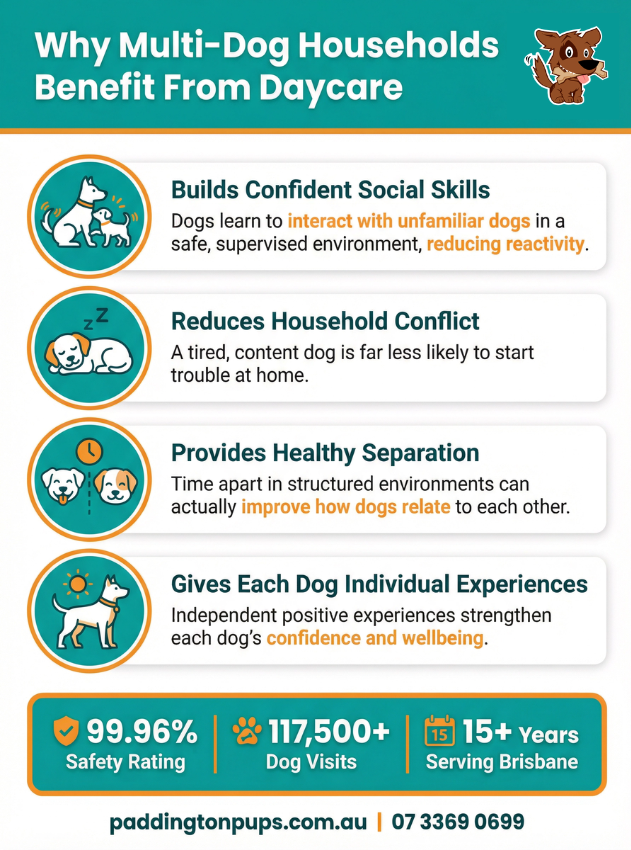
Absolutely. Dogs in multi-dog homes can become quite bonded to their household pack whilst remaining uncertain or anxious around unfamiliar dogs. They learn a particular social dynamic—the one that exists between two or three known companions—but don’t necessarily generalise that into confident behaviour with new dogs. Regular daycare at a facility like Paddington Pups exposes dogs to a rotating group of unfamiliar dogs in a supervised, structured environment. Over time, dogs that attend regularly tend to show far more relaxed, adaptive social behaviour—less reactivity, better communication, and greater confidence in new situations. The social learning that happens in a well-run daycare facility isn’t something easily replicated at a dog park, where interactions are unstructured and supervision is limited.
Can Daycare Reduce Conflict at Home?
In many cases, yes. Competition and conflict in multi-dog households often peaks when dogs are bored, under-exercised, or overstimulated. A dog that has spent a day in supervised play at a professional facility like Paddington Pups returns home tired, content, and significantly less interested in starting trouble. It’s also worth considering staggered daycare attendance if you have two or three dogs with a tense relationship. Having them spend time apart in structured environments—and giving each dog independent positive experiences—can actually improve how they relate to each other at home.
What Should You Look for in a Daycare for Multiple Dogs?
If you’re enrolling more than one dog, look for:
- Transparent supervision standards—low dog-to-staff ratios and clear protocols for managing group dynamics
- Temperament and health requirements—reputable facilities require vaccinations, temperament assessments, and health screening to keep all dogs safe
- Flexibility for different needs—a smaller, anxious dog and a large boisterous dog may not suit the same playgroup, so look for a facility that can appropriately group dogs
At Paddington Pups, our 99.96% safety rating across 117,500+ dog visits reflects the care we put into how dogs are grouped, monitored, and supported throughout the day. Both your dogs’ safety and their enjoyment matter equally to us.
What Are the Most Common Mistakes in Multi-Dog Households?
Even experienced dog owners fall into patterns that create unnecessary tension. A few of the most common:
- Treating all dogs identically—dogs aren’t resentful if one gets fed first or goes out the door first, but they do notice inconsistency. Clear, consistent rules applied the same way each time are far more settling than attempting perfect equality.
- Assuming they’ll sort it out—some tension will resolve naturally, but chronic conflict or a dog that’s clearly being bullied needs human intervention, not benign neglect. If a household pattern is causing one dog to consistently defer, hide, or show stress, that’s worth addressing with a professional trainer.
- Skipping individual time—each dog in your household deserves individual attention and one-on-one time with you. In multi-dog homes, this gets deprioritised quickly. Even short individual walks or training sessions maintain the individual bond and help each dog feel secure.
How Do You Know When to Ask for Professional Help?
Structure, routine, and gradual introductions solve most multi-dog challenges. But some situations genuinely benefit from professional guidance. If you’re seeing resource guarding that escalates to snapping or biting, persistent bullying where one dog has no relief, or significant anxiety in one or more dogs that isn’t responding to routine changes, it’s worth consulting a qualified dog trainer or behaviourist sooner rather than later. Patterns that are ignored tend to become more entrenched over time. The International Association of Animal Behavior Consultants (IAABC) is an excellent resource for finding certified professionals in your area. Similarly, if grooming multiple dogs at home is consistently stressful—for you or the dogs—transitioning to professional grooming is a practical solution, not an admission of failure.
Bringing It All Together
A harmonious multi-dog household isn’t accidental—it’s the result of thoughtful introductions, consistent routines, and attentive care for each individual dog’s needs. The investment you make in getting the foundations right pays dividends for years. If you’re navigating the joys and challenges of a multi-dog home here in Brisbane, Paddington Pups is here to support you. Whether it’s professional daycare to give your dogs structured socialisation and exercise, expert grooming across different coat types, or simply advice from a team that’s worked with thousands of Queensland dogs over 15+ years—we’re just around the corner in Paddington. Reach out to our team through our Owner Portal or call us at 07 3369 0699.
Frequently Asked Questions About Multi-Dog Households
What is the main cause of conflict in a multi-dog home?
The most common cause of conflict is a lack of clear structure and routine. When dogs are uncertain about resources like food, space, and your attention, it creates competition and anxiety that can lead to squabbles. Consistent rules create a calmer, more predictable environment for everyone.
Can dogs of different sizes and breeds live together safely?
Yes, absolutely. Long-term compatibility is far more dependent on individual temperament and a well-managed introduction process than it is on breed or size. With proper supervision and clear household rules, dogs of all different shapes and sizes can coexist happily and safely.
How should we manage toys and chews to prevent fighting?
It is safest to only provide high-value items like bones or long-lasting chews when your dogs are separated in their own spaces, such as their crates or different rooms. For communal play, stick to lower-value toys like balls and ropes, and always supervise the interaction to ensure play remains positive.
Is it a good idea to get two puppies at the same time?
While it can seem like a lovely idea, most professional trainers and behaviourists advise against it. Raising two puppies at once can sometimes lead to “littermate syndrome,” where they bond too intensely with each other and not enough with their human family, which can create significant training and socialisation challenges down the line.
How can you tell if dogs are playing or actually fighting?
Healthy play is generally bouncy, loose, and reciprocal, with dogs taking turns chasing or being on top. Look for “play bows” (front end down, back end up) and short breaks. In contrast, a real fight is typically stiffer, faster, and louder, with a clear intention to do harm. If you are ever in doubt, it is always safest to separate the dogs calmly.