Most dog owners do not need to be convinced that daycare and professional grooming are good ideas. What they actually want to know is what their dog’s day will look like. Will they be anxious? Will they come home different, and if so, different in what way?
Those are the right questions. The difference between average professional care and genuinely good professional care shows up most clearly in how a dog behaves when they get home, and how that changes over time.
After more than 15 years and 117,500 dog visits at Paddington Pups, we have seen what consistent, structured professional care does for Brisbane dogs at every age and temperament. Here is what that actually looks like.
What Does a Dog Actually Experience at Daycare?
The mental image most first-time daycare owners have is something like a dog park: a big space, lots of dogs running around, and controlled chaos. The reality of well-run daycare is significantly more structured than that, and the structure is the whole point.
How Is the Day Actually Structured?
At Paddington Pups, doggy daycare is not one long unbroken stretch of free play. Dogs cycle through periods of supervised group interaction, quieter downtime, and individual attention. A dog left in constant high stimulation does not relax; they escalate. Over the course of a day, well-managed rest periods are what allow a dog to genuinely decompress and benefit from the social time they do have.
This rhythm of activity, rest, and activity mirrors what a well-balanced dog’s natural day looks like. It is one of the reasons dogs that attend daycare regularly tend to settle more quickly at home than dogs that have simply been left alone all day with pent-up energy.
What Happens on a Dog's First Day?
Every dog that visits Paddington Pups for the first time goes through a day assessment before being confirmed as a returning member of the daycare group. This is not a formality. It is how we ensure the dogs already in our care remain safe and comfortable, and how we identify whether daycare is genuinely the right fit for a particular dog.
Not every dog thrives in a group daycare environment, and a responsible facility will tell you that honestly rather than accepting every dog regardless of temperament. Dogs that pass their assessment are the ones for whom this kind of environment is a genuine positive. That is exactly why our regular attendees come back week after week, relaxed and happy to walk through the door.
One important practical note is that our daycare operates as a walk-in service, with no booking required. For busy Brisbane dog owners, that flexibility is genuinely useful. Your dog’s day does not have to depend on whether you remembered to book three days in advance.
What Is the Desexing Policy and Why Does It Matter?
All dogs aged six months and over need to be desexed to attend daycare at Paddington Pups. The Australian Veterinary Association’s guidance on desexing and behaviour supports the understanding that intact dogs introduce hormonal dynamics into group environments. Dogs between six and twelve months who are not desexed may attend by approval only, based on whether any behavioural concerns have emerged. Dogs over twelve months who are not desexed are not permitted to attend.
This policy exists for a straightforward reason. Group environments with intact dogs of either sex create hormonal dynamics that increase the likelihood of conflict and stress for every dog in the group, not just the one in question. Desexing requirements at reputable daycare facilities are not arbitrary. They are a meaningful contributor to why our safety record sits at 99.96% across more than a hundred thousand visits.
What Changes in a Dog's Behaviour After Regular Daycare?
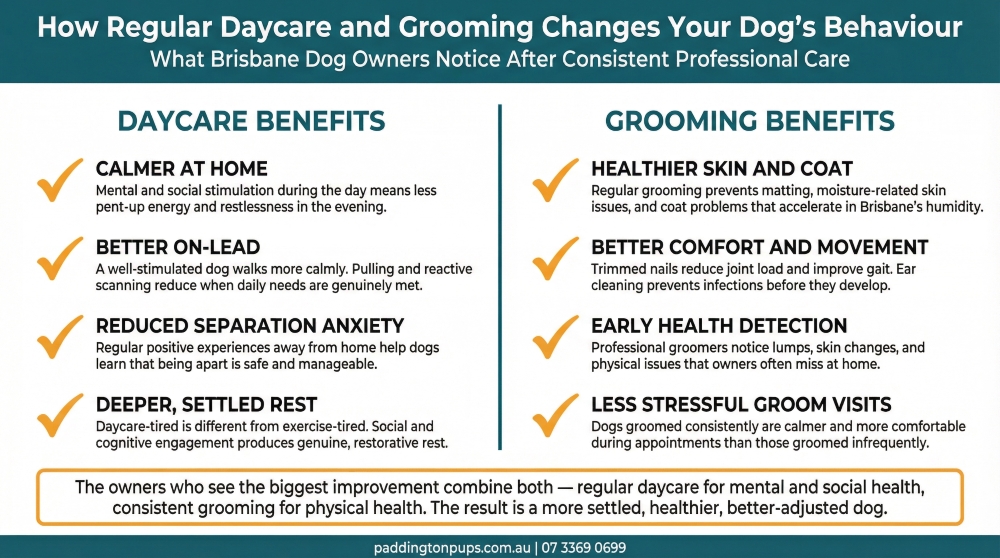
This is where things get interesting, and where daycare pays dividends well beyond the day itself.
Does Daycare Actually Reduce Separation Anxiety?
For dogs prone to separation anxiety, daycare alone is not a treatment, but it plays a meaningful role in the broader picture. According to RSPCA Australia’s resources on separation anxiety in dogs, a structured routine and positive experiences away from home are key components of managing the condition. Dogs that have a predictable, positive experience away from home on a regular basis develop a different relationship with the experience of being apart from their owner. They accumulate evidence that being away is manageable and that their person always comes back.
Over time, this can meaningfully reduce the anticipatory anxiety that builds in the hours before an owner leaves and the distress that follows. Owners of dogs with separation anxiety who use daycare consistently often notice their dogs handling non-daycare days differently too, as though the regular experience of a good day away has recalibrated what being alone means for them.
Why Do Dogs Come Home Tired After Daycare, But Not Exhausted?
There is a specific quality to a daycare-tired dog that is different from a dog that has been running at the dog park. Physical exercise contributes, but the mental engagement of navigating social dynamics with a rotating group of dogs is cognitively demanding in a way that pure physical exercise is not.
A dog that has spent a day reading other dogs’ body language, managing their own social responses, and operating within a structured group environment comes home with a different kind of tiredness. It is one that leads to deep, settled rest rather than the wired restlessness that sometimes follows a very physical but mentally under-stimulated day.
This is why dogs who attend daycare consistently tend to be calmer on their off days too. The cumulative effect of regular social and mental engagement changes a dog’s baseline behaviour over time.
How Does Daycare Support On-Lead Behaviour?
An under-stimulated dog brings everything they have not processed to a walk. The pulling, the reactive scanning, and the inability to focus on you are often symptoms of a dog whose needs have not been met, rather than a training problem.
Dogs that have adequate stimulation and socialisation across the week tend to walk more calmly. They have processed enough during the day that a walk can be a walk, rather than the primary release valve for every unspent impulse.
What Does Professional Grooming Actually Do That Home Care Doesn't?
Home brushing and occasional baths keep a coat manageable. Professional grooming does something different. It maintains the coat, skin, ears, nails, and overall physical condition at a level that has direct implications for your dog’s comfort and long-term health.
What Is Included in Each Grooming Service?
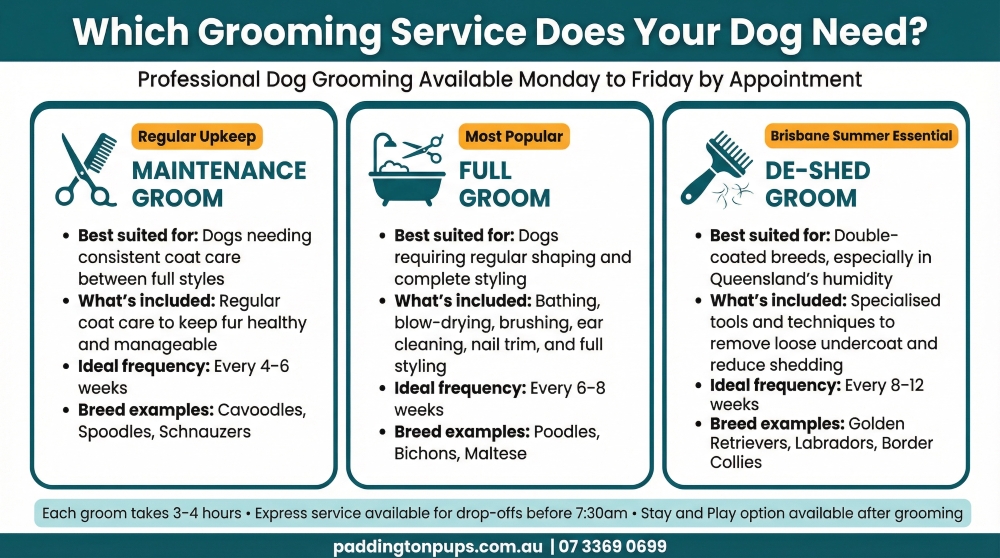
At Paddington Pups, our professional grooming services are delivered Monday to Friday by appointment and include three core options:
| Service | Best Suited For | What It Includes |
|---|---|---|
| Maintenance Groom | Dogs needing consistent upkeep between full styles | Regular coat care to keep fur healthy and manageable |
| Full Groom | Dogs requiring regular shaping and complete styling | Comprehensive service including bathing, blow-drying, brushing, and styling |
| De-shed Groom | Double-coated breeds, especially in Brisbane’s summer | Specialised tools and techniques to remove loose undercoat and reduce shedding |
Each groom takes approximately three to four hours depending on your dog’s size, coat condition, and the service selected. If you need an earlier pickup, an express service is available for drop-offs before 7:30am, with guaranteed completion by 11:00am, though limited spots apply.
What Is the "Stay and Play" Option?
One of the more practical aspects of the Paddington Pups setup is that grooming and daycare share the same facility. After their groom, dogs can stay on for the day and join the daycare group rather than waiting in a crate until pickup. This means your dog’s grooming appointment does not have to interrupt their social day. They simply transition from one to the other, and you collect a clean, well-socialised dog at the end of it. Additional daycare charges apply.
Why Does Grooming Frequency Matter More Than Most Owners Realise?
The most common grooming mistake Brisbane dog owners make is not the wrong product or the wrong technique. It is leaving too long between sessions. When coat maintenance slips, small problems compound quickly. Minor matting becomes serious matting. Overgrown nails affect gait and joint load. Ear buildup progresses to infection. What would have been a straightforward groom becomes a more involved and often more uncomfortable experience for the dog.
In Queensland’s climate specifically, this cycle accelerates. Humidity encourages mats to tighten and skin issues to develop faster than they would in drier conditions. Dogs with dense or long coats that are not regularly groomed through Brisbane’s summer often present with moisture-related skin problems that regular grooming would have prevented.
Booking grooming appointments at consistent intervals, and treating them as a recurring calendar commitment rather than something to schedule when you notice the coat looking rough, is the simplest way to avoid this entirely.
How Do Daycare and Grooming Work Together as a Routine?
The owners who see the most significant improvement in their dogs’ wellbeing and behaviour are typically those who treat professional care as a consistent routine rather than an occasional service.
A dog that attends daycare two or three times a week and is groomed at appropriate intervals for their coat type is a different dog from one that attends sporadically and goes too long between grooms. The difference is not just in how they look. It is in how they regulate, how they handle novel situations, and how they behave at home.
For busy Brisbane dog owners, that is the core of what professional care delivers: a more settled, healthier, better-adjusted dog, achieved through services that fit around your week rather than adding to it.
What Makes Paddington Pups Different From Other Facilities?
The honest answer is track record. Fifteen-plus years serving Brisbane families, a 99.96% safety rating, and more than 117,500 dog visits are not marketing claims. They are a record of what consistent standards produce over time. Our facility is vet-grade sterilised, our team ratios are kept deliberately low to ensure every dog gets real attention, and our walk-in daycare model means your dog’s care does not depend on whether life cooperated with a booking window.
We are also Brisbane-based and Paddington-based, not a franchise with a head office elsewhere. The dogs that come through our facility are our community’s dogs, and that matters to how we approach their care.
How Do You Get Started?
For new customers, the first step is registering through our new customer page before your dog’s first visit. Existing customers can book grooming directly through our online booking system.
Daycare operates as a walk-in service, so no advance booking is required for your dog’s first day, though they will need to pass their assessment to confirm they are a good fit for our daycare group.
If you have questions about whether daycare or grooming is right for your dog’s specific situation, contact us. Our team is always happy to talk it through.
FAQs about Daycare and Dog Grooming
Do I need to book in advance for doggy daycare?
No, our doggy daycare operates as a walk-in service. Once your dog has passed their initial assessment and is registered with us, you can drop them off any day we are open without needing to book ahead.
How long does a typical grooming session take?
A standard grooming session takes approximately three to four hours, depending on your dog’s size, coat condition, and the specific service selected. We also offer a limited express service for early morning drop-offs.
Can my dog stay for daycare after their grooming appointment?
Yes! We offer a “Stay and Play” option where your dog can join the daycare group after their groom instead of waiting in a crate. This is a great way to combine coat maintenance with socialisation. Additional daycare charges apply.
Why do dogs need to be desexed to attend daycare?
All dogs over six months must be desexed to attend daycare (with some case-by-case exceptions for dogs aged 6-12 months). Intact dogs introduce hormonal dynamics into group environments that significantly increase the likelihood of conflict and stress for all dogs present. This policy is a key reason we maintain a 99.96% safety rating.
Will daycare cure my dog's separation anxiety?
While daycare is not a standalone cure for separation anxiety, it can be a highly effective part of a broader management plan. Regular, positive experiences away from home help dogs learn that being apart from their owners is safe and manageable, which can reduce their overall anticipatory anxiety over time.