Most Brisbane working dog owners have a routine that works. The morning walk happens before 7am. Daycare is Tuesday, Wednesday, Thursday. The grooming appointment is in the calendar. The evening walk is after 6. It runs smoothly until, suddenly, it doesn’t.
A project deadline that requires you in the office until 9pm. A work trip announced on Monday morning for Thursday. A child’s illness that means school pickup at 2pm — on a daycare day. A flooded road that makes the usual drop-off route unworkable. A visitor who turns out to be severely allergic to dogs and cannot be in your home.
Life disrupts even the best-maintained dog care routines, and when it does, the dog pays the price — an extra-long day alone, a missed walk, an anxious wait for someone who is three hours later than usual. For a dog that has been carefully set up with a predictable, needs-meeting routine, that disruption is more than an inconvenience. It is a welfare problem .
The solution is not a better routine. It is a contingency plan — a system of backup options, registered relationships, and pre-authorised arrangements that means when your routine breaks down, your dog’s care does not.
This guide is for Brisbane working dog owners who want to build that system before they need it.
Why Are Routine Disruptions Harder on Dogs Than Owners Realise?
Dogs do not understand why the schedule has changed. They experience the disruption — a late return, an absent walker, a skipped daycare day — without the context that makes it comprehensible. For dogs with established routines, that absence of context creates genuine stress.
Regular daycare creates a routine that helps anxious dogs feel secure and builds confidence through positive experiences.
The flip side of that benefit is that when the routine breaks, the security it provided breaks with it. A dog accustomed to three daycare days a week, a consistent morning walk, and a predictable return time does not adapt immediately to an unpredictable week. They are managing uncertainty in the only way they know how — through their behaviour.
For high-drive breeds in particular — the Border Collies, Kelpies, Labradors, and German Shepherds that are common across Brisbane and Queensland — a disrupted care week produces visible and sometimes costly consequences. High-energy breeds like Border Collies, Kelpies, and Australian Shepherds need hours of exercise daily. A quick morning walk before work and an evening stroll simply are not enough. The result is destructive behaviour, excessive barking, and frustrated dogs. A disrupted care routine amplifies exactly this problem. For more information on managing these needs, see our guide on dog care routines for full-time workers.
Building a contingency system is not pessimism. It is the same logic as keeping a spare tyre in the boot. The routine is the primary tyre. The contingency plan is what means you are not stranded.
What Are the Most Common Dog Care Disruptions for Brisbane Working Dog Owners?
Understanding which disruptions are most likely helps you prepare for the specific ones that affect your situation.
Unexpected Work Demands
Meetings that run late, project crises, mandatory overtime, and last-minute travel are the most common sources of routine disruption for Brisbane working professionals. These tend to happen with little or no notice and fall disproportionately on the days the dog is already home alone.
The specific risk: a dog expected home at 5:30pm who is now waiting until 8 or 9pm has had a very long day without appropriate breaks or interaction. For a dog in an apartment or without outdoor access, this is also a practical welfare concern around toilet access. Our guide for Brisbane CBD workers offers strategies for managing long commutes.
Sudden Travel Requirements
A work trip announced on short notice — particularly one involving interstate or international travel — leaves insufficient time to arrange pet care through normal channels. Boarding facilities with availability in peak periods cannot always accommodate last-minute requests, and pet-sitting arrangements that have not been established in advance are difficult to arrange safely on short notice.
Illness and School or Family Disruptions
An owner’s illness, a child’s unexpected illness requiring school pickup, or a family emergency can collapse a normal working-day routine with a few hours’ notice. These disruptions are unpredictable by nature and often happen when the owner’s cognitive capacity to arrange alternatives is also reduced.
Service Provider Disruptions
Dog walkers have their own emergencies. Daycare facilities have exceptional closure days. A grooming appointment that was supposed to include Stay and Play gets cancelled. Any routine that depends entirely on a single provider or a fixed schedule has a single point of failure.
Environmental Disruptions
Brisbane’s wet season, flooding events, severe storms, and infrastructure disruptions can make normal drop-off routes impractical. A flood event in inner Brisbane can isolate suburbs that are normally a five-minute drive from each other, turning a routine daycare morning into a logistical problem .
How Do You Build Your Dog Care Contingency System?
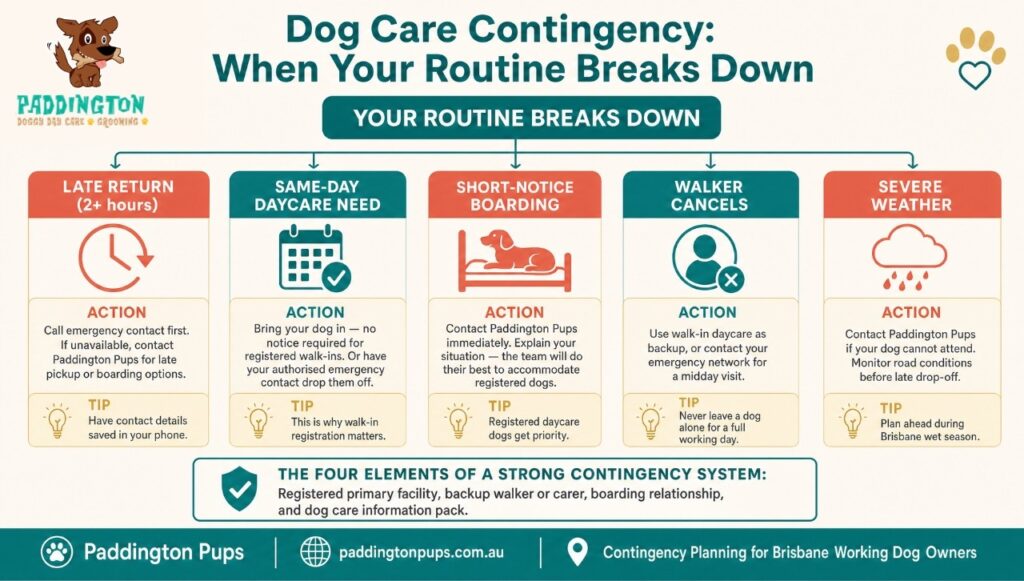
A good contingency system has four elements: a registered primary facility, at least one alternative care option, a trusted emergency contact, and clear pre-authorised arrangements with each.
Element One: Register at Your Primary Facility Before You Need It Urgently
The most important contingency preparation most Brisbane working dog owners overlook is registering at their primary daycare facility before an emergency forces them to. This sounds obvious, but the reality is that many owners think about professional daycare only when something goes wrong — and the first daycare visit requires a registration process and a first-day assessment that cannot happen on the morning you need emergency cover.
At Paddington Pups, new customers register online and bring their dog for a first-day assessment. Once registered and the dog has passed their assessment, they are confirmed as a walk-in attendee for future visits — no further bookings required for doggy daycare.
This walk-in model is the most practical contingency tool available to Brisbane working dog owners. It means that once your dog is registered and assessed, you can bring them in on any operating day without notice. An unexpected late meeting, a last-minute work trip, a disrupted morning — any of these can be managed by an unplanned daycare day at no additional friction beyond the drive to Paddington.
The time to register is not when you need emergency care. It is on a normal week when you can take the process at a comfortable pace, let your dog complete their assessment positively, and establish the relationship before it is put under pressure.
Element Two: Have a Backup Walker or Carer for After-Hours and Short-Notice Coverage
Professional daycare covers business hours. The contingency gaps that daycare does not solve are the ones that happen outside those hours — an 8pm return, an early-morning crisis, a weekend disruption.
For these situations, a trusted network matters. This could be:
A professional dog walker with your regular arrangement established. A walker who already knows your dog, your home, and your routines can respond to short-notice requests far more reliably than one you are calling for the first time. The time to establish this relationship is before you need it in an emergency.
A trusted neighbour or friend with a pre-established arrangement. This does not need to be a formal ongoing commitment — it is simply someone who has been to your home, knows your dog, and has been explicitly asked whether they can be called in an emergency. Most people are willing to say yes when asked directly in advance; very few can say yes reliably when contacted without warning.
Your building manager or a trusted nearby family member. For apartment dwellers in inner Brisbane, proximity matters. Someone five minutes away who can let a dog out and spend twenty minutes with them is a genuine emergency option. Someone an hour away is not.
Element Three: Have Boarding Established as Your Travel Contingency
Unexpected travel is a specific and recurring disruption for Brisbane professionals, and it requires a different solution from daycare or a walker. A work trip of two days or more requires overnight accommodation for your dog.
The practical contingency is establishing a relationship with a dog boarding facility before travel is announced unexpectedly. Dogs that already attend daycare at a facility where boarding is also offered have a structural advantage here. Dogs that already attend daycare regularly know our facility, know our staff, and have established relationships with the dogs they play with. For those dogs, boarding is a stay with familiar people in a familiar place.
At Paddington Pups, dogs that are regular daycare attendees can often be accommodated for boarding on shorter notice than entirely new dogs, because the assessment relationship is already established. This is a practical reason to build a daycare relationship before travel is ever announced — the relationship means your emergency option is better than it would be otherwise. You can learn more in our guide on preparing for boarding.
For peak periods — school holidays, Christmas to January, Easter — even established clients should contact Paddington Pups in advance as soon as travel dates are known. Demand during these periods is high and availability is limited regardless of your existing relationship.
Element Four: Create a Dog Care Information Pack That Anyone Can Use
A practical contingency gap is information — the specific details about your dog’s care that are in your head but not documented anywhere. In a genuine emergency, you may be handing your dog’s care to someone who does not know them, and the information transfer needs to happen quickly and reliably.
A simple dog care information pack solves this. It does not need to be elaborate. A single document, kept somewhere accessible (pinned to the fridge, saved in your phone, shared with your emergency contact) covering:
Feeding schedule and portion sizes
- Location of food, leads, poo bags, and medications
- Veterinary contact details and your vet’s name
- Paddington Pups contact details and your dog’s registration status (including that no booking is needed for daycare)
- Any health conditions, medications, or known anxiety triggers
- Your dog’s microchip number and council registration details
- An emergency authorisation — a written note that your named emergency contact has your permission to authorise veterinary care on your behalf if you are unreachable
This document takes twenty minutes to create and removes a significant source of friction in any emergency handover.
What Should You Do When the Routine Breaks Down Right Now?
Even with a contingency system in place, there will be moments where everything falls apart simultaneously and you need to triage quickly. Here is a practical decision tree: