If you have a dog that jumps on people, you have almost certainly tried the obvious things. You have said “off.” You have pushed them down. You have told guests to ignore it. And yet the moment the front door opens, the jumping happens again, with the same enthusiasm it always has.
The reason these approaches rarely produce lasting results is not that your dog is stubborn or untrainable. It is that jumping is a behaviour built on repetition, and the repetition of the right response is exactly what most home training environments struggle to provide consistently. This is where professional daycare changes the equation.
This article explains why jumping is so persistent, why home training alone often stalls, and how the daily social environment at Paddington Pups doggy daycare provides the consistent, professionally managed repetition that accelerates lasting change.
Why Does Dog Jumping Persist Even When Owners Try to Stop It?
Jumping on people is one of the most common problem behaviours reported by dog owners. Research published in Applied Animal Behaviour Science found that more than 90% of dogs jump on household members returning home at some point in their life, and 59% jump on strangers entering the house . A separate 2024 study in the Journal of Veterinary Behavior found that 73% of dogs jump on household members before going for a walk . These figures confirm that jumping is not a niche problem. It is a near-universal one.
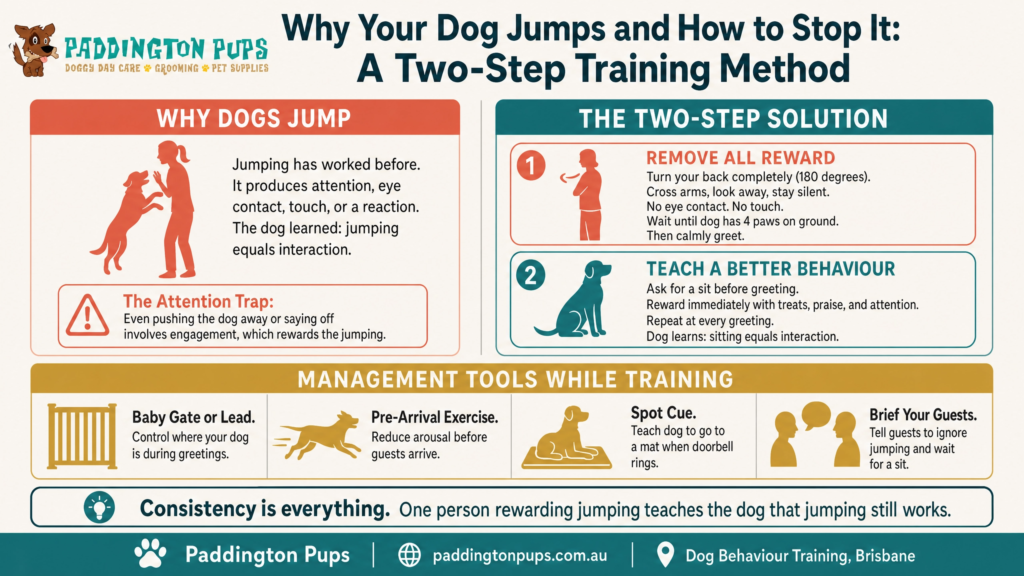
Dogs jump on people for one primary reason: it has worked. At some point, usually very early in the dog’s life, often as a young puppy, jumping up produced exactly what the dog was looking for. Attention. Eye contact. A reaction. Physical contact. A voice, even a sharp one. All of these register as social reward for a dog whose primary goal in the greeting moment is connection.
The puppy that launched itself at visitors and received a laugh, a pat, and an “oh how cute” learned immediately: jumping equals interaction. As the puppy grew into a dog, the behaviour scaled up in physical impact but the underlying reinforcement history remained unchanged. The dog is not misbehaving. It is doing the thing that has reliably produced the outcome it wants.
This is why corrections delivered after the dog has already jumped rarely produce lasting results. They arrive too late to interrupt the behaviour at its source, and even a correction involves social engagement that the jumping dog reads as reward.
Why Home Training Often Stalls
The home environment creates three specific difficulties that are worth understanding directly.
Inconsistent responses across the household. A household with multiple people rarely applies the exact same response to jumping consistently. Children are particularly inconsistent because they move quickly and unpredictably, which many dogs find exciting. One consistent person in the household does not override an inconsistent person. It creates a variable reinforcement schedule, which actually makes the behaviour more persistent, not less.
Peak arousal at exactly the wrong moment. The front door arrival scenario, whether someone is coming home, a new guest arriving, or a food delivery, reliably produces the highest arousal moment in many dogs’ day. Training at peak arousal is the hardest context to work in, and it is exactly when most jumping happens.
Insufficient repetition of the correct response. A dog that has been jumping for two years has two years of reinforcement history behind the behaviour. Removing reward takes longer to produce change when the behaviour is deeply established. Most home training schedules simply cannot generate enough repetitions of the correct response, four paws on the floor, calmly greeted, to outweigh that history quickly.
This is precisely where daycare provides something home training alone cannot easily replicate.
How Does Daycare at Paddington Pups Help Stop Dog Jumping?
Every daycare day at Paddington Pups involves repeated greeting interactions, with staff, with other dogs, across arrivals and transitions throughout the day. These interactions are managed consistently by experienced staff who understand appropriate greeting behaviour and do not inadvertently reward jumping the way well-meaning visitors often do.
The daycare context provides daily, professionally managed repetition of the exact type of greeting interaction that builds the polite, four-paws-on-the-floor habit you are trying to establish at home. A dog that practises calm greetings at daycare multiple times a week is accumulating significantly more reinforced repetitions of polite greeting behaviour than most home training schedules can produce.
This is confirmed in how Paddington Pups structures its programmes. In puppy preschool, trainers specifically model calm greetings and avoid over-excitement cycles, because the greeting moment is understood as one of the highest-risk points for reinforcing the wrong behaviour. That same principle carries through into how daycare staff interact with dogs at drop-off, during the day, and at pickup.
The reinforcement does not need to be labelled “jumping training” to contribute to it. A dog that receives consistent, calm greetings across every daycare interaction is accumulating evidence that calm approaches produce positive social outcomes, the same evidence you are trying to build at home. The two contexts reinforce each other.
Dogs that attend Paddington Pups daycare regularly and whose owners are also applying the correct response at home consistently tend to show faster improvement than owners managing the behaviour only within the home environment. The additional repetitions of rewarded calm interaction provide a foundation that accelerates the home training.
What Is the Correct Training Response at Home?
Daycare works best when the home environment is applying the same principles. The training approach that reliably changes jumping has two components: removing the reward for jumping, and building a specific alternative behaviour that gets rewarded instead.
Remove All Reward for Jumping
The moment your dog jumps, remove every form of social engagement. Turn your back completely, a full 180-degree rotation. Cross your arms, look away, and go completely still. Say nothing. Make no eye contact.
Do not push the dog off. Do not knee them in the chest. Do not grab the paws. All of these involve physical contact and engagement, which is exactly what the jumping dog is seeking.
Remain in this position until your dog has all four paws on the ground and has remained there for a moment. Then, and only then, turn back and calmly greet them. If they jump again immediately, turn away again. Repeat as many times as needed.
Teach and Reward a Specific Alternative Behaviour
Removing reward for jumping is more effective when combined with actively teaching what you want instead. For most dogs and owners, the alternative is a sit during greetings, rewarded reliably and enthusiastically every time it happens.
Before opening the door or approaching a guest situation, ask your dog to sit. The moment they sit, mark it with a treat, praise, or both, and deliver the greeting they wanted, calm pats, attention, connection. If they jump from the sit, turn away again and restart. Repeat at every greeting opportunity.
The dog is learning that the reliable route to the greeting interaction they want is a sit, not a jump. Over time and with sufficient repetition, the sit becomes the default greeting behaviour because it has been more reliably rewarded than jumping ever was.
What Does the Combined Approach Look Like in Practice?
The most effective strategy combines consistent home training with regular daycare attendance. The table below shows how the two environments complement each other.