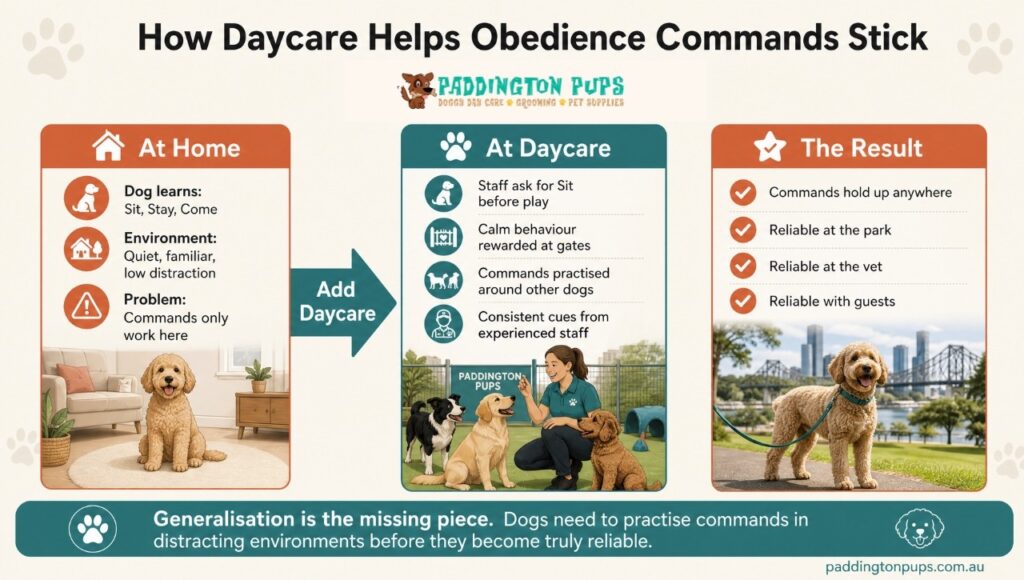
How Dog Daycare Helps Basic Dog Obedience Commands Actually Stick

Your dog sits beautifully in the kitchen. Ask for the same sit at the park, with another dog trotting past, and it is like the word has never been spoken before. If that sounds familiar, you are not doing anything wrong, and neither is your dog. Basic obedience commands like sit, stay, and come are simple to teach in a quiet lounge room, but dogs do not naturally apply what they have learned to noisy, exciting, or unfamiliar places.
 
This guide covers how to teach these three foundational commands step by step at home, why they so often fall apart once real distractions turn up, and why a structured environment like is one of the most effective ways to help them hold up anywhere, not just in your lounge room.
 

What Are the Basic Obedience Commands Every Dog Should Know?

Sit, stay, and come are the three foundational obedience commands most trainers recommend teaching first, because they cover the situations where reliable behaviour matters most:
 
  • Sit gives you a default, calm behaviour to ask for instead of jumping or barging.
  • Stay builds impulse control, asking your dog to hold a position even when something interesting is happening nearby.
  • Come (also called recall) is the command that keeps your dog safe around roads, other dogs, and wildlife.
These three commands are not just party tricks. They are the building blocks that make everyday life with a dog easier, from calmly greeting visitors to safely calling your dog back at the local park. Most trainers agree that a dog with a genuinely reliable sit, stay, and come is easier to manage in almost every other situation, because these commands teach patience and attention as much as any specific action.
 
They also form the foundation for anything more advanced you might want to teach later, whether that is loose-lead walking, settling on a mat, or more complex tricks. Getting these three right first makes everything that follows considerably easier.

How Do You Teach Sit, Stay, and Come at Home?

To teach these commands at home, use short, reward-based sessions in a quiet space before adding any distractions. Each command builds on the last, so it helps to work through them in order.
 
  • Teaching Sit: Hold a treat close to your dog’s nose and slowly move it up and back over their head. As their head follows the treat, their bottom naturally lowers to the ground. The moment they sit, say “sit” and reward immediately. Repeat this five or six times per session, a few times a day.
  • Teaching Stay: Once your dog reliably sits, ask for a sit, then say “stay” and take one small step back. Return immediately and reward if they held the position. Gradually increase the distance and the time before adding any distractions. Rushing this step is the most common reason stay falls apart later.
  • Teaching Come (Recall): Start in a low-distraction room. Crouch down, say your dog’s name followed by “come” in a warm, upbeat tone, and reward generously when they arrive. Never call your dog to you for something unpleasant, like a bath they do not enjoy, or they will start to hesitate on the recall itself.
Keep every session short, no more than five minutes, and end on a success rather than pushing until your dog loses focus. Consistency between family members matters too. If one person allows jumping and another does not, the mixed signals will slow the whole process down considerably.

Why Do Dogs Struggle to Generalise Commands Outside the Home?

Dogs do not naturally generalise what they have learned from one setting to another, so a command practised only in the lounge room often does not hold up at the park or on the footpath. Every new environment, sound, or smell competes for your dog’s attention, and a command that felt automatic at home can feel brand new somewhere unfamiliar.
 
Research published in the confirms that generalisation is a critical component of dog training, noting that caregivers need dogs to be able to perform commands from different people, in different situations, and across different distractions . This is why so many owners feel like their training “did not work,” when really it just has not been practised anywhere except one quiet room.
 
Think of it the way you would think of learning a new skill yourself. Being confident giving a presentation to a small, familiar team is very different from doing the same thing in front of a large, unfamiliar crowd, even though the content has not changed. Dogs face a similar gap between a quiet lounge room and a busy park, and the only way to close it is repeated, positive practice in progressively more distracting settings.
 

How Does Dog Daycare Reinforce Basic Obedience Commands?

Dog daycare gives your dog a supervised, sociable setting to practise these commands with real distractions present, which is exactly what generalising a command actually requires. At Paddington Pups, our team reinforces good manners throughout every daycare day:
 
  • Asking for a sit before releasing dogs into the play area
  • Waiting for calm behaviour before opening a gate
  • Rewarding polite greetings with staff and other dogs
  • Reinforcing consistent cues throughout the day
Over time, this repetition with other dogs and people around helps a command that only worked at home start to hold up anywhere.
Our low dog-to-staff ratio means our team can actually notice and reward these small moments, rather than just managing a crowd. With over fifteen years of experience caring for Brisbane dogs, we have seen how much difference consistent, calm handling makes to a dog’s obedience outside the home. One of our clients at Paddington Pups had a dog with a lovely sit at home that fell apart completely around other dogs. After a few months of daycare visits, where our staff consistently asked for a sit before mealtimes and play, the same command started holding up on walks and at the vet.
 
Daycare is not a replacement for the training you do at home. It is the missing piece that lets a command practised in one quiet room get tested, and strengthened, in a busier, more sociable setting. For inner-city Brisbane owners in particular, whose backyards or apartments do not offer much space for distraction-based practice, a supervised daycare setting can be one of the few genuinely safe places to test a command like recall around other dogs.
 

When Should You Start Practising Sit, Stay, and Come?

You can start teaching sit, stay, and come as soon as a puppy joins your household, usually from around eight weeks of age, using short sessions of a few minutes at a time. Adult dogs and rescues can learn these commands just as well. They simply may need a little more patience if they are arriving with different habits already in place.
 
The key across every age is consistency rather than speed. A few quick tips to keep in mind:
 
  • Puppies (8 weeks+): Keep sessions to two minutes each, spread across the day. Short attention spans mean frequent, brief repetitions work far better than one long block.
  • Adult dogs: Can handle slightly longer sessions of three to five minutes, but the same rule applies — stop on a success, not on a failure.
  • Rescue dogs: May need extra patience if arriving with established habits, but are fully capable of learning new commands with consistent, positive practice.
  • All ages: A few short sessions each day will always outperform one long, frustrating session.

What Common Mistakes Undermine At-Home Obedience Training?

A handful of habits quietly undo weeks of good training. The table below outlines the most common training errors and how to correct them.
Common Mistake
Why It Undermines Training
What to Do Instead
Repeating the command
Saying “sit, sit, sit” teaches your dog that the first cue does not count.
Say the command once and wait. If they do not respond, reset and try again.
Practising in only one room
Dogs are context-specific learners; a lounge-room sit does not equal a park sit.
Gradually practise in the backyard, then the footpath, then around other dogs.
Skipping the reward early
Behaviours that stop being reinforced tend to fade quickly.
Continue rewarding intermittently even after the dog knows the command.
Using punishment
Makes dogs hesitant, damages trust, and increases stress.
Focus on rewarding the correct behaviour, which research shows is more effective.
Calling for unpleasant things
Teaches the dog that “come” means something bad is about to happen.
Always reward recall. If you need to bathe the dog, go and get them instead of calling.
Training when overstimulated
A tired, hungry, or highly aroused dog cannot focus on learning.
Train in short bursts when the dog is rested and attentive.
The is clear that reward-based training is the most humane and effective way to train dogs, and that punishment tends to make unwanted behaviour worse rather than better.
 
This is backed by extensive research. A 2020 study published in directly compared positive reinforcement with aversive methods (electronic collars) for teaching recall and general obedience. The researchers found that dogs trained with positive reinforcement achieved significantly better responses to both “sit” and “come” commands after a single instruction, and responded faster, than those trained with aversive methods.
 
Similarly, research in confirmed that reward-based training methods are equally or more effective than mixed methods, while producing fewer stress behaviours and better long-term welfare outcomes . If your dog shows fear, anxiety, or aggression during training rather than simple distraction, it is worth speaking with your vet or a qualified trainer rather than pushing through alone.

Bringing It All Together

Sit, stay, and come are simple to introduce at home with short, reward-based sessions, but they only become genuinely reliable once they have been tested somewhere busier than your lounge room. That is where a structured, supervised environment like dog daycare earns its keep, giving your dog the chance to practise these basic obedience commands around real distractions, with consistent adults reinforcing the same cues every visit.
 
Whether you are just starting out with a new puppy or trying to sharpen up an adult dog’s manners, the combination of home practice and a supervised daycare routine tends to get results faster than either one alone. If you would like your dog’s training to hold up outside the house as well as it does inside it, to talk through what a daycare routine could look like for your dog. New customers can register through our to get started.

FAQs

Will dog daycare train my dog for me?

Daycare is not a formal training school, but it provides the essential environment needed to generalise commands you have taught at home. Our staff consistently reinforce good manners, such as sitting at gates and calm greetings, which helps your dog understand that the rules apply everywhere, not just in your house.

This is a classic example of a dog failing to generalise a command. The park is filled with high-value distractions like smells, other dogs, and open space. To fix this, you need to practise recall in environments with gradually increasing distractions, rewarding heavily every time they succeed, before expecting perfection at the park.

The best reward is whatever your dog values most in that specific moment. For many dogs, this is high-value food like small pieces of chicken or cheese. For others, it might be a quick game with a tug toy or enthusiastic praise. The higher the distraction level, the higher the value of the reward needs to be.

Keep sessions very short, ideally between two and five minutes. Dogs, especially puppies, lose focus quickly. Three two-minute sessions spread throughout the day are far more effective than one frustrating fifteen-minute session. Always try to end on a successful repetition.

It is never too late. Older dogs and rescues are highly capable of learning new commands. The process is exactly the same as with a puppy, though you may need a little more patience if the dog has spent years practising different behaviours. Consistency and high-value rewards will help them learn the new rules quickly.

Scroll to Top