Brisbane apartment living and dog ownership are increasingly overlapping realities. Inner suburbs like Paddington, Milton, Fortitude Valley, and Spring Hill are attracting more young professionals every year. Most of them rent. Most of them live in apartments. And a growing number of them want dogs.
The question is not whether people in these areas want dogs. They clearly do. The question is whether they have thought through what apartment dog ownership actually requires.
This is not a discouraging article. Dogs absolutely thrive in apartments when the right conditions are in place. But getting those conditions right takes more deliberate planning than suburban dog ownership does. Suburban life comes with built-in buffers: a backyard, more space for a dog to move around, and a quieter environment overall. When those buffers are not there, you need to replace them with structure, a consistent routine, and the right professional support.
Here is the honest guide.
Is Apartment Life Actually Suitable for Dogs?
The short answer is yes, but it depends on the specific dog, the specific apartment, and how committed the owner is to meeting the dog’s needs within that space.
The longer answer is that apartment suitability is more about the dog’s temperament and the owner’s daily routine than it is about square footage. A calm, lower-energy Cavalier King Charles Spaniel can thrive in a compact inner-Brisbane apartment with a committed owner. A high-drive Border Collie in the same apartment with the same owner will likely struggle. Not because apartments are wrong for dogs, but because that combination of breed energy and limited space creates needs that are genuinely hard to meet.
What Genuinely Matters for Apartment Dogs?
Temperament over size: The common assumption is that small dogs suit apartments and large dogs do not. In reality, a Greyhound is one of the largest breeds and is famously well-suited to apartment living because of its calm, low-energy indoor nature. A Jack Russell Terrier, by contrast, has an energy and independence that makes apartment containment actively uncomfortable for the dog. When choosing a breed, focus on energy level, tolerance for being alone, and sensitivity to noise rather than physical size.
Tolerance for time alone: Every working dog owner faces this reality: the dog will spend time home alone. Some breeds manage this well. Others do not. Dogs prone to separation anxiety in a house with a backyard will feel it more intensely in a smaller apartment. This is worth researching carefully before committing to a breed, as recommended byRSPCA Queensland’s guide to apartment living for dog lovers
Noise sensitivity: Apartments share walls, floors, and ceilings. A dog that barks reactively at corridor footsteps, neighbouring conversations, or street noise will be unhappy in most apartment buildings and will likely create problems with neighbours. This is not automatically a dealbreaker, but it is worth factoring in honestly.
Which Dog Breeds Tend to Suit Brisbane Apartment Life?
These are breeds whose temperament genuinely aligns with apartment living, not just small breeds by default:
| Suitability Level | Breed Examples | Key Characteristics |
|---|---|---|
| Highly Adaptable (Lower Energy) | Cavalier King Charles Spaniel, Bichon Frise, Maltese, Pug, Shih Tzu, Greyhound, French Bulldog | Content with moderate exercise and settle well indoors. |
| Good Adaptability (Medium Energy) | Poodles and crosses (Cavoodles, Labradoodles, Spoodles) | Intelligent, trainable, and social. Energy can be managed through structured exercise and daycare. |
| Approach Carefully (High Energy/Drive) | Huskies, Malamutes, Australian Cattle Dogs, Border Collies, Jack Russells, Beagles | High exercise needs, strong independent drives, or vocal tendencies that can make apartment living difficult. |
One important Queensland note: Brisbane’s subtropical climate affects some breeds more than others. Flat-faced breeds such as Bulldogs, Pugs, and French Bulldogs are highly vulnerable to heat stress in summer. If your apartment has limited ventilation or no air conditioning, these breeds need careful management during the December to February heat period, asheat and dehydration are real risks in Queensland’s climate according to RSPCA Australia
How Do You Set Up an Apartment for a Dog?
The goal is not to recreate a backyard inside your apartment. The goal is to create a space that gives your dog what it needs most: a sense of security, a consistent place to rest, and defined territory within the space you have.
What Does a Dog Actually Need Inside an Apartment?
A designated rest space: A dog with a consistent place to sleep and settle regulates its energy more easily than one that moves from spot to spot with no established area. This is the most impactful home setup decision you can make for an apartment dog. A crate, introduced gradually and positively from puppyhood, becomes a place the dog chooses to go rather than one it is forced into. Done well, it is a genuine asset for both the dog and the owner.
Distance from noise sources: Apartments near busy streets or in densely occupied buildings expose dogs to a constant stream of sound that can keep them in a low state of alertness throughout the day. Positioning your dog’s rest area away from the front door and street-facing windows makes a real difference to how well the dog actually rests during your working hours.
Reliable access to water: Dogs left home alone in a Brisbane apartment during summer need access to fresh water at all times. Heat and dehydration are real risks in Queensland’s climate, especially for flat-faced breeds and dogs in apartments without air conditioning.
Mental enrichment: A dog with nothing to do in a small space will find something to do, and the options they find themselves are rarely ones owners appreciate. Puzzle feeders, Kong-style toys filled with food, and safe chew options give dogs something constructive to engage with during alone time and reduce the restlessness that leads to destructive behaviour.
What Care Routine Does an Apartment Dog in Brisbane Actually Need?
This is where honest planning matters most, because it is also where the gap between expectations and reality tends to be widest.
How Much Exercise Does an Apartment Dog Need?
More than most owners anticipate before they get the dog. The baseline for almost any adult dog is two proper walks per day. Not a quick trip around the block, but walks that provide real physical effort and sensory interest. For higher-energy breeds, that baseline is the minimum, not the target.
Brisbane’s climate adds timing pressure that suburban dog owners do not face to the same degree. During summer, footpath surfaces reach temperatures that can burn paw pads well before noon and do not cool until late in the evening. For apartment dog owners, this means summer morning walks need to happen early, ideally before 8am, and evening walks often cannot happen until after 7:30 or 8pm when the ground has cooled enough.
How Does Daycare Fit Into an Apartment Dog's Week?
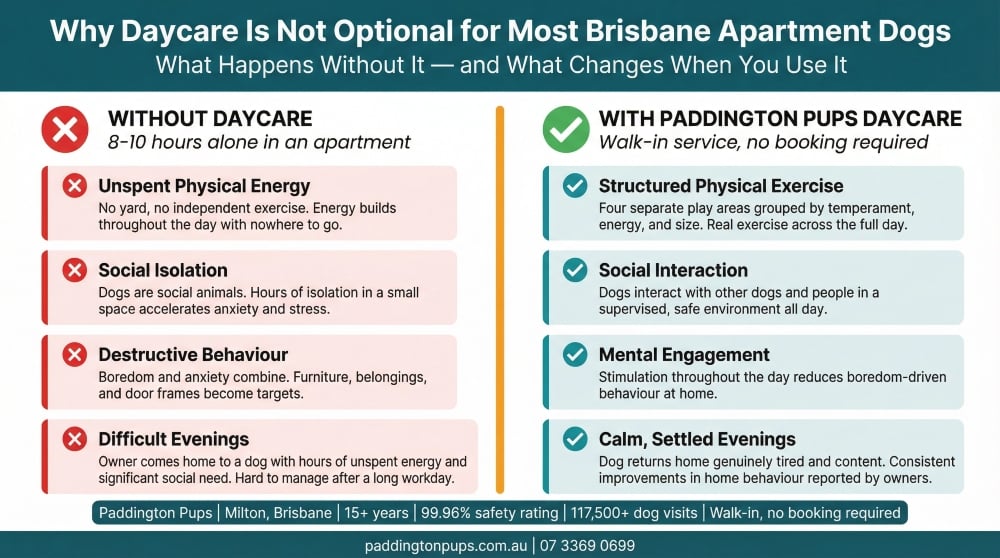
For most Brisbane apartment dog owners working full-time, professionaldoggy daycare is not an optional extra. It is what makes the arrangement genuinely workable for the dog.
A dog that spends eight to ten hours alone in an apartment without adequate exercise and social contact is not in a good position. By the time the owner gets home, the dog has hours of unspent energy, significant social need, and often developing anxiety. An evening walk helps, but it does not fully address what has built up throughout the day.
Daycare provides structured exercise, interaction with other dogs, and mental engagement across the working day. It returns a genuinely tired and settled dog to the apartment in the evening. Dogs that attend regularly show consistent improvements in their behaviour at home.
At Paddington Pups, our daycare is structured specifically with these needs in mind. We operate four separate play areas, grouped by temperament, energy level, and size. A smaller or more reserved apartment dog is not placed in the same group as a large, boisterous dog. That grouping is deliberate, because unmanaged group environments do not produce the calm, settled dog that apartment owners need at the end of a long day.
Our daycare runs as a walk-in service with no advance booking required. For working professionals whose schedule changes week to week, that flexibility is genuinely useful. You can bring your dog on the days that suit your week without being locked into a fixed recurring booking.
What Grooming Routine Do Apartment Dogs Need?
Apartment dogs need more consistentdog grooming than dogs with regular outdoor access, not less. Dogs that live inside full-time are in constant contact with carpets, soft furnishings, and the people they live with. Coat condition, nail length, and general cleanliness all have a direct effect on the household environment as well as the dog’s comfort.
Nail care is particularly important for apartment dogs. Dogs that spend most of their time on carpet and smooth flooring do not naturally wear their nails down the way outdoor dogs do on rough surfaces. Overgrown nails affect how a dog walks, cause discomfort, and can lead to joint problems over time.
At Paddington Pups, professional grooming runs Monday to Friday by appointment. Our groomers are experienced with the coat types most common among Brisbane apartment dogs, including the curly and wavy coats of poodle crosses that are so popular across Brisbane’s inner suburbs. Whether your dog needs a Maintenance Groom for regular upkeep, a Full Groom for complete bathing and styling, or a Style Groom for breed-specific finishing, we can help.
After their groom, dogs can stay on and join the daycare group for the rest of the day through our Stay and Play option rather than waiting in a crate for pickup. Additional daycare charges apply.
How Do You Manage a Dog's Behaviour in an Apartment?
Behaviour issues in apartment dogs almost always come back to unmet needs rather than a difficult temperament. A dog that barks excessively, destroys belongings, or becomes increasingly anxious is telling you that something is not working. Usually that something is insufficient exercise, not enough mental stimulation, or too many hours alone without social contact.
The most effective approach is prevention rather than correction. A consistent daily routine gives apartment dogs the predictability that reduces baseline anxiety. Same wake time, same walk schedule, same feeding times, same rest patterns. Dogs that know what to expect throughout their day are much calmer than dogs living with unpredictable schedules.
If behaviour problems have already developed, getting a qualified dog trainer or behaviourist involved early is worth it. Patterns that become established tend to entrench quickly, and the apartment environment can accelerate that process because the dog has limited space to decompress and limited exposure to varied experiences.
The Realistic Picture
Apartment dog ownership in Brisbane is absolutely sustainable and genuinely rewarding when the foundations are in place. Those foundations are the right dog for your lifestyle and space, a realistic daily care commitment, and professional support through daycare and grooming that fills the gaps the apartment itself cannot.
Paddington Pups has been part of that support system for Brisbane dog owners for more than 15 years. Our walk-in daycare, professional grooming, anddog boarding are designed for exactly the kind of owner Brisbane’s inner suburbs produce: busy, genuinely committed to their dog’s wellbeing, and in need of professional care they can rely on week after week.
If you are setting up for apartment dog ownership in Brisbane, or you are already living it and want better support,contact us. If you are anew customer, we would love to help you get started. Also, ensure your dog isregistered with Brisbane City Council to comply with local regulations.
FAQs
Can large dogs live comfortably in Brisbane apartments?
Yes, depending on the breed’s energy level. A Greyhound, despite being large, is famously well-suited to apartment living because of its calm, low-energy indoor nature. Temperament and energy level matter much more than physical size when choosing an apartment dog.
How often should I walk my apartment dog in Brisbane's summer?
You should still aim for two proper walks per day, but timing is critical. To avoid burning your dog’s paw pads on hot pavement, walks must happen early in the morning (ideally before 8am) and late in the evening (after 7:30pm or 8pm).
Why is daycare recommended for apartment dogs?
Apartment dogs lack a private yard for independent exercise and stimulation. If left alone for 8-10 hours during a workday, they can develop boredom, anxiety, and destructive behaviours. Daycare provides the structured physical activity, mental engagement, and social interaction they need.
Do I need to book daycare days in advance at Paddington Pups?
No, our doggy daycare operates as a walk-in service. Once your dog is registered and has passed their initial assessment, you can drop them off any day we are open without needing to book ahead, offering maximum flexibility for busy professionals.
Why is nail trimming especially important for apartment dogs?
Dogs that spend most of their time indoors on carpet or smooth flooring do not naturally wear their nails down on rough surfaces like outdoor dogs do. Overgrown nails can cause discomfort, affect how a dog walks, and lead to joint problems over time, making regular professional grooming essential.