
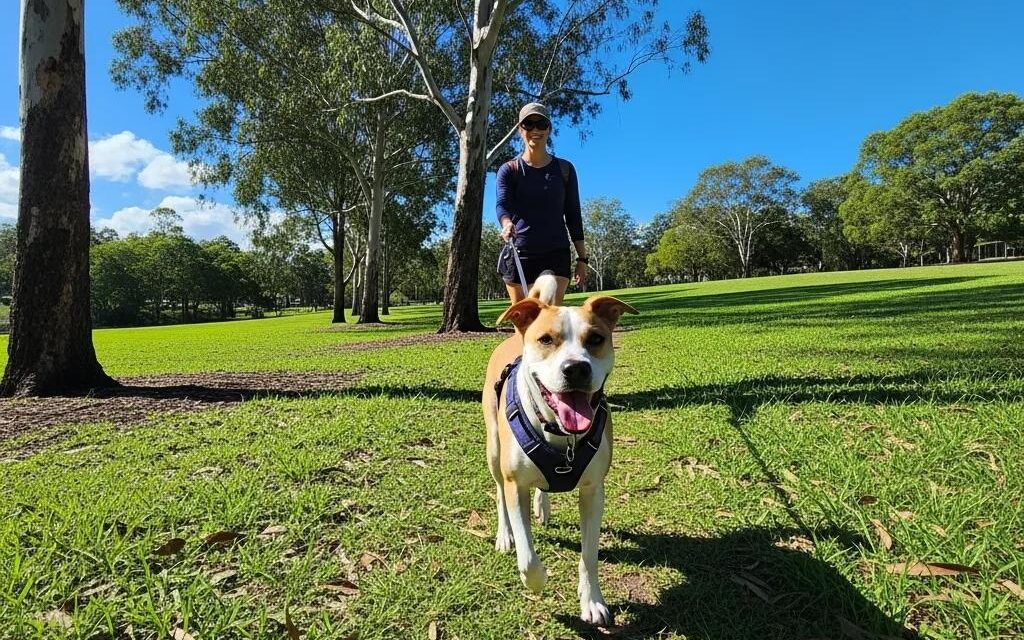
Brisbane is one of the most dog-friendly cities in Australia—and once you start exploring, it is easy to see why so many dog owners put it at the top of their list. With more than 160 off-leash areas maintained by Brisbane City Council, kilometres of riverside paths, and a mild climate that makes year-round walking genuinely enjoyable, there is no shortage of places to take your dog for a proper outing.
The challenge is knowing where to go, what the rules are at each location, and how to make every walk as comfortable and safe as possible—for your dog and for everyone else sharing the space. This guide covers the best routes and parks in Paddington and greater Brisbane, the local regulations you need to know, and the practical steps that make walks better in every season.
What Are the Best Dog-Friendly Walking Routes Near Paddington?
For dog owners based in Paddington and inner Brisbane, there is an excellent spread of routes within easy reach—from short neighbourhood circuits to longer trail networks that give both you and your dog a real workout.
- Paddington Hill: A moderate walk that rewards the effort with panoramic views across Brisbane. The path is well-maintained and wide enough to give passing dogs plenty of space. It is a good option for dogs that find busy urban environments stressful—the route is active but not overwhelming, and the elevated position means your dog gets genuinely varied sensory input throughout.
- Brisbane Riverwalk (New Farm Riverwalk): One of the most enjoyable flat walks in the inner city. The paved path runs from New Farm along the eastern riverbank toward Howard Smith Wharves, with extensions possible toward the Brisbane City Botanic Gardens. Dogs must remain on-lead, but the route is wide and well-shaded at various points, with plenty of natural rest spots along the way. Early morning is the best time to visit—you will avoid the heat and the crowds, and the light on the river is exceptional.
- Mt Coot-tha: For owners after a proper trail walk, Mt Coot-tha offers an extensive network of tracks suited to different fitness levels. The Summit Track from J.C. Slaughter Falls is a popular choice—a 3.8km return route with a moderate grade and well-marked trail. Dogs must be on-lead throughout Mt Coot-tha’s parklands, so a reliable recall is not required here, but good lead manners make the experience far more pleasant for both of you. Carry more water than you think you will need—the trails are exposed in sections, and Brisbane’s heat builds quickly even in cooler months.
What Are the Best Off-Leash Dog Parks in Brisbane?
Brisbane City Council maintains over 160 off-leash dog areas across the city—a number that reflects just how seriously the city takes dog ownership. Most fenced off-leash parks include seating, water stations, waste bins, and shade, with some featuring agility equipment and separate enclosures for small dogs.
- New Farm Park: One of the most popular inner-city off-leash areas, and for good reason. The designated off-leash section sits within an expansive park with river views, picnic spots, and proximity to the New Farm Riverwalk, making it easy to combine a structured walk with off-leash time. It gets busy on weekend mornings, which is great for socialisation but worth keeping in mind if your dog finds large groups of unfamiliar dogs overwhelming.
- South Bank Parklands: The Riverside Green off-leash area within South Bank is a favourite with local dogs and their owners. It is important to note that only the designated off-leash section permits dogs off-lead—the broader South Bank precinct requires dogs to remain on-lead at all times, so check signage carefully when you arrive.
- Bardon Dog Park: A fully fenced off-leash area with agility equipment and good space for running, Bardon is a practical local choice for Paddington dog owners looking for somewhere close to home. The fencing gives owners confidence to let dogs run freely, which is particularly helpful for dogs still working on recall.
- Kedron Brook: A well-loved unfenced off-leash area with meandering paths and shallow creek access. Because it is unfenced, solid recall is important here. The creek provides a natural cooling option on warmer days, and the relatively open layout makes it easy to keep an eye on your dog throughout.
What Local Regulations Do Brisbane Dog Owners Need to Know?
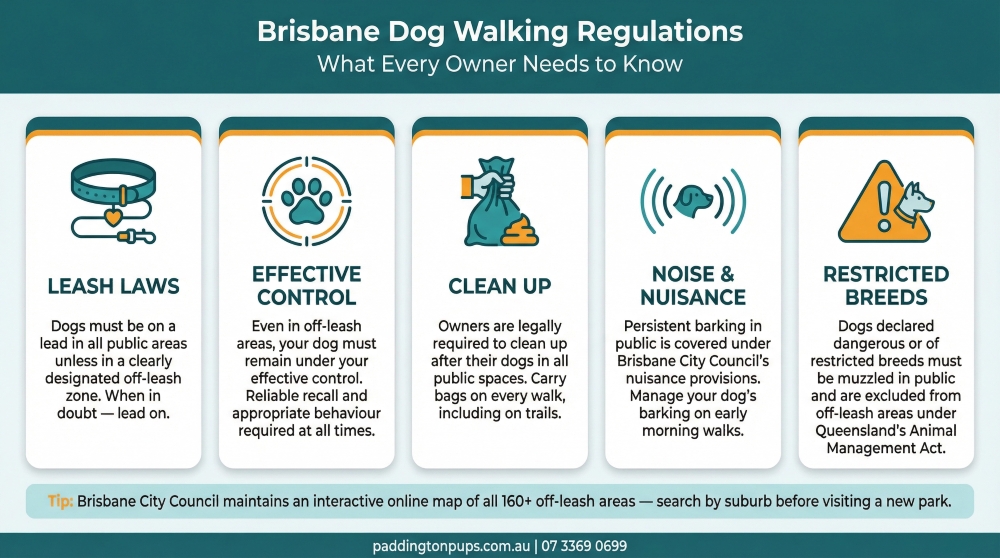
Understanding Brisbane’s dog regulations is not just about avoiding fines—it is about making shared spaces enjoyable for everyone who uses them, including people who may be anxious around dogs or whose dogs need space.
Leash laws: In Brisbane, dogs must be on a lead in all public areas unless in a clearly designated off-leash zone. Off-leash areas are signposted and mapped by Brisbane City Council, which maintains an interactive online map you can search by suburb. When in doubt about a particular area, the default is lead on.
Effective control: Even within off-leash areas, your dog must remain under your effective control. This means a reliable recall and appropriate behaviour—a dog that is charging at or repeatedly pestering other dogs is not under effective control, regardless of whether it is technically within an off-leash boundary.
Cleaning up: Owners are legally required to clean up after their dogs in all public spaces. Carry bags on every walk, including on trails where bins may be infrequent. Leave-it-and-walk-away is the quickest way to undermine community goodwill toward dog owners at shared parks.
Noise and nuisance: Persistent barking in public is covered under Brisbane City Council’s nuisance provisions. Managing your dog’s barking during walks—particularly in the early morning when residential areas are quiet—is part of responsible urban dog ownership.
Restricted and declared dogs: Dogs declared dangerous, menacing, or of restricted breeds face additional requirements in Brisbane, including mandatory muzzling in public and exclusion from off-leash areas. If your dog has been declared under Queensland’s Animal Management (Cats and Dogs) Act, check the specific conditions that apply to your dog before visiting any park.
What Tips Make Brisbane Dog Walks Safer and More Enjoyable?
Brisbane’s climate and geography create a few specific considerations that are not relevant in cooler southern cities. Getting these right makes a meaningful difference to how your dog experiences every walk.
Hydration comes first. In Brisbane’s subtropical heat, dehydration is a genuine risk on walks longer than thirty minutes, and the risk window extends across most of the year. Always carry water for your dog—purpose-designed dog water bottles with integrated bowls are compact and easy to clip to a bag. On summer days, plan walks for early morning or evening and avoid the period between 10am and 4pm when ground surfaces become dangerously hot. The five-second test applies year-round: if you cannot hold the back of your hand on the footpath for five seconds comfortably, it is too hot for your dog’s paws.
Use appropriate gear. A well-fitted harness gives better control than a collar alone on lead walks, particularly for dogs that pull or are easily distracted by other dogs. For breeds that run warm or have double coats, a cooling vest on warmer days can make the difference between an enjoyable walk and a stressful one. Reflective collars or lead attachments are worth using for early morning or evening walks during winter, when visibility on footpaths and shared paths is reduced.
Respect other dogs and their owners. Not every dog at a park or on a path is social or interested in interaction. Before allowing your dog to approach another, check with the owner first. A dog that is on-lead at an off-leash park is often there for a reason—giving them space is the courteous and safe choice.
Socialise intentionally. Regular walks in varied environments—different parks, different routes, different levels of activity—build a more adaptable, confident dog over time. Consistent, positive exposure to different people, dogs, and environments is one of the best investments you can make in your dog’s long-term behaviour.
How Do Grooming and Daycare Support an Active Dog's Walking Life?
The connection between professional dog care and walking performance is more direct than most owners realise. A dog that is physically well-maintained and mentally stimulated arrives at every walk ready to engage—rather than channelling pent-up energy into pulling, reactivity, or anxious behaviour on the lead.
Grooming plays a practical role after trail and park visits. Debris, seeds, and grass burrs accumulate in coats quickly on Brisbane’s trails, and some—including grass seeds—can work their way into skin and ears if not removed promptly. Regular professional dog grooming at a facility like Paddington Pups keeps coats in good condition, paws and ears checked, and nails at an appropriate length for comfortable movement on varied terrain. Overgrown nails affect a dog’s gait on hard surfaces and can cause long-term joint issues that limit how much exercise they can comfortably take.
Daycare benefits active dogs in a different way. Dogs that have structured, supervised socialisation and exercise during doggy daycare days tend to be calmer, more focused, and better-behaved on-lead. The mental stimulation of a well-run daycare environment tires dogs differently from physical exercise alone—which means a dog that attends regular daycare may walk more calmly beside you than one that has simply been left at home all day with excess energy to burn.
At Paddington Pups, our Brisbane daycare and grooming services are designed for exactly this kind of active dog ownership. After 15+ years and more than 117,500 dog visits, we understand what Brisbane dogs need—and we are right here in Paddington when you need us.
Explore our grooming and daycare services or get in touch to find out more.
What Products Make Brisbane Dog Walks Better?
A few well-chosen items make a consistent difference to walk safety and comfort in Brisbane’s conditions:
| Product | Purpose | Best For |
|---|---|---|
| Portable water bottle | Hydration on the go | Any walk over 30 minutes in Brisbane’s climate |
| Padded harness | Better control, reduced neck strain | Dogs that pull or are easily distracted |
| Cooling vest | Temperature regulation | Warm-weather walks, double-coated or short-nosed breeds |
| Reflective gear | Improved visibility | Early morning or evening outings |
| Waste bags | Legal compliance and courtesy | Every walk, especially on trails with few bins |
For summer walks specifically, consider timing as the most important variable. A shorter walk in the cool of early morning is better for your dog than a longer one in midday heat—Brisbane summers can push ground temperatures well beyond what paws can tolerate comfortably.
Frequently Asked Questions
Where can I find a map of off-leash dog parks in Brisbane?
Brisbane City Council maintains an interactive online map of over 160 off-leash dog areas. You can search by suburb or facility type (such as fenced areas or small dog enclosures) directly on the Council’s website.
Are dogs allowed at South Bank Parklands?
Dogs are allowed at South Bank but must remain on-lead at all times, except within the designated Riverside Green off-leash area. Always check local signage, as rules are strictly enforced in this busy precinct.
How do I know if the pavement is too hot for my dog's paws?
Use the five-second test: place the back of your hand flat on the pavement. If you cannot hold it there comfortably for five seconds, it is too hot for your dog to walk on. In Brisbane, this is a common issue between 10am and 4pm during the warmer months.
Does my dog need to be on a lead at Mt Coot-tha?
Yes, dogs must be kept on a lead at all times on Mt Coot-tha trails and within the parklands. While it is a fantastic area for active walking, it is not an off-leash zone.
How can daycare help if my dog pulls on the lead?
Dogs often pull on the lead due to pent-up physical and mental energy. Regular attendance at a structured dog daycare provides intensive socialisation and mental stimulation, which tires them out differently. A fulfilled, tired dog is generally much calmer and easier to handle on a lead.