Caring for Older Dogs: Home, Routine, and Care Adjustments

Most Brisbane dog owners notice the change before they can quite name it. Their dog takes a moment longer to get up in the morning. The back legs seem slightly less steady on tiles. The enthusiasm for a long park run has given way to a preference for a shorter, slower walk. The dog that used to leap onto the couch now stands at the base and looks up hopefully.
 
These are the small, gradual signals that a dog is moving into the senior years. They do not arrive all at once, and they do not require panic. What they do require is a thoughtful recalibration of your home environment, your daily routine, and the professional care your dog receives so that the changes ahead are managed proactively rather than reactively.
 
This guide covers exactly that: the practical adjustments that make a genuine difference when caring for older dogs, written for Brisbane dog owners navigating this transition.

When Does a Dog Become a Senior? Understanding the Timeline for Caring for Older Dogs

The answer varies more than most people expect, and it matters for when you start making adjustments to your approach for caring for older dogs.
 
Large and giant breeds age faster than small breeds. A Great Dane or Rottweiler may be considered senior from around six to seven years of age. A Border Collie or Labrador typically enters the senior category from around eight years. Small breeds, such as Cavalier King Charles Spaniels, Maltese, and Toy Poodles, often do not reach senior status until nine or ten years old. You can read more about the biological process in our guide on .
 
The distinction matters because senior health changes do not wait for a calendar milestone. Owners who understand their breed’s expected ageing timeline can start making gradual adjustments ahead of the curve rather than scrambling to respond once symptoms appear. This proactive approach to caring for older dogs makes a significant difference to their comfort and longevity.
 
If you are unsure when your dog is entering the senior phase, . According to the , most vets recommend shifting to more frequent health checks, typically every six months rather than annually, once a dog is classified as senior.

How Can You Make Your Home Work Better When Caring for Older Dogs?
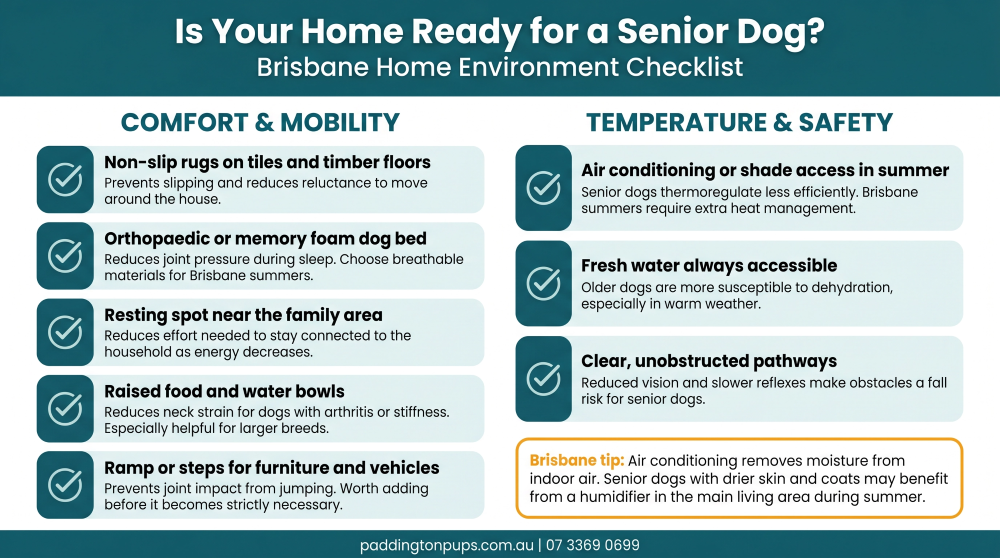
The home environment that suited a young, agile dog often creates unnecessary difficulty for a dog whose joints, vision, or mobility is changing. Most of the adjustments needed for caring for older dogs are simple and inexpensive, but they make a meaningful difference to daily comfort.
 
infographics about senior dog home environment checklist

What Are the Most Important Home Changes for Caring for Older Dogs?


Flooring and traction. Smooth floors such as tiles and polished timber are one of the most common sources of discomfort for senior dogs. Reduced muscle strength and joint stiffness make it harder to maintain traction, and dogs that slip repeatedly on hard floors can develop a reluctance to move around the house. Rubber-backed rugs or non-slip matting on main pathways and in front of resting spots address this directly without requiring renovation.

Bedding. Standard flat dog beds provide minimal joint support for dogs with developing arthritis or muscle loss. An orthopaedic or memory foam dog bed reduces pressure on joints during sleep and makes getting up and lying down significantly more comfortable. In Brisbane’s climate, choose a material that is breathable and easy to wash, as heat retention in dense foam bedding can be uncomfortable through summer.
 
Resting spot placement. Senior dogs benefit from resting spots that are easy to reach without navigating stairs, jumping, or travelling long distances through the house. A bed near where the family gathers most reduces the effort required for the dog to stay connected to the household, which matters more as energy levels decrease.
 
Food and water bowl height. Dogs with neck stiffness or arthritis benefit from raised bowls that reduce the angle required to eat and drink. This is a small change that can make a noticeable difference to mealtimes, particularly for larger breeds.
 
Ramp or steps access. If your dog regularly accesses furniture, a vehicle, or a raised sleeping area, a ramp or set of low steps reduces the impact on joints compared to jumping. For dogs already showing signs of joint stiffness, this transition is worth making before it becomes necessary to prevent injury.
 
Temperature management. Brisbane’s subtropical climate is generally kind to senior dogs during winter, but summer heat requires extra attention. Older dogs thermoregulate less efficiently than younger dogs. Air conditioning, shade, fresh water access, and avoiding outdoor activity during peak heat are all important during Brisbane’s summer months.

How Should Your Daily Routine Change When Caring for Older Dogs?

Routine is particularly important for senior dogs because consistency reduces the stress of cognitive and physical change. At the same time, the content of that routine needs to evolve as your dog’s capacity changes. A structured approach to caring for older dogs supports both their physical and mental wellbeing.

What Exercise Approach Works Best When Caring for Older Dogs?

The goal shifts from building fitness to maintaining it. Senior dogs benefit most from regular, moderate exercise that keeps joints mobile and muscles active without causing fatigue or pain. If your dog is specifically struggling in winter, see our guide on .
 
What works well for senior dog exercise:
  • Shorter, more frequent walks rather than one long outing
  • Flat, even surfaces that reduce joint strain (paved paths over uneven terrain)
  • Swimming or hydrotherapy if accessible, which provides resistance exercise with minimal joint impact
  • Gentle off-lead sniff time in safe, familiar areas
  • Indoor mental enrichment such as puzzle feeders and gentle scent games on days when physical exercise is reduced
  • Signs that exercise has been too much:
  • Excessive stiffness the day after activity
  • Reluctance to move the following morning
  • Limping or favouring a limb during or after a walk
  • Lagging significantly behind their usual pace
Scale back if you notice these signs and discuss with your vet whether the current exercise level is appropriate.

How Does Feeding Change When Caring for Older Dogs?

Senior dogs generally have slower metabolisms and require fewer calories than they did in their prime. At the same time, their need for high-quality protein to maintain muscle mass remains significant, and certain nutrients become more important for joint, cognitive, and immune health. Proper nutrition is one of the most important aspects of caring for older dogs.
 
Key nutritional shifts for senior dogs:
  • Switch to a senior-specific formula if not already using one
  • Monitor weight closely and adjust portion size as metabolism slows
  • Ensure fresh water is consistently available, as senior dogs are more susceptible to dehydration
  • Add joint-supporting supplements such as glucosamine and omega-3 fatty acids only after discussing with your vet
  • Consider splitting daily food into two or three smaller meals if your dog shows signs of digestive sensitivity
  • Avoid making sudden dietary changes. Transition new food gradually over seven to ten days to reduce digestive upset.

How Important Is Mental Stimulation When Caring for Older Dogs?

Very important, and often the most overlooked aspect of caring for older dogs. Cognitive decline is a genuine concern for older dogs, and mental engagement actively slows its progression. A dog that stops being mentally challenged tends to disengage more quickly from the world around it.
 
Practical mental stimulation for senior dogs:
  • Puzzle feeders that make mealtimes engaging
  • Short, gentle training sessions that reinforce familiar commands
  • Scent-based games and hide-and-seek with treats around the house
  • New, low-energy walking routes that offer different smells and environments
  • Social interaction with familiar people and dogs
The key is keeping sessions short and positive. A senior dog should finish a mental enrichment activity satisfied and calm, not frustrated or tired.

How Does Grooming Change When Caring for Older Dogs?

Senior dogs often need more careful and more frequent  than they did when younger, but they are also less able to tolerate the physical demands of a long or intensive grooming session. The approach needs to adapt accordingly when caring for older dogs.
 

What Changes About a Senior Dog’s Coat and Skin When Caring for Older Dogs?

 
As dogs age, several coat and skin changes become common:
  1. Coat texture changes: Many senior dogs develop a coarser, drier, or thinner coat as sebaceous gland activity decreases. This can make the coat more prone to matting and the skin more prone to dryness and irritation.
  2. Slower oil production: Natural coat oils reduce with age, leaving the skin more susceptible to dryness. This is particularly relevant in Brisbane where air conditioning removes moisture from indoor environments.
  3. Increased skin lump and growth development: Older dogs are more likely to develop benign lumps, warts, and skin tags. Regular grooming provides consistent monitoring of these changes and alerts owners to anything that appears new or changed.
  4. Reduced tolerance for cold: Senior dogs feel temperature changes more acutely. In Brisbane’s brief winter months, a cold grooming environment or incomplete drying after a bath can cause more discomfort than it would for a younger dog.

What Grooming Adjustments Help When Caring for Older Dogs?

  • Use softer brushes that are gentler on thinning or more sensitive skin
  • Keep grooming sessions shorter and include rest breaks if the dog becomes tired or uncomfortable
  • Use hypoallergenic or moisturising shampoos suited to drier, more sensitive skin
  • Ensure complete, warm drying after every bath, and do not let a senior dog air-dry in air-conditioned spaces or during cooler weather
  • Trim nails more frequently if the dog is less active, as reduced movement on hard surfaces means nails do not wear down naturally
  • Clean ears regularly and check carefully, as older dogs can be more prone to ear infections
At Paddington Pups, our groomers are experienced in caring for older dogs and adjust their approach for dogs that need more time, more rest breaks, or gentler handling. If your dog is entering the senior years and you have not discussed their grooming needs with our team, it is worth having that conversation when you next book.

Does Daycare Still Suit an Older Dog? Finding the Right Care When Caring for Older Dogs

 
Yes, for many senior dogs, provided the facility accommodates their specific needs. The key considerations are grouping, rest access, and supervision. Daycare can be an excellent option when caring for older dogs, as it provides structured activity and social engagement.
 
Paddington Pups confirms on the  page that senior dogs are placed in calmer groups and have comfortable resting areas available at all times. This is the specific accommodation that makes daycare appropriate for older dogs: they are not placed in high-energy play groups where the pace and activity level are mismatched to what they can comfortably manage, and they can rest whenever they need to rather than being kept in continuous active play.
 

What Are the Benefits of Daycare When Caring for Older Dogs?

Maintained social engagement: Older dogs that become isolated at home tend to withdraw more quickly from social interaction. Regular, appropriate socialisation keeps them engaged and mentally stimulated.
 
Structured activity: The rhythm of a daycare day, with periods of activity followed by rest, suits the needs of senior dogs well. It mirrors the balanced routine that supports their physical and cognitive health.
 
Professional observation: Staff who see your dog regularly notice changes in gait, energy level, appetite, and behaviour that may not be immediately obvious at home. This can lead to earlier identification of health changes worth discussing with a vet.
 
Owner peace of mind: For Brisbane owners whose senior dog is home alone during working hours, knowing the dog is in a supervised environment with access to rest and attention removes the worry of an undetected fall, health event, or prolonged distress.

What to Check Before Enrolling a Senior Dog in Daycare

Before enrolling or continuing a senior dog in daycare, it is worth confirming with the facility how senior dogs are grouped (separate from high-energy dogs), what resting areas are available and how accessible they are, how staff monitor for signs of fatigue or discomfort during the day, and whether any health conditions or mobility limitations need to be disclosed.
 
At Paddington Pups, sharing your dog’s health history and any senior-related conditions at registration or before each visit allows our team to provide appropriate support from the moment they arrive.

Quick Reference: Senior Dog Care Checklist for Caring for Older Dogs

Use this table to assess where adjustments are needed in your dog’s current care routine when caring for older dogs:
Care Category
Recommended Adjustments
Home Environment
Add non-slip rugs on smooth flooring, provide orthopaedic bedding, move resting spots near family areas, raise food bowls, and add ramps for furniture access.
Daily Routine
Shift to shorter, frequent walks, provide mental enrichment through puzzle feeders, feed two smaller meals, and schedule six-monthly vet check-ups.
Grooming
Use softer brushes and moisturising products, request shorter sessions with rest breaks, trim nails more frequently, and ensure thorough warm drying.
Professional Care
Communicate senior needs to groomers, ensure daycare uses calmer grouping, and consult your vet on appropriate supplements and exercise levels.
 

Booking at Paddington Pups for Caring for Older Dogs

Our grooming services are available Monday to Friday by appointment. If your dog is entering the senior years and you would like to discuss how we can adapt their grooming experience when caring for older dogs,  when you book.
 
Our daycare is a walk-in service with no advance booking required. New customers can register through our . Senior dogs are accommodated in appropriate groups with access to resting areas throughout the day.
 
For  enquiries for senior dogs, contact our team to discuss your dog’s specific needs and any accommodations that would support their comfort during their stay. 

FAQs

At what age should I start making adjustments when caring for older dogs?

It depends on the breed. Giant breeds may need adjustments from age 6, while small breeds might not need them until age 9 or 10. Start making simple changes like adding non-slip rugs and orthopaedic beds as soon as you notice them slowing down or hesitating on hard floors. The key to caring for older dogs is starting early and making gradual adjustments.

No, but you should change how you walk them. Regular, gentle movement is essential for keeping arthritic joints mobile. When caring for older dogs with arthritis, switch to shorter, more frequent walks on flat surfaces, and avoid pushing them to the point of fatigue. Always consult your vet for an exercise plan tailored to your dog’s specific condition.

Yes, if the facility groups dogs appropriately. At Paddington Pups, when caring for older dogs, senior dogs are placed in calmer groups with other low-energy dogs and have constant access to comfortable resting areas. It provides excellent mental stimulation without the physical strain of high-energy play.

As dogs age, their sebaceous glands produce less natural oil, leading to drier skin and a coarser coat. This is common in Brisbane’s climate, especially for indoor dogs exposed to air conditioning. When caring for older dogs, switching to a moisturising shampoo and increasing brushing frequency can help distribute remaining oils.

Yes. The Australian Veterinary Association recommends six-monthly check-ups for senior dogs because age-related health changes (like kidney issues, heart conditions, or dental disease) can develop rapidly. Catching these early significantly improves the management options available when caring for older dogs.
Close-up of a relaxed senior Labrador Retriever outdoors, eyes closed while being gently held and comforted by a person’s hands in warm natural light.
Scroll to Top