Complete Guide to House Training Your Puppy: Step-by-Step Tips for Brisbane Dog Owners

Bringing a new puppy home is an exciting time for any Brisbane family. However, the reality of cleaning up on the rug can quickly turn that excitement into frustration. If you are feeling overwhelmed bpuddlesy the constant vigilance required, you are not alone. House training puppies is one of the most common challenges new owners face, but it is also one of the most solvable with the right approach.
 
The key to success is understanding that your puppy is not having accidents out of spite or stubbornness. They simply do not yet know the rules of your house, and their physical capacity to hold their bladder is still developing. By establishing a clear routine, managing their environment, and using positive reinforcement, you can guide them toward success.
 
This comprehensive guide will walk you through the essential steps to house training puppies effectively, taking into account the unique lifestyle of Brisbane dog owners.

Why Is Routine Crucial for House Training Puppies?

Establishing a predictable routine is the foundation of successful house training. Puppies thrive on consistency, and a regular schedule helps them understand what is expected of them and when. It also helps you predict when they will need to go outside, significantly reducing the chance of accidents.
 
When you bring a puppy home, their digestive system operates like clockwork. What goes in must come out, usually within a fairly predictable timeframe. By feeding your puppy at the same times each day, you can anticipate when they will need to toilet. Similarly, establishing a consistent sleep and play schedule helps regulate their bodily functions.
 
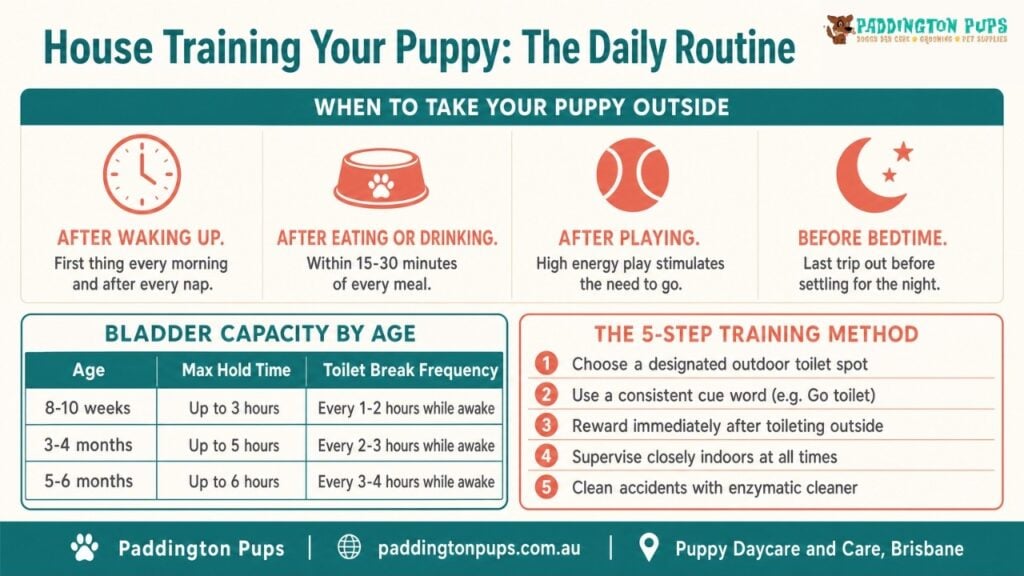
A typical house training routine should include taking your puppy outside immediately after they wake up, shortly after eating or drinking, after a vigorous play session, and right before bed. Sticking to this schedule, even on weekends, accelerates the learning process and builds your puppy’s confidence.

How Do You Set Up Your Home for House Training Success?

Your home environment plays a massive role in how quickly your puppy learns. If they have free roam of the house, they will inevitably find a quiet corner to relieve themselves, making it harder for you to catch them in the act and redirect them.
 

Use a Crate or Playpen

Management is critical in the early stages. When you cannot actively supervise your puppy, they should be in a puppy-proofed area, such as a playpen or a crate. Dogs naturally avoid soiling their sleeping area, so a appropriately sized crate can be a highly effective tool for encouraging them to hold it until you take them outside.


Supervise Constantly

When your puppy is out of their pen, they need your undivided attention. Keep them in the same room as you, perhaps by closing doors or using baby gates. Watch for signs that they need to go, such as sniffing the ground, circling, or suddenly stopping play. If you see these signs, immediately take them outside to their designated toilet spot.


Clean Accidents Thoroughly

Despite your best efforts, accidents will happen. When they do, it is vital to clean them up using an enzymatic cleaner. Standard household cleaners may remove the stain and the smell to your nose, but a puppy’s sensitive nose can still detect the ammonia in their urine, which will draw them back to the same spot.

What Are the Essential Steps for House Training Puppies?

House training puppies requires patience and a systematic approach. Follow these steps to build a solid foundation for your puppy’s toilet habits.

Choose a Designated Spot

Select a specific area in your yard where you want your puppy to toilet. Take them to this exact spot every time. The lingering scent from previous visits will act as a trigger, reminding them of why they are there. In Brisbane’s subtropical climate, ensure the spot is easily accessible even during sudden downpours.
 

Use a Cue Word

As your puppy is in the act of toileting, introduce a specific cue word or phrase, such as “go toilet” or “do your business.” Say it calmly and clearly. Over time, they will associate the word with the action, allowing you to prompt them to go when needed, which is especially useful on rainy days or before a car trip.
 

Reward Immediately and Generously

Positive reinforcement is the most effective training method. As soon as your puppy finishes toileting in the correct spot, immediately praise them enthusiastically and offer a high-value treat. The reward must happen within seconds of the action so the puppy makes the connection.
 
Do not wait until you are back inside to give the treat.

How Long Does House Training Take?

The timeline for house training puppies varies widely depending on the breed, the individual dog, and how consistent you are with the routine. As a general rule, a puppy can hold their bladder for one hour for every month of age, plus one. For example, a three-month-old puppy can typically hold it for about four hours.
Puppy Age
Maximum Bladder Control
Expected Frequency of Toilet Breaks
8-10 weeks
2-3 hours
Every 1-2 hours while awake
3-4 months
4-5 hours
Every 2-3 hours while awake
5-6 months
5-6 hours
Every 3-4 hours while awake
While some puppies may catch on within a few weeks, it is completely normal for the process to take several months before they are fully reliable. Consistency and patience are your best tools during this period. The provides excellent resources on managing expectations during this time .
 

What Should You Do When Accidents Happen?

Accidents are an inevitable part of house training puppies. How you react to them is crucial to the success of the training process.
 
If you catch your puppy in the act, interrupt them with a sharp but not angry sound, like a clap or a firm “Ah-ah!” Immediately scoop them up and carry them outside to their designated spot. If they finish the job outside, praise and reward them generously.
 
If you find an accident after the fact, do not punish the puppy. Rubbing their nose in it or scolding them will only teach them to be afraid of you and to hide when they need to toilet. Simply clean it up thoroughly with an enzymatic cleaner and resolve to supervise them more closely next time.

How Can Daycare Support Your Puppy’s Development?

While house training is primarily managed at home, early socialisation is equally important for a puppy’s development. Once your puppy is fully vaccinated, usually around 14-16 weeks of age, introducing them to a structured social environment can be incredibly beneficial.
 
At Paddington Pups, our provides a safe, supervised space for puppies to learn crucial social skills from both our experienced staff and well-adjusted adult dogs. Regular daycare attendance helps puppies burn off excess energy, reducing destructive behaviours at home, and builds their confidence in new environments.
 
Our team understands the importance of consistency, and we can support your house training efforts by ensuring your puppy has regular access to appropriate toileting areas throughout the day. This continuity between home and daycare helps reinforce the good habits you are building.

Setting Your Puppy Up for a Lifetime of Success

House training puppies is a commitment of time and energy, but the reward is a clean home and a well-adjusted companion. By establishing a routine, managing their environment, and using positive reinforcement, you will navigate this challenging phase successfully.
 
Remember that every puppy learns at their own pace. Celebrate the small victories, stay consistent with your routine, and do not hesitate to seek professional advice if you are struggling.
 
If you are looking for support with your puppy’s socialisation and energy management, explore how Paddington Pups can help. Our daycare services are designed to complement your home training efforts, providing a balanced and enriching experience for your growing dog. today to learn more about how we can support your puppy’s development.

FAQs

Should I use puppy pads for house training?

Puppy pads can be useful for apartment dwellers or those with limited outdoor access, but they can also slow down the process of teaching your puppy to toilet exclusively outside. If your ultimate goal is for them to go outdoors, it is generally better to skip the pads and take them straight outside from day one.

No, this is likely submissive or excitement urination, which is common in young puppies. It is an involuntary physical response, not a behavioural choice. The best approach is to keep greetings very calm and low-key, and avoid leaning over or reaching down toward the puppy. Most puppies outgrow this as they mature and gain confidence.

Take your puppy out right before you go to bed. For the first few weeks, you will likely need to set an alarm to take them out once or twice during the night. Keep these nighttime trips strictly business—no playing or talking. Once they toilet, put them straight back to bed.

Regression is common in house training puppies, often occurring around adolescence or if there has been a change in routine. Go back to basics: tighten up supervision, increase the frequency of toilet breaks, and ensure you are cleaning accidents thoroughly. If the problem persists, consult your vet to rule out a urinary tract infection.

Yes! The principles of routine, management, and positive reinforcement apply to dogs of all ages. Older dogs may take a bit longer to break old habits, but with consistency, they can successfully learn the new rules of your home.
Scroll to Top