Dog Grooming Aftercare: What Happens to Your Dog’s Skin Between Grooms

Most Brisbane dog owners think about grooming in terms of appointments. They book a groom, their dog comes home looking and smelling great, and the next appointment gets pencilled in for six or eight weeks away. What happens in between those appointments is where most skin and coat problems actually begin, quietly, gradually, and in ways that only become obvious once they have progressed further than they needed to.
 
Brisbane’s subtropical climate is a meaningful part of this. High humidity, wet-season moisture, and the temperature swings between seasons create conditions that accelerate the skin and coat issues that a more forgiving climate would let owners catch more slowly. Understanding what is happening to your dog’s skin between professional grooms, and what to do about it, is one of the more practical things a Brisbane dog owner can learn.
 

Why Does the Between-Groom Window Matter So Much?

 
A professional groom resets your dog’s coat and skin to a clean baseline: properly bathed, dried, brushed through, nails trimmed, and ears checked. But that baseline does not hold indefinitely, and the rate at which it degrades depends heavily on your dog’s breed, their lifestyle, and the conditions they are living in.
 

What Does Brisbane’s Climate Do to a Dog’s Coat?

 
Queensland’s humidity is the biggest variable that separates Brisbane dog owners from those in cooler, drier cities. Moisture in the air does not just slow down drying after a bath. It actively works against coat health in between baths and grooms.
 
In humid conditions, dog coats retain more environmental moisture, which creates a warm, damp microenvironment close to the skin. For double-coated breeds, long-coated breeds, and dogs with dense or curly fur, that moisture gets trapped against the skin for hours at a time after exercise, walks in rain or dew, or even just a humid night. This is the environment where hot spots develop, where yeast overgrowth occurs, and where the skin irritation that owners often attribute to allergies or diet actually begins.
 
Brisbane’s wet season, roughly November through April, compounds this significantly. Dogs walk in wet grass, come inside with damp feet and bellies, and dry incompletely before the next exposure. During this period, the interval between grooms that works adequately in drier months may no longer be enough.
 

What Are the Signs That Between-Groom Care Is Falling Behind?
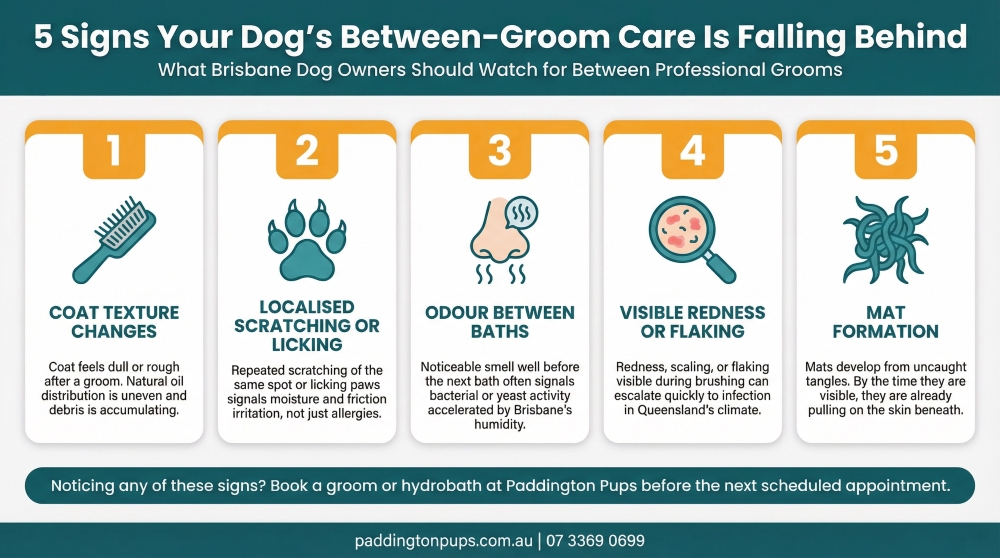
 
These are the indicators worth watching for in the weeks following a professional groom:
 
Coat texture changes: A coat that felt soft and smooth after the groom becoming dull, slightly rough, or difficult to brush through is an early sign that natural oil distribution has become uneven and debris is beginning to accumulate.
 
Localised scratching or licking: When a dog repeatedly scratches the same spot, or licks at paws, the base of the tail, or belly, it often indicates localised irritation rather than a generalised allergy. These hotspots develop in the areas where moisture and friction are most concentrated, such as armpits, groin, between the toes, and under the collar.
 
Odour between baths: A dog developing noticeable odour well before their next bath or groom is often a sign of bacterial or yeast activity on the skin surface, accelerated by moisture and heat.
 
Visible redness or flaking: Any redness, scaling, or flaking visible through the coat during brushing warrants attention. In Brisbane’s climate, these can escalate quickly from mild irritation to infection if not addressed.
 
Mat formation: Mats do not appear overnight. They develop from tangles that were not caught early enough, tightening progressively with moisture and movement. By the time a mat is visible or palpable, it is already putting traction on the skin beneath it.
 

What Should Your Between-Groom Routine Actually Include?

 
The goal between professional grooms is to maintain the baseline your groomer established. It is not to replicate the full groom at home, but to slow the rate at which coat and skin conditions deteriorate so your dog arrives at their next appointment in genuinely good condition rather than requiring extra remedial work.
 

How Often Should You Brush Between Grooms?

 
Brushing frequency is the single most impactful thing most owners can improve. The right frequency depends on coat type, but in Brisbane’s climate, most dogs need more brushing than owners in drier cities would.
 
As a practical guide for Queensland:
Coat Type
Breeds
Recommended Brushing Frequency
Focus Areas
Short-coated
Staffies, Beagles, Boxers
Once or twice weekly
Removing loose hair and checking skin condition
Medium-coated
Labradors, Golden Retrievers, Border Collies
Three to four times weekly
Undercoat and friction points (armpits, collar area, behind ears)
Long-coated & curly
Cavoodles, Maltese, Shih Tzus, Spoodles
Daily, or every other day at minimum
Preventing tangles from tightening into mats
Double-coated
Huskies, German Shepherds, Corgis
Three to four times weekly (daily during shedding)
Using an undercoat rake first before a finishing brush

What Bathing Approach Works Between Professional Grooms?

 
Home bathing between professional grooms is appropriate for some dogs and unnecessary for others. The right answer depends on your dog’s coat type, activity level, and skin condition. What matters more than frequency is technique.
 
Always use a shampoo formulated specifically for dogs. Human shampoo has a different pH to dog skin and will strip natural oils in a way that causes dryness and irritation, particularly in Queensland’s already-challenging conditions. For dogs with sensitive or reactive skin, oatmeal-based or aloe vera formulations provide gentle cleansing without further disruption.
 
Thorough drying after any bath is non-negotiable in Brisbane. A dog that air-dries incompletely, particularly one with a dense or long coat, is spending hours with trapped moisture against their skin. A blow-dryer on a low heat setting, worked through the coat properly, makes a significant difference to skin health outcomes between professional grooms.
 

What Else Should You Check During Brushing Sessions?

 
Regular brushing sessions are the most natural opportunity for a health check that most owners underutilise. While brushing, make a habit of:
 
Checking ears: Look for redness, unusual odour, dark discharge, or your dog showing discomfort when the ear is touched. Brisbane’s humidity makes ear infections more common than in cooler climates, particularly in breeds with floppy or heavily-furred ear canals.
 
Examining paws: Check between the toes for redness, debris, or small grass seeds. According to the Australian Veterinary Association’s guidance on grass seeds, grass seeds can work their way into skin quickly and require veterinary attention once embedded. They are a genuine and frequently underestimated risk for Brisbane dogs during certain seasons.
 
Noting any lumps, bumps, or skin changes: New growths, changes in existing spots, or areas your dog reacts to when touched are all worth noting and raising with your vet at your next visit.
Australian Veterinary Association. “Grass Seeds in Dogs.”
 

How Do Skin Allergies Interact With Grooming Aftercare?

 
Skin allergies in dogs often appear most obviously in the between-groom period, when pollen, dust, and environmental allergens accumulate in the coat without the regular removal that professional grooming provides. Brisbane’s subtropical environment produces year-round pollen activity with peaks in spring and early summer, making environmental allergies a year-round consideration for many Queensland dogs rather than a seasonal one.
 

What Are the Most Common Skin Allergy Patterns in Brisbane Dogs?

 
Environmental allergies: Reactions to grass pollens, dust mites, and mould spores typically show up as itching around the face, paws, and belly, which are the areas most directly in contact with outdoor surfaces. Dogs that lick their paws excessively, especially after grass contact, are often reacting to environmental skin allergies.
 
Contact reactions: Some dogs react to specific surfaces, grasses, or plants. If your dog develops redness or itching in a consistent pattern after visiting a particular park or outdoor space, contact allergy is worth considering.
 
Coat accumulation: Allergens that settle in the coat are not removed between professional grooms without active brushing and bathing. A dog whose coat is accumulating pollen, dust, and dander carries those irritants against their skin continuously, which can trigger or worsen reactions regardless of the underlying allergy type.
 

What Role Does Professional Grooming Play in Managing Skin Allergies?

 
Consistent professional dog grooming is one of the most effective and underappreciated tools for managing environmental skin allergies in Brisbane dogs. It provides regular, thorough removal of accumulated allergens from the coat, including the undercoat layers that home brushing does not always reach, and gives experienced groomers the opportunity to identify early signs of skin reactions before they become established.
 
Hydrobathing, which Paddington Pups uses as part of our grooming and bathing services, is particularly valuable for dogs with sensitive or allergic skin. The warm, pressurised water penetrates deep into the coat, flushing allergens, debris, and loose hair from the skin surface in a way that standard bathing does not replicate. For Brisbane dogs prone to environmental skin reactions, regular hydrobathing between full grooming appointments is often a practical and effective part of managing their condition.
 

When Should You Come Back to the Groomer Sooner Than Planned?

 
Most grooming intervals are set as a general guide, but there are situations where bringing a dog in ahead of schedule makes more sense than waiting.
 
Matting is developing faster than expected: If mats are forming before the end of the standard interval, the interval is too long for that coat in Brisbane’s current conditions. This is common during the wet season, and adjusting the schedule before mats become severe saves the dog significant discomfort.
 
A skin issue is developing: If you are seeing hot spots, persistent redness, or unusual odour that is not resolving with home care, a professional groom provides both a thorough clean and a trained second set of eyes on the problem. Groomers regularly notice skin conditions that are not obvious through a coat and can advise whether a vet visit is warranted.
 
Your dog has been particularly active outdoors: Dogs that swim regularly, visit beaches, or spend time in long grass benefit from more frequent bathing and coat maintenance than those with quieter lifestyles. Salt, sand, and grass seeds all affect coat and skin condition, and the effects accumulate between grooms.
 
At Paddington Pups, our groomers have been working with Brisbane dogs for more than 15 years and understand how Queensland’s climate affects different breeds and coat types across different seasons. If you are noticing changes in your dog’s coat or skin condition between appointments, it is always worth a conversation, either to adjust the grooming schedule or to identify whether a hydrobath in the interim would help.
 

Booking at Paddington Pups

 
Grooming is available Monday to Friday by appointment. If your dog’s coat or skin condition needs attention before their next scheduled groom, or if you would like to discuss whether a more frequent schedule suits your dog’s breed and lifestyle, contact us or book online.
 
For dogs that have never visited before, our new customer page is the starting point. And if you would like your dog to spend the rest of the day in doggy daycare after their groom, our Stay and Play option keeps them active and social rather than waiting for pickup. Additional daycare charges apply.
RSPCA Australia. “Does My Pet Have Allergies?”

FAQs

How often should I brush my dog between grooming appointments?

It depends on their coat type. Short-coated dogs need brushing once or twice a week. Medium and double-coated breeds should be brushed three to four times a week. Long-coated and curly breeds (like Cavoodles) require daily brushing to prevent mats from forming, especially in Brisbane’s humidity.

No. Human shampoo has a different pH level than dog skin and can strip natural oils, leading to dryness and irritation. Always use a shampoo specifically formulated for dogs, preferably one that is oatmeal-based or contains aloe vera if your dog has sensitive skin.

High humidity and frequent exposure to wet grass trap moisture in your dog’s coat. When a coat remains damp, tangles tighten into mats much faster than they do in dry conditions. Ensuring your dog is thoroughly dried after getting wet is the best way to prevent this.

A hydrobath uses warm, pressurised water to penetrate deep into the coat, flushing out allergens, loose hair, and debris from the skin surface more effectively than a standard home bath. This is especially helpful for dogs prone to environmental skin allergies.

Localised scratching (like chewing a specific paw or scratching one ear) often indicates a specific irritant, such as a grass seed or a hot spot. Generalised scratching or excessive paw licking, particularly after being outside, may point to environmental allergies. If the scratching persists after a thorough bath and brush, consult your vet or groomer.
Scroll to Top