What Are the Basic Obedience Commands Every Dog Should Know?
- Sit gives you a default, calm behaviour to ask for instead of jumping or barging.
- Stay builds impulse control, asking your dog to hold a position even when something interesting is happening nearby.
- Come (also called recall) is the command that keeps your dog safe around roads, other dogs, and wildlife.
How Do You Teach Sit, Stay, and Come at Home?
- Teaching Sit: Hold a treat close to your dog’s nose and slowly move it up and back over their head. As their head follows the treat, their bottom naturally lowers to the ground. The moment they sit, say “sit” and reward immediately. Repeat this five or six times per session, a few times a day.
- Teaching Stay: Once your dog reliably sits, ask for a sit, then say “stay” and take one small step back. Return immediately and reward if they held the position. Gradually increase the distance and the time before adding any distractions. Rushing this step is the most common reason stay falls apart later.
- Teaching Come (Recall): Start in a low-distraction room. Crouch down, say your dog’s name followed by “come” in a warm, upbeat tone, and reward generously when they arrive. Never call your dog to you for something unpleasant, like a bath they do not enjoy, or they will start to hesitate on the recall itself.
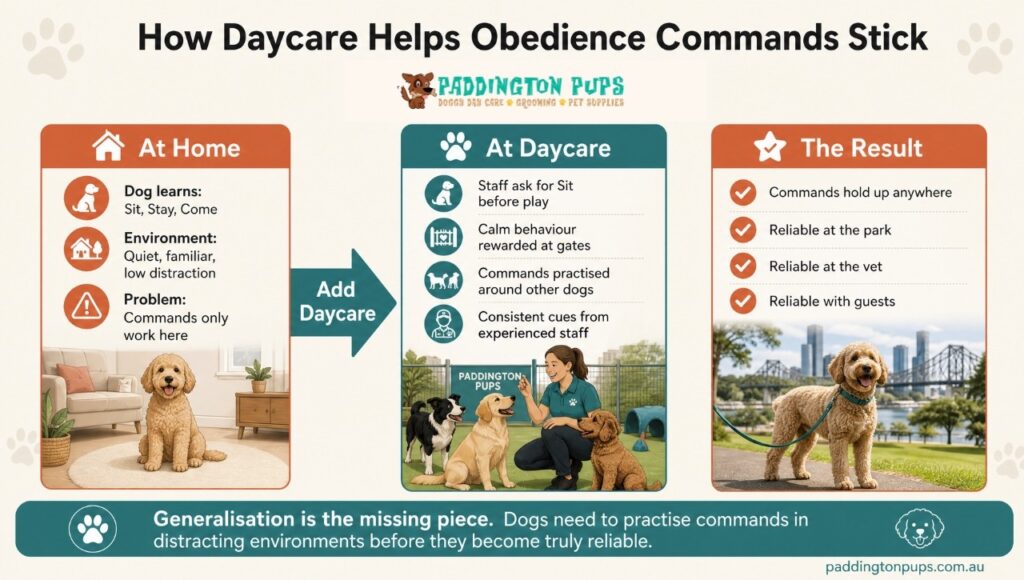
Why Do Dogs Struggle to Generalise Commands Outside the Home?
How Does Dog Daycare Reinforce Basic Obedience Commands?
- Asking for a sit before releasing dogs into the play area
- Waiting for calm behaviour before opening a gate
- Rewarding polite greetings with staff and other dogs
- Reinforcing consistent cues throughout the day
When Should You Start Practising Sit, Stay, and Come?
- Puppies (8 weeks+): Keep sessions to two minutes each, spread across the day. Short attention spans mean frequent, brief repetitions work far better than one long block.
- Adult dogs: Can handle slightly longer sessions of three to five minutes, but the same rule applies — stop on a success, not on a failure.
- Rescue dogs: May need extra patience if arriving with established habits, but are fully capable of learning new commands with consistent, positive practice.
- All ages: A few short sessions each day will always outperform one long, frustrating session.
What Common Mistakes Undermine At-Home Obedience Training?
Common Mistake | Why It Undermines Training | What to Do Instead |
Repeating the command | Saying “sit, sit, sit” teaches your dog that the first cue does not count. | Say the command once and wait. If they do not respond, reset and try again. |
Practising in only one room | Dogs are context-specific learners; a lounge-room sit does not equal a park sit. | Gradually practise in the backyard, then the footpath, then around other dogs. |
Skipping the reward early | Behaviours that stop being reinforced tend to fade quickly. | Continue rewarding intermittently even after the dog knows the command. |
Using punishment | Makes dogs hesitant, damages trust, and increases stress. | Focus on rewarding the correct behaviour, which research shows is more effective. |
Calling for unpleasant things | Teaches the dog that “come” means something bad is about to happen. | Always reward recall. If you need to bathe the dog, go and get them instead of calling. |
Training when overstimulated | A tired, hungry, or highly aroused dog cannot focus on learning. | Train in short bursts when the dog is rested and attentive. |
Bringing It All Together
FAQs
Will dog daycare train my dog for me?
Daycare is not a formal training school, but it provides the essential environment needed to generalise commands you have taught at home. Our staff consistently reinforce good manners, such as sitting at gates and calm greetings, which helps your dog understand that the rules apply everywhere, not just in your house.
My dog comes when called at home, but ignores me at the park. Why?
This is a classic example of a dog failing to generalise a command. The park is filled with high-value distractions like smells, other dogs, and open space. To fix this, you need to practise recall in environments with gradually increasing distractions, rewarding heavily every time they succeed, before expecting perfection at the park.
What is the best reward to use when teaching obedience commands?
The best reward is whatever your dog values most in that specific moment. For many dogs, this is high-value food like small pieces of chicken or cheese. For others, it might be a quick game with a tug toy or enthusiastic praise. The higher the distraction level, the higher the value of the reward needs to be.
How long should a training session last?
Keep sessions very short, ideally between two and five minutes. Dogs, especially puppies, lose focus quickly. Three two-minute sessions spread throughout the day are far more effective than one frustrating fifteen-minute session. Always try to end on a successful repetition.
Is it ever too late to teach an older rescue dog basic commands?
It is never too late. Older dogs and rescues are highly capable of learning new commands. The process is exactly the same as with a puppy, though you may need a little more patience if the dog has spent years practising different behaviours. Consistency and high-value rewards will help them learn the new rules quickly.