Large dog breeds are rewarding companions, but their care needs become more noticeable when there is a large body, a heavy coat, or both to look after. For Brisbane owners, grooming is not only about appearance. It removes loose hair, helps check for skin problems, keeps nails at a safe length, and maintains comfort through hot, humid weather.
Which Dogs Are Considered Large or Giant Dog Breeds?
There is no single veterinary cut-off that applies to every purpose, but large dog breeds generally include dogs such as German Shepherds, Labradors, Golden Retrievers, Rottweilers, and Dobermanns. Giant breeds include Great Danes, Newfoundlands, Saint Bernards, Irish Wolfhounds, Mastiffs, and Leonbergers.
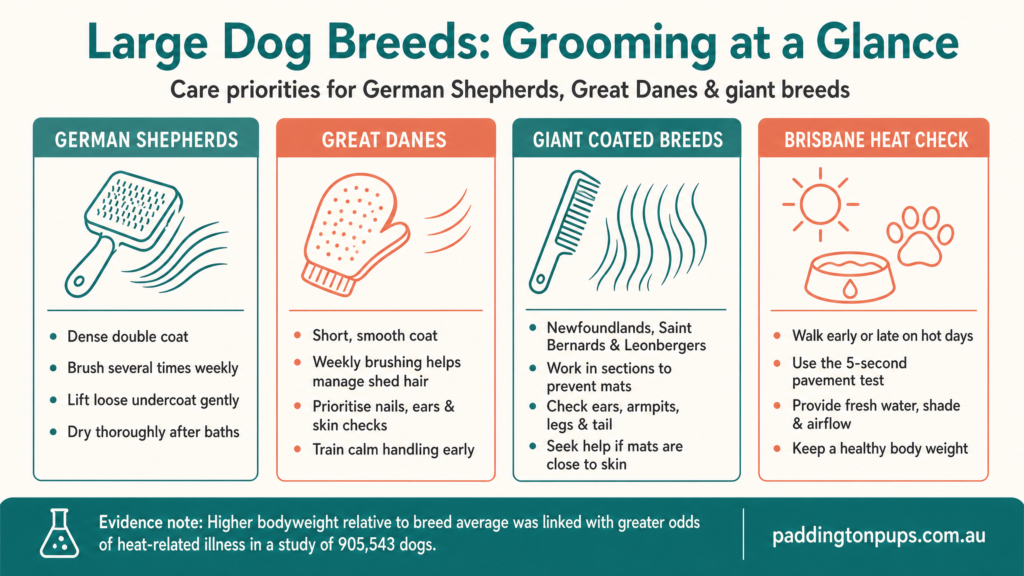
Size alone does not determine a grooming plan. A German Shepherd’s dense double coat can demand more brushing than a Great Dane’s sleek, short coat, while the height and strength of a giant breed can make bathing and nail care physically harder to manage.
The key principle: Choose grooming tools and a care routine for the coat and the dog in front of you, not simply for the label “large breed”.
How Do Grooming Needs Differ Between German Shepherds, Great Danes, and Giant Breeds?
Large dog breeds have very different coat types. German Shepherds normally have a double coat, made up of a dense undercoat beneath a harsher outer layer. Great Danes are short-coated but can still shed significantly because of their size and surface area. Giant breeds vary widely: Newfoundlands and Saint Bernards have dense, longer coats, while Mastiffs and Great Danes have short, close coats that require less de-shedding but still need regular skin, ear, and nail care.
The RSPCA’s dog grooming guidance explains that regular grooming removes loose hair and debris, helps prevent matting, distributes natural oils, and gives owners a chance to notice skin changes, parasites, scratches, lumps, and grass seeds early . These benefits apply to every large dog, although the time and tools required can differ substantially.
Bathing frequency should be based on coat type, skin health, swimming habits, and how dirty your dog becomes. The RSPCA recommends tailoring bathing to the individual dog and seeking veterinary guidance where skin problems are present .
How Should You Groom a German Shepherd in Brisbane?
German Shepherds are known for thick double coats and impressive seasonal shedding. In Brisbane’s humidity, trapped loose hair and moisture can leave the coat feeling heavy and uncomfortable. Start with short, positive brushing sessions using a suitable slicker brush, undercoat rake, or wide-toothed comb. Work in the direction of coat growth, avoid scraping the skin, and check behind the ears, the trousers, armpits, and hind legs, where dense coats can tangle more easily.
For double-coated dogs, the goal is not to remove the protective outer coat. It is to remove dead undercoat, surface debris, and developing tangles. The RSPCA advises that thick double coats need regular, thorough grooming and notes that special tools, including undercoat rakes, slickers, and de-shedding combs, can help when used gently .
Bathing should be followed by careful drying. A damp undercoat can stay moist for a long time, especially in summer, and may contribute to skin irritation. A professional hydrobathing service can be useful when a home bath cannot properly rinse and dry a large, heavy coat. What Does a Great Dane Grooming Routine Look Like?
Great Danes have short, close coats, so they do not need the intensive de-shedding routine of a German Shepherd or Newfoundland. A soft-bristle brush or grooming mitt removes loose hair, spreads natural oils through the fur, and allows you to check the skin for redness, lumps, scabs, or tenderness. Their size makes calm handling especially important. Introduce nail trims, ear checks, brushing, and standing still from puppyhood wherever possible.
Pay particular attention to nails. The RSPCA recommends trimming nails before they touch the ground while the dog is standing or walking, and reminds owners to check dewclaws, which do not naturally wear down through exercise . For a giant dog, overgrown nails can be uncomfortable and difficult to manage, so it is best not to wait until a trim becomes urgent.
Why Do Large Dog Breeds Need Special Grooming Handling?
Trying to lift a German Shepherd into a home bathtub or physically force a reluctant Great Dane through grooming can create stress and a preventable injury risk. Use a non-slip surface, keep sessions short, reward calm behaviour, and introduce one part of grooming at a time. Stop before your dog becomes uncomfortable, then build duration gradually. This mirrors the RSPCA’s recommendation to make grooming pleasant and reward calm handling .
Professional support is sensible when your dog is very large, heavily matted, difficult to dry, or uncertain about being handled. At Paddington Pups, our qualified dog groomers are available Monday to Friday. Grooming generally takes three to four hours, depending on the dog’s size, behaviour, coat length, and coat condition. This time allows for a calmer process rather than rushing a large dog through care. How Does Brisbane Heat Change Large Dog Grooming and Exercise?
Brisbane’s heat and humidity make coat maintenance and exercise timing especially important. Dogs with thick or long coats are among those more vulnerable to overheating and the serious effects of heatstroke. The RSPCA Australia heat-safety guide recommends walking early in the morning or late in the evening on hot days, ensuring access to fresh water and shade, and keeping dogs in a cooler indoor environment when possible .
Use the five-second pavement test before a walk: press the back of your hand to the surface for five seconds. If it is too hot for your hand, it is too hot for your dog’s paws. Never rely on coat clipping alone to manage heat. For a German Shepherd or another double-coated dog, regular brushing, thorough drying, shade, and sensible activity timing are more useful foundations.
What Health Risks Should Owners of Large and Giant Breeds Know About?
Large and giant breeds can be predisposed to particular health conditions, including orthopaedic problems and gastric dilatation-volvulus (GDV), often called bloat. Keeping your dog at a healthy weight and attending routine veterinary checks are practical foundations for long-term care.
GDV is a life-threatening emergency that occurs primarily in large and giant breeds. A genetic study that included Great Danes reported a lifetime-risk range of 3.9% to 36.7% across breeds and sources, showing how strongly risk varies by breed and population . A distended or hard abdomen, repeated unproductive retching, heavy drooling, restlessness, weakness, or collapse require emergency veterinary attention.
Good grooming will not prevent these conditions, but it can make routine health checks easier. A dog who is used to calm handling is more likely to tolerate paws, skin, ears, teeth, and body being examined. Regular brushing also means you are more likely to notice a new lump, sore spot, or skin change early enough to discuss it with your vet.
When Should You Book Professional Grooming for a Large Dog?
Professional grooming can be helpful before loose undercoat becomes compacted, when seasonal shedding becomes difficult to manage, after muddy or wet-weather adventures, or whenever you cannot safely bathe and dry your dog at home. It is also an appropriate choice if your dog is becoming uncomfortable with brushing, has tangles close to the skin, or needs regular nail care.
For busy Brisbane households, a grooming visit can fit into a broader care routine. Paddington Pups offers the option for dogs to Stay and Play after grooming, with additional charges potentially applying. For dogs who enjoy appropriate social settings, doggy daycare can provide supervised activity while grooming keeps their coat and hygiene care on track.
The best schedule is the one you can maintain. Set a reminder for quick weekly checks of the coat, ears, paws, and nails, then book professional support when your dog’s coat condition or handling needs call for it. There is no advantage in waiting until a grooming job becomes overwhelming for you or uncomfortable for your dog.
How Can You Build a Sustainable Care Routine for a Large Dog?
Large dog breeds need a plan that is practical as well as kind. Start grooming habits while your dog is young, but adult and rescue dogs can learn to enjoy handling too. Pair each small step with rewards, stay patient, and keep a simple record of when your dog was last brushed, bathed, and given a nail check.
If you feel unsure about tools, coat condition, or how to handle a large dog safely, it is far better to ask for help than to push through a difficult session. Contact Paddington Pups to discuss an appropriate grooming routine for your German Shepherd, Great Dane, or giant breed. With consistent care, the right handling, and sensible heat management, your large dog can stay clean, comfortable, and ready for Brisbane life.