
Bringing a puppy home is one of the most exciting things a dog lover does. It is also one of the most humbling—because within approximately forty-eight hours, you will discover exactly how many things in your home a curious, teething, fearless puppy can get into.
Puppy-proofing is not about creating a sterile environment where nothing fun can happen. It is about removing the genuine risks so your puppy can explore, learn, and play safely whilst you build the foundation of a trusting, well-structured relationship together.
This guide gives you a clear, practical checklist of the steps to take before your puppy arrives, the hazards most commonly overlooked, and the supplies that make the early weeks smoother for both of you.
What Does Puppy-Proofing Actually Involve?
Puppy-proofing means systematically removing known hazards and organising your home so your puppy can explore within safe boundaries. It is best done before your puppy arrives—once they are home, you are in reactive mode, and it is much harder to assess your space objectively whilst also managing an energetic new arrival.
Work through your home room by room, looking at each space from low down—at puppy height—rather than from a standing position. You will notice hazards you would otherwise miss entirely.
Puppy-Proofing Safety Checklist for New Dog Owners
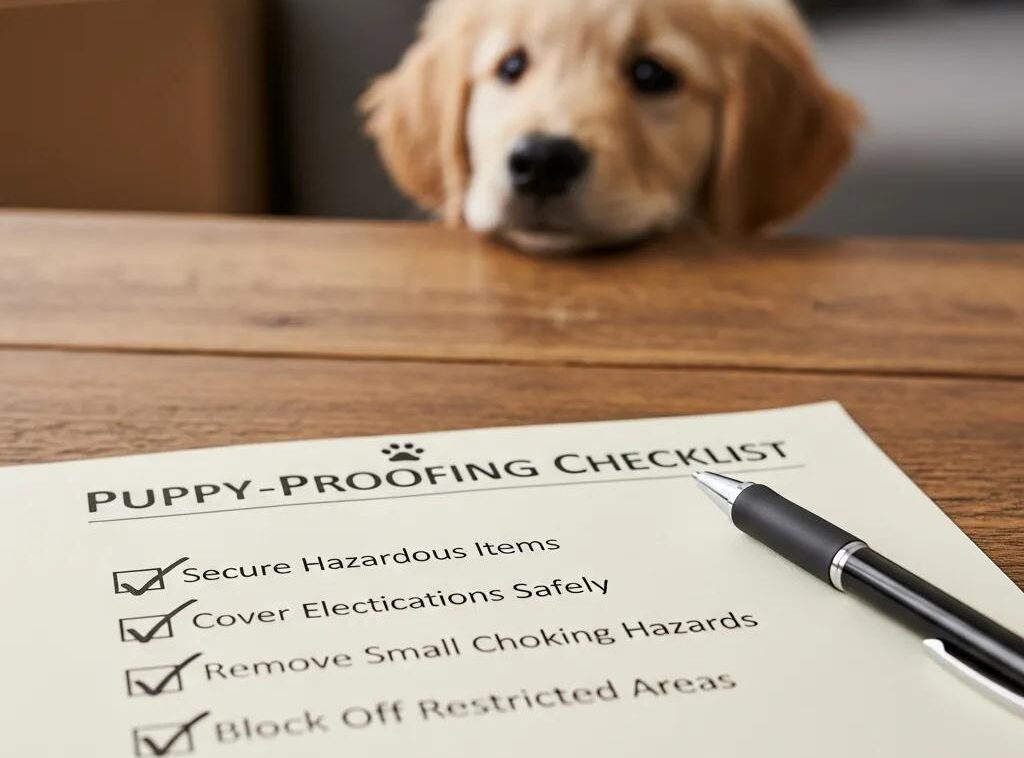
Puppy-Proofing Safety Checklist
Use this as your baseline before bringing your puppy home:
- Secure hazardous substances. Store all cleaning products, medications, pesticides, and fertilisers in locked or latched cupboards. In Brisbane homes, this includes outdoor chemicals—tick treatments, pool chemicals, and garden products that are commonly stored in accessible areas.
- Cover or conceal electrical cords. Use cord protectors, cable management covers, or move cords behind furniture. Puppies chew cords instinctively, and the consequences can be severe.
- Remove small objects at floor level. Coins, batteries, hair ties, children’s toys, and small decorative objects are all choking or obstruction risks. Get into the habit of scanning the floor before leaving your puppy unsupervised.
- Install puppy gates. Use these to restrict access to stairs, rooms with hazards, or any area you cannot monitor. This is especially relevant in Queensland homes where open-plan layouts and sliding doors create large, hard-to-supervise spaces.
- Designate a safe space. Choose a specific area—a pen, a gated room, or a crate corner—where your puppy can rest and play safely when you cannot give your full attention.
How Do You Create a Safe Environment at Home?
Physical hazard removal is only part of the picture. A genuinely safe environment for a puppy combines hazard management with routine and structure—because predictability is what keeps a puppy calm and reduces the stress-driven behaviours that lead to accidents and injury.
- Designate a safe space. Choose a specific area with your puppy’s bed, water, and toys where they can settle without overstimulation. This becomes their anchor point in the home.
- Use crates wisely. A crate, introduced correctly and gradually, becomes a sanctuary rather than a confinement. If you are also considering dog boarding, familiarising your dog with a crate early on can help them adjust to the environment much faster. It gives your puppy a secure place to rest when you are not able to supervise, and it supports toilet training significantly. The key is making the crate a positive association from day one—never use it as punishment.
- Establish a routine. Puppies regulate their behaviour around predictable patterns. Set consistent meal times, toilet breaks, play sessions, and nap times from the first day. This is not just for your benefit—routine actively reduces anxiety in young dogs and speeds up the learning process.
Which Common Household Hazards Pose the Greatest Risk?
Some hazards are obvious; others catch even experienced dog owners off guard. These are the most important categories to address:
- Toxic foods: Dogs cannot safely process many common human foods. Chocolate, grapes, raisins, onions, garlic, macadamia nuts, and anything containing xylitol (an artificial sweetener found in sugar-free products and some peanut butters) are all potentially serious poisoning risks. Keep these stored securely and ensure all household members—including children and visiting family—understand the rules.
- Small objects: Coins, buttons, batteries, hair accessories, pen lids, and small children’s toys are all choking and intestinal obstruction hazards. Make regular floor sweeps part of your daily routine whilst your puppy is young.
- Electrical cords: A puppy that chews through a live cord can suffer electrocution, burns, or worse. Use cord covers, route cords behind furniture, and consider deterrent sprays on anything that cannot be physically concealed.
- Toxic plants: Several plants common in Australian gardens and homes are toxic to dogs. These include lilies (highly toxic to cats and moderately toxic to dogs), sago palms (extremely toxic—all parts of the plant), azaleas, oleander, and yesterday-today-and-tomorrow(Brunfelsia), which is particularly common in Queensland gardens. Check every plant in your home and garden before your puppy arrives and remove or fence off anything toxic.
- Chemicals and household substances: Antifreeze (ethylene glycol) is extremely toxic and unfortunately palatable to dogs. Concentrated essential oils, many common cleaning products, and some pest control products are also dangerous. In Queensland, be especially mindful of outdoor products: certain flea and tick treatments intended for other animals can be fatal to dogs if ingested or applied incorrectly.
Which Rooms Pose the Highest Risk?
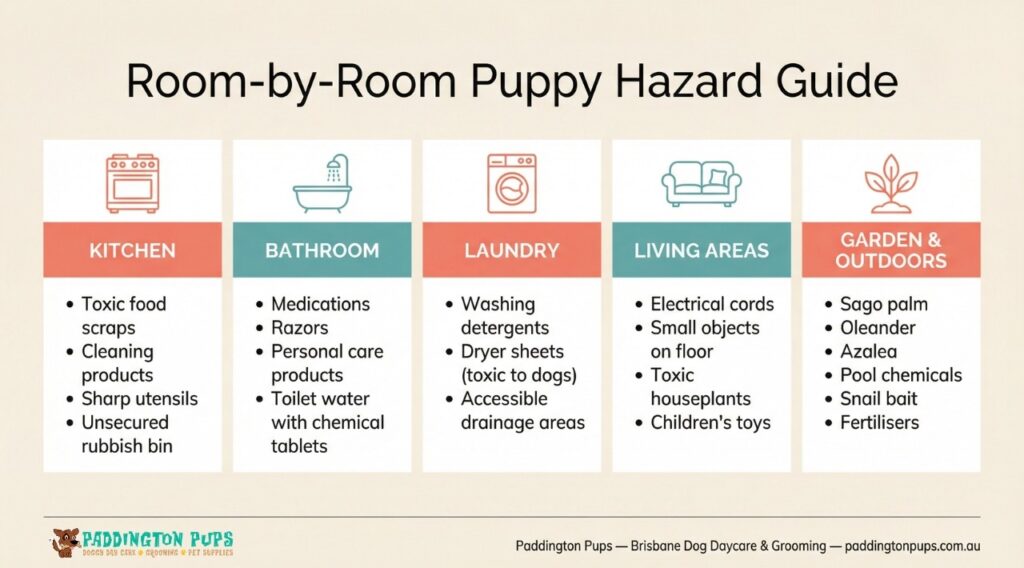
- Kitchen: Food scraps, cleaning products, sharp objects, and rubbish bins (invest in a bin with a secure lid).
- Bathroom: Medications, personal care products, razors, and toilet water if chemical tablets are used.
- Laundry: Washing detergents, dryer sheets (toxic to dogs), and accessible drainage areas.
- Garden and outdoor areas: Toxic plants, pool chemicals, fertilisers, snail bait, and outdoor tools.
How Do You Prevent Destructive Chewing?
Chewing is completely normal puppy behaviour—it is how they explore the world, relieve teething discomfort, and process excess energy. The goal is not to stop chewing; it is to direct it toward appropriate items and away from things that are dangerous or valuable.
- Provide a range of suitable chew toys. Offer options across different textures—rubber, rope, and nylon—so your puppy has something to chew at every stage of teething. Rotate toys regularly to maintain interest.
- Redirect, do not just correct. When your puppy chews something off-limits, calmly remove the item and immediately offer an appropriate chew toy instead. Consistent redirection teaches them what is theirs to chew.
- Use deterrent sprays on protected items. Bitter apple spray and similar products can be applied to furniture legs, cables, and other targets to make them unpleasant to chew. These work best in combination with active redirection.
- Manage the environment. Supervision and physical barriers do more to prevent destructive chewing than any correction. If your puppy cannot access the shoes or the coffee table legs, the problem does not arise.
What Supplies Do You Need Before Your Puppy Comes Home?
Having the right supplies in place before your puppy arrives makes the early days significantly less chaotic. Focus on quality and appropriateness for your puppy’s size and breed rather than buying everything available.
Core Supplies
- Food and water bowls: Choose sturdy, non-tip options. Stainless steel is more hygienic and harder to chew than plastic.
- Puppy food: Select a high-quality puppy formula appropriate for your dog’s expected adult size. Large and small breed puppies have different nutritional requirements.
- Collar, ID tag, and lead: Your puppy should be wearing ID from day one. In Queensland, dogs must be microchipped and registered with your local council. Check the Brisbane City Council requirements if you are in the Brisbane area.
- Grooming supplies: A soft brush, nail clippers, and a gentle puppy shampoo. Starting grooming early builds a positive association that pays dividends throughout your dog’s life.
- Crate or pen: Appropriately sized for your puppy’s current size with room to grow, but not so large that one end becomes a toilet area.
Puppy-Proofing Supplies
| Supply | Purpose | Key Benefit |
|---|---|---|
| Puppy gates | Restrict access to unsafe rooms and areas | Prevents accidents and limits unsupervised exploration |
| Chew-proof toys | Provides safe, appropriate chewing options | Reduces destructive chewing behaviour |
| Non-toxic cleaning products | Safe cleaning throughout the home | Protects puppy health if surfaces are licked or contacted |
| Cord protectors | Covers exposed electrical cables | Eliminates electrocution risk from chewing |
| Secure bin lids | Prevents access to food scraps and rubbish | Reduces toxic ingestion risk |
Choose supplies that are age-appropriate and match your puppy’s size and chewing strength. Toys and items labelled for large or adult dogs may not be suitable for a small or young puppy.
What Role Does Socialisation Play in Puppy Safety?
A well-socialised puppy is not just a better-behaved dog—they are a safer one. Dogs that have been exposed to a wide range of environments, people, sounds, and other animals during their critical development window (roughly three to sixteen weeks) are significantly less likely to develop fear-based reactivity that leads to biting or aggressive behaviour later in life.
Socialisation does not mean forcing your puppy into overwhelming situations. It means controlled, positive exposure—short outings, calm introductions, and varied experiences that build confidence gradually.
Practical Socialisation Steps:
- Supervise all playtime with other dogs and children, particularly in the early weeks.
- Expose your puppy to different environments—footpaths, parks, car trips, and busy areas—in short, positive sessions.
- Introduce handling of paws, ears, and mouth from day one to make grooming and vet visits easier throughout life.
- Schedule regular vet check-ups to monitor development, maintain puppy vaccinations, and address any health concerns early, especially if you plan to enrol them in preschool or daycare.
How Do Professional Grooming and Daycare Services Support Puppy Development?
Home care provides the foundation, but professional services play an important complementary role—particularly in the early months when habits and associations are forming quickly.
Professional grooming services keep your puppy’s coat, skin, nails, and ears in good condition, and—crucially—build a positive relationship with the grooming process from the start. You can even cut your grooming time by establishing these good habits early. A puppy that has positive early experiences with handling and professional grooming becomes a dog that tolerates and even enjoys grooming throughout their life. Groomers also regularly notice early signs of skin issues, parasite activity, or coat changes that owners may not detect at home.
Puppy daycare provides supervised socialisation with other dogs in a controlled environment—something that is genuinely difficult to replicate and safer than dog park play. For Brisbane puppies, well-run daycare at a facility like Paddington Pups means structured play with appropriate supervision, positive social exposure, and the kind of mental and physical activity that supports healthy development and a calmer dog at home.
At Paddington Pups, we have supported thousands of Brisbane puppies through those formative early months. Our team understands puppy behaviour, our environment is designed for safety, and our 99.96% safety rating across 117,500+ dog visits reflects the standard of care we hold ourselves to.
If you are bringing a new puppy home in Brisbane and want professional support you can rely on, we would love to meet them.
Explore our daycare and grooming services or get in touch with our Paddington team.
FAQs
When should I start puppy-proofing my home?
You should start puppy-proofing before your puppy arrives. Once your new dog is home, you will be focused on training, bonding, and managing their energy. Having hazards removed and boundaries (like puppy gates) already in place makes the transition much less stressful for both of you.
What are the most common household plants in Queensland that are toxic to puppies?
In Queensland, common toxic plants include sago palms (extremely toxic), oleander, azaleas, lilies (especially to cats, but also a risk to dogs), and the yesterday-today-and-tomorrow plant (Brunfelsia). Always check your garden thoroughly before letting your puppy explore.
How do I stop my puppy from chewing my furniture and shoes?
Chewing is a normal teething behaviour. The best approach is a combination of management and redirection. Keep shoes and valuable items out of reach, use bitter apple deterrent spray on furniture legs, and always provide appropriate, multi-textured chew toys. When they chew something they shouldn’t, calmly redirect them to their toy.
Can I use regular household cleaners around my puppy?
Many standard household cleaners contain harsh chemicals that can be dangerous if your puppy licks the floor or their paws after walking on a damp surface. It is best to switch to pet-safe, non-toxic cleaning products, particularly for floors and lower surfaces.
When can my puppy start attending daycare or grooming at Paddington Pups?
Puppies can begin attending daycare and grooming once they are fully vaccinated (usually around 14–16 weeks of age, depending on your vet’s schedule). Early introduction to both environments is highly recommended to build positive socialisation and handling habits.