Large Dog Grooming in Brisbane: What Big Breeds Actually Need and How to Get It Right

Large dogs are a different grooming proposition entirely. Not harder, necessarily, but different in ways that catch many owners off guard, particularly if they are coming from a lifetime of smaller dogs or are new to dog ownership altogether.
 
The coat volume alone changes everything. A Golden Retriever generates more loose hair in a single week than most small breeds produce in a month. A Husky in a Queensland summer with an unmanaged undercoat is not just untidy, it is genuinely uncomfortable. A Labrador whose nails have been neglected for two months does not just need a trim; it needs intervention.
 
This guide is for owners of Brisbane’s large breeds who want to understand what their dog actually needs from a grooming perspective, why it matters more for big dogs than generic grooming advice tends to acknowledge, and how to build a professional grooming routine that keeps a large dog healthy, comfortable, and manageable between appointments.
 

Why Large Breed Grooming Is a Different Challenge

The grooming challenges that apply to small dogs scale up significantly with large breeds, and in several cases they are not just larger versions of the same problem, they are categorically different.
 

Volume and Density

The most immediate difference is sheer coat volume. A large double-coated breed such as a Golden Retriever, Border Collie, or German Shepherd carries a significantly larger surface area of coat than a small dog. The undercoat alone on a full-grown Labrador can fill a small bag during a proper deshedding session.
 
This volume has practical consequences:
  • Home brushing sessions take significantly longer and require more robust tools
  • Bathing a large dog at home and achieving a thorough rinse is genuinely difficult without a purpose-built wash bay or equipment
  • Drying a large dense coat thoroughly after bathing, particularly important in Brisbane’s humid climate, can take well over an hour with a household dryer and often produces an incompletely dried dog that develops skin issues where moisture remains trapped
  • The consequences of irregular grooming accumulate faster and become more physically significant in a large dog than a small one

Physical Handling

Grooming a dog that weighs 30, 40, or 50 kilograms safely requires specific skills and appropriate equipment. A large dog that becomes anxious or resistant during grooming is a physical safety consideration in a way that a small dog is not. Professional groomers experienced with large breeds understand how to position, handle, and reassure big dogs in a way that makes the experience manageable for both the dog and the groomer.
 
Attempting to groom a large anxious dog at home without that experience and equipment frequently results in a partially completed groom, a stressed dog, and an owner who puts off the next appointment because the last one was unpleasant. This cycle compounds quickly.
 

Consequences of Neglect

In large breeds, the consequences of irregular grooming are more significant than in small breeds. Mats in a double-coated breed cover more skin surface. Overgrown nails on a dog that weighs 35 kilograms affect gait and joint loading more acutely. Trapped moisture under a dense, ungroomed coat in Brisbane’s humidity creates larger areas of skin irritation. The health implications of skipping professional grooming are simply more consequential in a large dog.
 

Which Large Breeds Need Professional Grooming Most Urgently?

 
Not all large breeds have the same grooming needs. Coat type is the primary variable that determines both how often a dog needs professional care and what type of care is most important.
 

Double-Coated Breeds: The Highest Priority Group

These are the large breeds where professional grooming makes the most significant difference to health and comfort, particularly in Queensland’s subtropical climate.
 
Common Brisbane double-coated large breeds:
  • Golden Retriever
  • Labrador Retriever
  • Border Collie
  • German Shepherd
  • Siberian Husky
  • Alaskan Malamute
  • Australian Shepherd
  • Bernese Mountain Dog
Double-coated breeds have two distinct coat layers: a soft, dense undercoat and a coarser outer coat. The undercoat is the source of most of their grooming challenges. In Brisbane’s warm, humid climate, an unmanaged undercoat traps heat and moisture against the skin throughout the year, not just in winter. This is the environment where hot spots develop, where yeast overgrowth occurs, and where skin irritation becomes chronic rather than episodic .
Australian Veterinary Association. “Hot Spots in Dogs.”
 
Professional deshedding, the specific removal of loose undercoat using appropriate tools and technique, is the single most important professional grooming service for these breeds. It cannot be effectively replicated at home for most owners, because the volume of undercoat that needs removal, the tools required to reach it thoroughly, and the time involved make it a genuinely professional task.
 
These breeds should not be shaved or clipped short as a summer heat management strategy. The outer coat actually protects against heat and sunburn . Removing it through clipping damages the coat’s natural structure and, in some breeds, causes a permanent change in coat texture. Deshedding the undercoat, not removing the outer coat, is the correct approach for hot-weather management in double-coated breeds.
Professional deshedding, the specific removal of loose undercoat using appropriate tools and technique, is the single most important professional grooming service for these breeds. It cannot be effectively replicated at home for most owners, because the volume of undercoat that needs removal, the tools required to reach it thoroughly, and the time involved make it a genuinely professional task.
 
These breeds should not be shaved or clipped short as a summer heat management strategy. The outer coat actually protects against heat and sunburn. Removing it through clipping damages the coat’s natural structure and, in some breeds, causes a permanent change in coat texture. Deshedding the undercoat, not removing the outer coat, is the correct approach for hot-weather management in double-coated breeds.
 

Continuously-Growing Large Coats

 
These breeds need a different type of professional grooming: regular cutting and styling rather than deshedding.
 
Common Brisbane large continuously-coated breeds:
 
  • Standard Poodle
  • Large Goldendoodle or Labradoodle
  • Large Groodle
  • Afghan Hound
  • Briard
These coats do not shed in the same way double-coated breeds do. Instead, they grow continuously and require regular professional cutting to stay manageable. Without regular grooming, these coats mat progressively and the mats become more painful and more difficult to address the longer they are left. In Brisbane’s humidity, the matting process accelerates.
 
For large continuously-coated breeds, the primary grooming decision is what type of groom you should book — a Full Groom for a shorter, lower-maintenance result, or a Style Groom for a longer, more specific finish — and how frequently to book based on the chosen length.
 

Short-Coated Large Breeds

 
These breeds have the lowest professional grooming requirements, but they still benefit from regular professional care.
 
Common Brisbane short-coated large breeds:
 
  • Boxers
  • Weimaraners
  • Great Danes
  • Dalmatians
  • Rhodesian Ridgebacks
 
Short-coated large breeds need primarily bathing, nail trimming, and ear cleaning from a professional grooming perspective. Home brushing with a rubber curry or short-bristle brush handles most between-visit coat maintenance. Professional appointments every eight to twelve weeks are typically sufficient, focused on thorough bathing, nail management, and a health check of skin, ears, and paws.
 

What Groom Type Is Right for Your Large Dog?

 
At Paddington Pups, we offer five groom types. For large breed owners, the relevant options are:
Groom Type
Best Suited For
What It Includes
Maintenance Groom
Mid-cycle appointments for continuously-coated breeds
Tidy-up of face, paws, and hygiene areas without body length removal
Full Groom
Continuously-coated breeds wanting a lower-maintenance result
All-over trim (same blade length), hydrobath, blow-dry, paw pad trim, nail clip
Style Groom
Continuously-coated breeds wanting a specific look
Longer scissored finish, requires consistent home brushing between appointments
Deshed Groom
Double-coated large breeds (Golden Retrievers, Huskies, etc.)
Thorough removal of undercoat, optional trimming of paws, legs, tail, chest, belly
Puppy Cut
Puppies four months and under
Introductory groom designed to build a positive first experience
Every dog grooming appointment at Paddington Pups includes a hydrobath, blow-dry, paw pad trim, and nail clip as standard. Ear cleaning is available as an add-on and is worth including for large breeds prone to ear infections, particularly those with floppy ears.
 

How Often Do Large Dogs Need Professional Grooming?

 
Frequency depends on coat type, not just breed size. Use this as a guide:
 
Double-coated large breeds:
 
  • Grooming every six to eight weeks is appropriate for most of the year
  • During Brisbane’s summer months, and during seasonal coat transitions, more frequent deshedding (every four to six weeks) manages the additional undercoat volume and heat discomfort more effectively
  •  Between professional grooms, brushing three to four times per week with an undercoat rake and finishing brush reduces the amount of loose coat accumulation and keeps home shed manageable
Continuously-coated large breeds:
 
  • Full or Style Grooms every six to eight weeks for most coat lengths
  • If a longer style is maintained, the interval may need to shorten because longer coats mat faster in Brisbane’s humidity
  • Maintenance Grooms at the midpoint between full grooms keep the face, paws, and hygiene areas clean without requiring a full appointment
Short-coated large breeds:
 
  • Professional bathing, nail trimming, and ear check every eight to twelve weeks
  • Home brushing once or twice weekly with a rubber curry brush maintains coat and distributes natural oils

What Home Grooming Routine Supports Large Breeds Between Appointments?

 
The gap between professional grooms is where most large breed coat problems begin. A consistent home routine significantly reduces the remedial work required at each appointment, and the associated costs, while keeping your dog more comfortable day to day. We recommend investing in affordable dog grooming tools to maintain the coat at home.
 
For double-coated large breeds:
 
  • Brush three to four times per week using an undercoat rake first, followed by a slicker brush or finishing brush
  • Pay particular attention to friction points (behind the ears, under the collar, armpits, and around the hindquarters) where mats develop fastest
  •  After wet-weather walks or swimming, dry the coat as thoroughly as possible before the dog settles. A large dog that air-dries slowly in Brisbane’s humidity can develop hot spots within 24 to 48 hours in warm weather
  •  Check ears weekly for redness, unusual smell, or dark discharge. Large floppy-eared breeds are particularly vulnerable to infection
For continuously-coated large breeds:
 
  • Daily brushing is required if keeping the coat long. Brush through to the skin, not just the surface
  • Work through the coat systematically rather than skimming the surface, as mats form close to the skin, not at the tips
  • Use a detangling spray on areas that are knotting and work through them gently with a comb before attempting a slicker brush
For short-coated large breeds:
 
  • Weekly brush with a rubber curry or short-bristle brush
  • Check paws after park visits and walks, as large breeds cover more ground and accumulate more debris between toes
  • Wipe ears weekly and monitor for early signs of infection
 

What to Expect at a Large Dog Grooming Appointment at Paddington Pups

 
Grooming at Paddington Pups runs Monday to Friday by appointment. Sessions for large breeds take approximately three to four hours, depending on your dog’s size, coat condition, and the groom type selected. Dogs with heavily matted coats, significant undercoat volume, or anxiety around grooming may take longer.
 
On the day:
 
  • Drop off during operating hours at our Paddington facility
  • Let our team know your dog’s history, any anxiety triggers, and what you are hoping to achieve from the groom
  • You will receive a text message when your dog is ready for collection
Express service: If you need your dog ready earlier, our express service guarantees completion by 11:00am for drop-offs before 7:30am. Express spots are limited, so book in advance if this timing is important to you.
 
Stay and Play: After their groom is complete, your dog can join the doggy daycare group for the rest of the day through our Stay and Play option rather than waiting in a crate. Additional daycare charges apply. For large, active breeds, staying social and moving after a long grooming session is often significantly better than a quiet wait.
 

Why Brisbane’s Climate Makes Large Breed Grooming More Important

 
Queensland’s subtropical climate is an amplifying factor for every large breed grooming issue.
 
Humidity accelerates matting in long and curly coats. Heat discomfort from an unmanaged double coat is more acute in Brisbane than in southern states. The wet season creates repeated cycles of wet coat and slow drying that, in ungroomed dogs, lead to skin problems. Summer heat pushes coat-related health issues, such as hot spots, fungal growth, and skin fold infections, into a faster development cycle.
 
For Brisbane owners of large double-coated breeds in particular, the summer months require more frequent professional grooming and more diligent home maintenance between appointments than they might in a cooler climate. This is not a reason to avoid these breeds, it is simply a factor to plan for when building a grooming budget and schedule.
 

Booking at Paddington Pups

 
Our grooming team works with large breeds regularly and is experienced in the handling techniques and groom types that produce the best outcomes for big dogs. Current pricing for large breed grooms is available on our grooming page. Prices vary by size and coat condition, and we would rather give you an accurate quote for your specific dog than a generic figure.
 
New customers can register before their first appointment. Existing customers can book directly through our online grooming system. If you are unsure which groom type suits your large breed’s coat, get in touch and our team can advise before you book.

FAQs

Can I get my Golden Retriever or Husky shaved for summer?

We strongly advise against shaving double-coated breeds. Their outer coat protects them from the sun and heat. Shaving can damage the coat structure permanently and does not cool the dog down. A Deshed Groom is the correct way to manage their coat in summer.

Typically 3 to 4 hours, depending on the coat condition, size, and behaviour of the dog. Heavily matted dogs or those with extreme undercoat volume may take longer.

Yes. Our experienced groomers use gentle handling techniques and take the time needed to keep anxious dogs calm. Please inform us of any anxiety triggers when booking so we can prepare accordingly.

Instead of waiting in a crate after their groom, your dog can join our daycare pack for the rest of the day. This is a great option for large, active breeds. Additional daycare charges apply.

It depends on the coat type. Double-coated breeds benefit from deshedding every 6-8 weeks (4-6 weeks in summer). Continuously-coated breeds need full or style grooms every 6-8 weeks, while short-coated breeds can be bathed every 8-12 weeks.
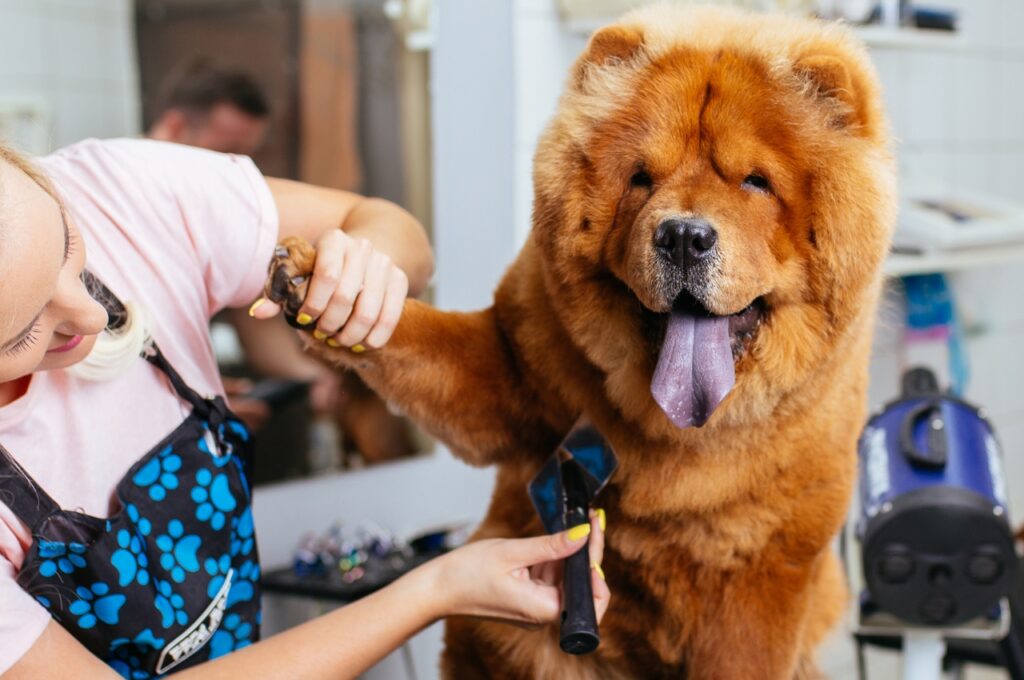
Professional groomer brushing a large fluffy Chow Chow during a large dog grooming session inside a modern pet grooming salon.
Scroll to Top