Why Does Leash Pulling Happen in the First Place?
Why Does Home Training Alone Sometimes Stall?
How Does Dog Daycare at Paddington Pups Help with Leash Pulling?
- Drop-off and pick-up repetition. Every daycare day begins and ends with your dog on a leash in a busy environment, with other dogs, unfamiliar people, and plenty of distractions. Our staff reinforce calm, loose-leash behaviour at drop-off and pick-up consistently, so your dog practises the skill in a genuinely stimulating setting multiple times a week.
- Structured transitions throughout the day. Dogs at Paddington Pups move between indoor and outdoor spaces, rest areas, and play groups on leash throughout the day. Each transition is an opportunity to practise walking calmly beside a handler, reinforced by experienced staff who understand how to reward the right behaviour at exactly the right moment.
- Exposure to other dogs and people. The most common trigger for leash pulling is the presence of other dogs or unfamiliar people. Daycare provides regular, supervised exposure to both, in a controlled environment where your dog learns that staying calm and loose on the leash is what earns access to the fun, not pulling toward it.
- Consistent reinforcement across multiple handlers. One of the biggest barriers to leash training at home is inconsistency between family members. At daycare, all staff apply the same approach, so your dog receives a consistent message about what earns forward movement and what does not.
What Should You Work on at Home Alongside Daycare?
- Start somewhere calm. Begin in your backyard or a quiet hallway, not the busiest part of your usual walking route. Your dog needs to learn the skill before being asked to use it around real distractions.
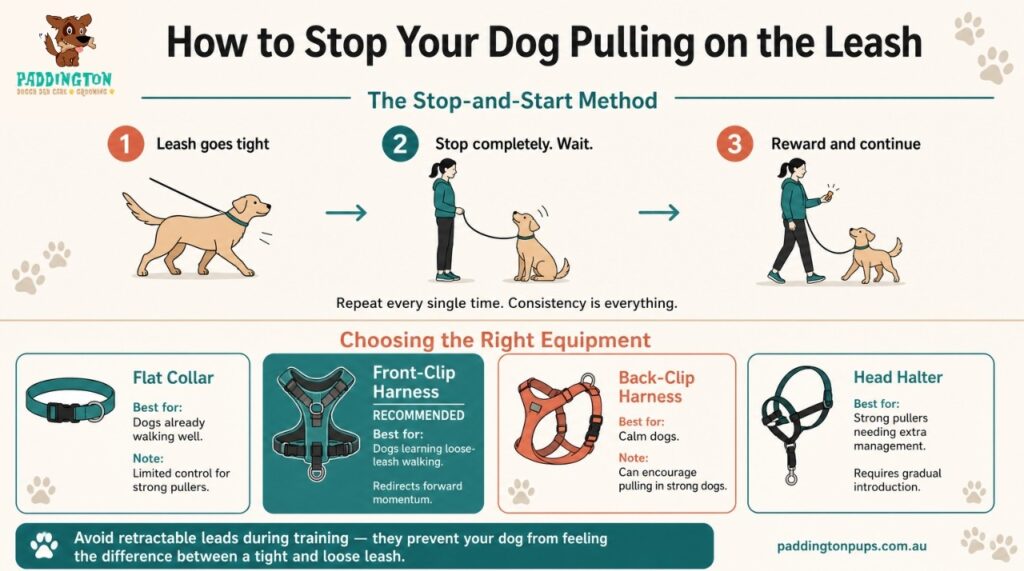
- Use the stop-and-start method. The moment the leash goes tight, stop walking completely. Wait for your dog to look back or release the tension, then reward and continue. Repeat this every single time the leash tightens, even if it means a five-minute walk takes twenty.
- Reward the right position. Rather than only correcting pulling, reward your dog generously whenever they are walking beside you with a loose leash. A small, tasty treat delivered right at your side reinforces exactly the position you are after, far more effectively than a treat tossed ahead of your dog.
- Keep early sessions short. Five or ten minutes is plenty, so neither of you finishes feeling frustrated or exhausted before the habit has a chance to form.
What Equipment Can Help While You Are Training?
Equipment | How It Helps | Best For |
Standard flat collar | Simple and familiar, but offers little control for a strong puller | Dogs who already walk well on a loose leash |
Front-clip harness | Redirects a dog gently sideways when they pull, reducing forward momentum | Most dogs learning loose-leash walking |
Back-clip harness | Comfortable and low-pressure, but can encourage pulling in strong dogs | Calm dogs or short training walks |
Head halter | Offers the most control by guiding the head, needs a proper introduction | Dogs who pull strongly and need extra management |
What Common Mistakes Make Leash Pulling Worse?
- Letting your dog pull toward things they want. If pulling gets your dog to the smell or the dog across the street even occasionally, the habit is being reinforced rather than broken.
- Yanking the leash as a correction. This tends to create tension and discomfort around walks rather than teaching an alternative behaviour.
- Only practising on the daily walk. Long, exciting walks are the hardest place to learn a new skill. Short, boring practice sessions build the habit faster.
- Inconsistent rules between family members. If one person allows pulling toward the front gate and another does not, your dog receives mixed signals that slow everything down.
- Skipping the reward once things improve. A loose leash that stops being reinforced can quietly drift back into old habits over time.
- Only walking the same quiet route. A dog that has only ever practised loose-leash walking on one familiar street may struggle the first time a busier path or a passing dog changes the picture.
Bringing It All Together
FAQs
Can daycare alone fix my dog's leash pulling?
Daycare significantly accelerates leash training by providing consistent, distraction-rich repetition with experienced handlers. However, it works best alongside home training. The combination of both approaches, consistent rules at home and regular practice in a busy supervised environment, produces the most reliable results.
Why does my dog walk perfectly at home but not at the park?
Dogs struggle to generalise behaviours. A loose leash in a quiet environment does not automatically transfer to a highly stimulating environment like a park. Daycare helps bridge this gap by giving your dog regular practice in a busy setting with other dogs and people present, which is exactly where pulling is most likely to happen.
Should I use a retractable leash while training?
No. Retractable leashes maintain constant tension on the collar or harness, which teaches the dog that pulling is normal. A standard fixed-length leash of 1.5 to 2 metres allows the dog to feel the clear difference between a loose leash and a tight one, which is essential for training.
Is a harness or a collar better for a dog that pulls?
A front-clip harness is generally best for a dog learning to walk nicely, as it gently redirects their forward momentum if they pull. A standard back-clip harness can actually encourage pulling. Collars are fine for dogs that already walk well, but can cause neck injury in strong pullers.
How do I stop my dog pulling toward other dogs?
Create distance before your dog reacts. If you see another dog approaching, step off the path, ask your dog to sit, and reward them for looking at you instead of the other dog. Regular daycare exposure to other dogs in a controlled environment also helps, as your dog gradually learns that the presence of other dogs is not a reason to pull.