One of the things new dog owners learn quickly is that grooming is not optional. A dog that goes without regular brushing, bathing, nail trimming, and ear cleaning will show the consequences in coat condition, in skin health, in comfort, and eventually in vet bills that a consistent at-home routine would have prevented.
The challenge for someone new to dog ownership is that generic grooming advice is everywhere, but a clear, practical picture of what a complete routine actually looks like, how often to do each thing, what tools you need, and what mistakes cost you the most, is harder to find. This guide provides exactly that, written specifically for Brisbane dog owners starting from scratch.
Why Grooming Matters More in Brisbane Than in Most Other Cities
Before getting into the routine itself, it is worth understanding why grooming is particularly important in Queensland’s subtropical climate. This is not something most generic grooming guides address.
Brisbane’s combination of high humidity, warmth through most of the year, and a genuine wet season creates specific conditions that accelerate coat and skin problems. Moisture that remains in a dog’s coat after a walk, a swim, or simply a humid night does not evaporate quickly in Brisbane’s air. It sits against the skin and creates the conditions where hot spots develop, yeast overgrowth occurs, and matting tightens. Problems that a Brisbane dog owner might see within a week of grooming slipping can take weeks to develop in a drier climate.
The practical implication is that the grooming intervals that work for dogs in Melbourne or Sydney may be too long for Brisbane dogs, particularly for dense, long, or double-coated breeds. Building your routine with Queensland’s climate in mind from the start means you are setting the right intervals rather than adjusting them after problems appear.
The Four Elements of a Complete Home Grooming Routine
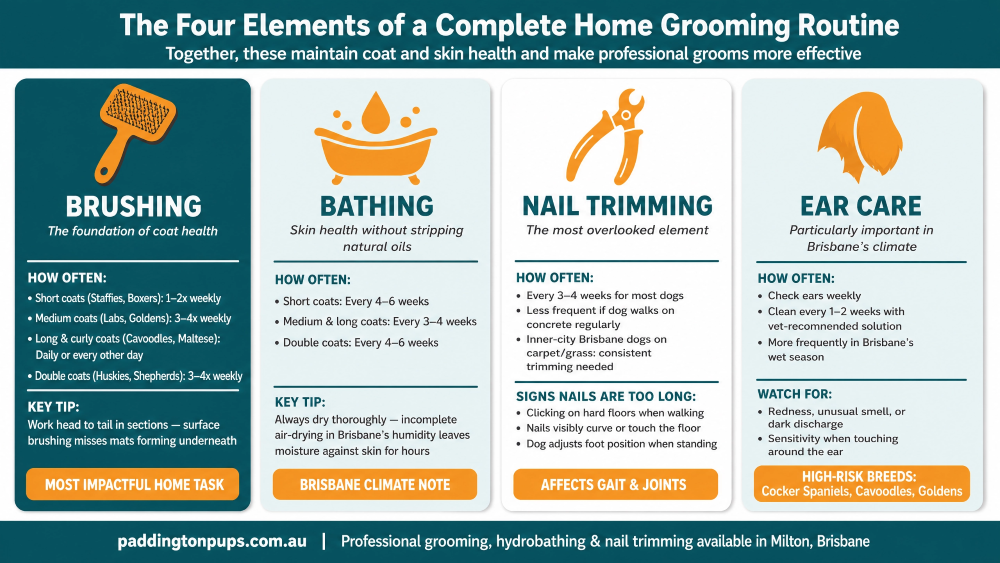
A complete home grooming routine has four components: brushing, bathing, nail trimming, and ear care. Each serves a different function. Together, they maintain coat and skin health, prevent common problems, and give you regular hands-on contact with your dog that makes professional grooming appointments easier and more effective.
Brushing: The Foundation of Coat Health
Brushing is the single most impactful thing most dog owners can do at home. It removes loose hair, prevents mats from forming, distributes natural oils through the coat, and gives you a visual and tactile check of your dog’s skin condition at every session. Understanding what happens to your dog’s skin between grooms is critical for preventing issues.
How often to brush depends on your dog’s coat type:
- Short, smooth coats (Staffies, Beagles, Boxers, Whippets): Once or twice weekly with a rubber curry or short-bristle brush. The goal is removing loose hair and checking skin condition rather than detangling.
- Medium coats (Labradors, Golden Retrievers, Border Collies): Three to four times weekly. Use a slicker brush for the body and an undercoat rake to reach the dense underlayer. Pay particular attention to friction points where mats form most readily: behind the ears, under the collar, in the armpits, and around the hindquarters.
- Long and curly coats (Cavoodles, Maltese, Shih Tzus, Spoodles): Daily or every other day. These coats mat quickly in Brisbane’s humidity and mats that have been developing for a week are significantly harder to work through than those caught on day two. Use a wide-toothed comb to check through to the skin before a slicker brush.
- Double coats (Huskies, German Shepherds, Corgis, Australian Shepherds): Three to four times weekly with an undercoat rake first, then a finishing brush. During seasonal coat transitions and through Brisbane’s summer, more frequent brushing manages the additional undercoat volume.
Work systematically from head to tail rather than skimming across the surface. Part the coat and brush in sections so you reach all the way through to the skin. Surface brushing gives the appearance of a groomed coat while mats continue to form underneath. Work through any tangles gently by holding the mat at its base and teasing from the end inward, rather than pulling from the skin outward.
When brushing indicates a problem:
Use brushing sessions to monitor your dog’s skin. Redness, flaking, unusual warmth, new lumps or growths, and areas where your dog reacts to being touched are all things worth noting. Catching skin changes early makes them much easier to manage. If you notice anything unusual, raise it at your next vet visit rather than waiting for it to become symptomatic. Investing in affordable dog grooming tools will make this process much easier.
Bathing: Maintaining Skin Health Without Stripping Natural Oils
Regular bathing keeps your dog’s coat and skin clean, removes accumulated allergens from the coat surface, and gives you the best view of your dog’s skin condition. In Brisbane’s climate, bathing plays a more active role in skin health than it does in drier cities because allergens, pollens, and moisture accumulate more quickly.
- Short-coated breeds: Every four to six weeks is sufficient for most dogs living in average suburban conditions
- Medium and long-coated breeds: Every three to four weeks, more frequently if your dog swims regularly or spends a lot of time in long grass
- Double-coated breeds: Every four to six weeks for most of the year, with professional hydrobathing recommended for thorough undercoat rinsing
Use a shampoo specifically formulated for dogs. Human shampoos are at a different pH from dog skin and disrupt the skin’s natural barrier. Choose a formula matched to your dog’s skin type, oatmeal-based for sensitive or dry skin, standard dog shampoo for most other dogs.
Wet the coat thoroughly before applying shampoo, working it through all layers rather than leaving it on the surface. Rinse completely. Shampoo residue left in the coat is a common cause of post-bath skin irritation. With dense or long coats, rinsing takes longer than most owners expect.
Drying matters enormously in Brisbane:
A dog that air-dries incompletely in Brisbane’s humidity is potentially sitting with moisture against its skin for hours. Use a towel to remove the bulk of water, then a blow-dryer on a low or warm setting worked through the coat systematically. This is particularly important for dogs with dense or long coats, where surface dryness does not mean the coat is dry through to the skin.
When professional bathing makes sense:
For large double-coated breeds, thoroughly rinsing and blow-drying at home is genuinely difficult without a purpose-built wash area and appropriate equipment. Professional hydrobathing at Paddington Pups uses warm pressurised water to penetrate deep into the coat, achieving a thorough rinse and flush of loose undercoat that home bathing typically cannot match. For Brisbane dogs in summer, this makes a meaningful difference to how clean and comfortable the coat remains between appointments.
Nail Trimming: The Most Overlooked Part of Home Grooming
Nail care is consistently the most neglected element of home grooming, and it is the one with the clearest physical consequences when it slips. Overgrown nails affect how a dog distributes weight across its feet, altering gait and placing increased load on joints. In larger breeds, long-term nail neglect contributes to joint problems that require veterinary attention.
Every three to four weeks for most dogs. Dogs that spend significant time on hard surfaces such as concrete or rough pathways may wear nails down naturally and need less frequent trimming.
Dogs that spend most of their time on carpet, grass, or smooth flooring, which describes many inner-city Brisbane dogs, do not wear nails down and need consistent trimming.
Use a dog-specific nail clipper or grinder. The most important thing to understand before trimming is the location of the quick, the blood vessel that runs through the nail. Cutting into the quick causes pain and bleeding. In dogs with pale or clear nails, the quick is visible as a pink area within the nail. In dogs with dark nails, the quick is not visible and you should trim in small increments.
A useful guide for dark nails: trim small slices until the cut surface of the nail shows a small grey or darker circle in the centre. That is the beginning of the quick. Stop there.
Signs nails are too long:
- You can hear clicking on hard floors when your dog walks
- The nails visibly curve or touch the floor when the dog is standing
- Your dog adjusts its foot position when standing to accommodate the nail length
If you are not confident trimming your dog’s nails at home, professional grooming appointments include nail trimming as standard. It is worth asking your groomer to show you their technique so you can maintain nails between professional visits.
Ear Care: Particularly Important for Brisbane Dogs
Ear care deserves specific attention in Brisbane because Queensland’s warm, humid climate creates ideal conditions for the bacteria and yeast that cause ear infections. The ear canal of a dog is warm, often poorly ventilated in floppy-eared breeds, and in Brisbane’s humidity it retains moisture more readily than in drier climates.
How often to check and clean:
Check ears weekly as part of your regular handling routine. Look for redness, unusual smell, dark discharge, or your dog showing sensitivity when you touch around the ear. Clean every one to two weeks using a veterinary-recommended ear cleaning solution and cotton balls or gauze pads. Do not use cotton tips, they push debris further into the canal. For more detailed information, read our complete guide to dog ear care in Brisbane.
Apply enough solution to fill the ear canal, then massage the base of the ear for twenty to thirty seconds to loosen wax and debris. Allow your dog to shake its head, then wipe away loosened material from the visible part of the canal and the ear flap with a cotton ball. Only clean what you can see.
Breeds that need particular attention in Brisbane:
Cocker Spaniels, Basset Hounds, Golden Retrievers, Cavoodles, and any breed with floppy ears or significant hair growth inside the ear canal. These breeds should have ears checked and cleaned more frequently in Brisbane’s wet season, when the combination of humidity and increased moisture from outdoor activity raises infection risk significantly.
Building a Consistent Home Grooming Schedule
Consistency matters more than perfection. A dog that is brushed briefly three times a week is in better condition than one that receives a thorough brush once a fortnight. Short, regular sessions establish the routine and keep your dog accustomed to being handled, which makes professional grooming appointments calmer and more efficient.
Here is a practical home grooming schedule that works for most Brisbane dog owners:
Adjust these intervals based on your dog’s specific breed, lifestyle, and skin condition. A dog that swims twice a week in summer needs more frequent ear checking than one that does not. A dog that walks primarily on hard surfaces needs less frequent nail trimming than one that walks mainly on grass and carpet.
When Professional Grooming Supplements What You Do at Home
Home grooming and professional grooming serve different functions. Home grooming maintains the baseline between professional appointments. Professional grooming resets the coat properly, addresses what home brushing and bathing cannot reach, and provides an experienced set of eyes on your dog’s coat and skin condition at regular intervals.
For most Brisbane dogs, professional dog grooming at Paddington Pups is the complement that makes home grooming more effective rather than a replacement for it. A dog on a consistent home brushing routine arrives at their professional groom in better condition, which means the groomer can achieve a better result in less time. A dog that arrives with matting, long nails, and overgrown coat requires remedial work that affects what the appointment can deliver.
Think of home grooming as the maintenance and professional grooming as the service. Both are necessary. Together, they keep your dog looking and feeling consistently well across their entire life.
Getting Started at Paddington Pups
Our professional grooming services are available Monday to Saturday by appointment. We offer five groom types: Maintenance, Full, Style, Deshed, and Puppy Cut, each designed for specific coat types and situations. Every groom includes a professional wash and blow-dry, with additional services like nail clipping and paw pad trims available as add-ons.