Resource guarding is one of the most misunderstood dog behaviours Brisbane owners encounter. When a dog growls over their food bowl, stiffens when someone approaches their toy, or snaps when a family member reaches toward something they are holding, the instinct is often to label the dog as aggressive or dominant. The reality is considerably more straightforward.
Resource guarding is a normal canine behaviour rooted in survival instinct. Dogs that guard valuable items, such as food, toys, resting spots, or chews, are doing something that made evolutionary sense for generations before domestication. Understanding this does not make the behaviour acceptable when it puts family members at risk. But it does shape how you address it. Punishment-based approaches to resource guarding consistently make the behaviour worse. Desensitisation and positive association approaches, when done carefully and consistently, produce lasting improvement.
This guide covers how to recognise resource guarding at different levels of severity, the safety measures that protect your family in the meantime, the step-by-step training approach that reduces guarding behaviour over time, and when to involve a professional.
What Is Resource Guarding and Why Do Dogs Do It?
Resource guarding occurs when a dog perceives a threat to something they value and responds with behaviours designed to keep that item. The “resource” is not always food. It can be a toy, a chew, a specific resting spot, a piece of rubbish they have picked up outside, or even a person they feel possessive toward.
The behaviour makes sense from a dog’s perspective. In the wild, an animal that did not protect its food did not eat. That instinct does not disappear simply because a dog now lives in a house where food appears twice a day on a reliable schedule. For many dogs, resource guarding is a low-level, occasionally expressed behaviour that becomes a problem only in specific contexts, such as around children, with specific high-value items, or in multi-dog households.
For other dogs, resource guarding is more pervasive and escalates quickly. Understanding where your dog sits on that spectrum is the starting point for addressing it safely.
How Can You Recognise the Signs of Resource Guarding?
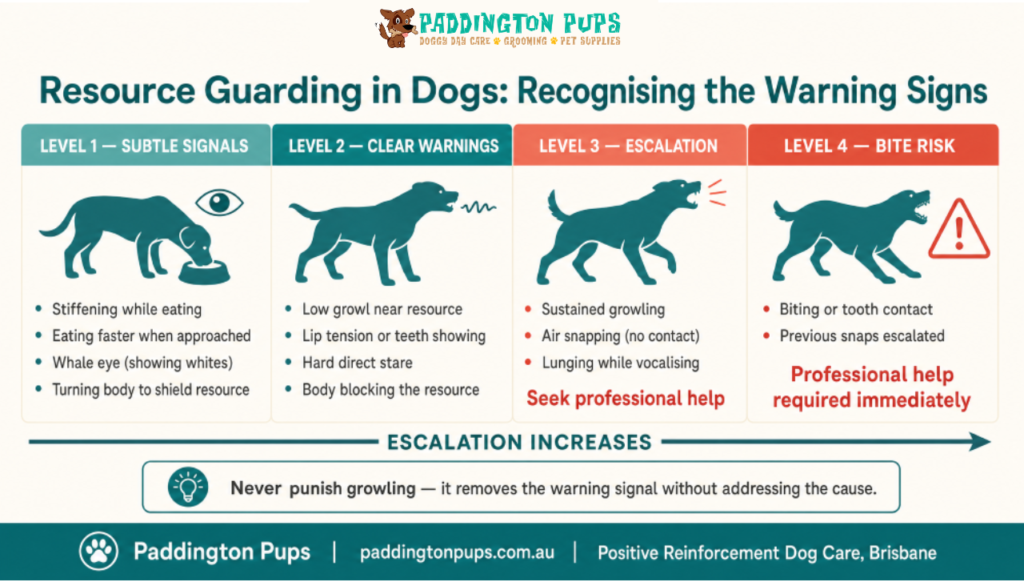
Resource guarding rarely appears without warning. Dogs communicate discomfort through a clear escalation of signals before they reach the point of snapping or biting. Most incidents that appear to come “out of nowhere” were preceded by earlier signals the owner missed or dismissed.
The Resource Guarding Escalation Scale
Why You Should Never Punish Growling
This is one of the most important principles in resource guarding management. A dog that growls is communicating. If you punish the growl through a verbal correction, a physical consequence, or any form of intimidation, you do not remove the underlying discomfort that caused it. You remove the warning signal. The result is a dog that bites without warning, because the warning was penalised away.
Growling is information. It tells you that the dog is uncomfortable and that the situation needs to be managed differently. Treat it as communication and respond accordingly, not as defiance requiring correction.
How Do You Manage the Environment Safely During Training?
Before any training begins, the immediate priority is ensuring no one in your household is at risk of being bitten. Management and training are separate steps. Management protects people now while training addresses the root behaviour over time.
Practical Safety Measures for Resource Guarding Households
Remove triggers from shared spaces. High-value items like raw bones, stuffed Kongs, chews, or favourite toys should only be given to the dog in a space where they will not be approached. If the resource guarding is around food, feed your dog in a separate room with the door closed until training is making progress.
Teach children specific rules immediately. Children and resource guarding are a significant injury risk, as highlighted by RSPCA Australia [1]. Children move unpredictably, approach quickly, and often reach toward dogs without reading the warning signals adults might notice. If you have children at home, establish and enforce these rules without exception: - Never approach the dog while they are eating
- Never take something from the dog’s mouth
- Never reach toward a dog that is holding or lying near an item
- If the dog has something they should not have, find an adult rather than trying to retrieve it themselves
- Give the dog space on their bed or in their crate without approaching
Use management tools during the transition period. Baby gates and exercise pens allow the dog to have their resource in peace while the household continues normally around them. A lead can be used to gently guide a dog away from a situation before it escalates, without the owner needing to reach toward the guarded item.
Never attempt to physically take an item from a guarding dog. Trading is always safer and more effective. Reaching in to take something from a dog that is guarding is the most common way owners and family members get bitten during resource guarding incidents.
What Is the Core Training Technique for Resource Guarding?
The goal of resource guarding training is not to teach the dog that their resource will be taken away when a person approaches. It is to teach the dog that a person approaching while they have something valuable means good things happen, which is the opposite of a threat.
This approach is called counter-conditioning. It changes the emotional response to the trigger (a person approaching while the dog has a resource) by consistently pairing the trigger with something the dog values more than the resource itself.
The Trade Technique
The trade technique is the practical foundation of resource guarding work. It teaches the dog that giving something up results in getting something better, and that the item is returned afterward. Over time it builds a generalised understanding that human approach near resources predicts good outcomes rather than loss.
How to practise the trade:
- Wait until your dog has a low-value item, not their highest-value possession to begin with.
- Approach calmly and present a high-value treat (something clearly more exciting than what the dog has) within sniffing range but without reaching toward the dog.
- As the dog drops the item to take the treat, pick up the item calmly.
- After the dog has the treat, return the item to them.
- Walk away.
The return of the item is critical. Many owners practise taking and not returning, which teaches the dog that approach equals permanent loss and strengthens guarding motivation. Returning the item teaches the dog that dropping it is not a permanent surrender.
Practise this daily with low-value items before progressing to higher-value ones. Progress should be gradual and based on the dog showing no guarding signals at each level before moving up.
The Approach-Reward Protocol
For food bowl guarding specifically, a systematic desensitisation approach helps the dog build a positive association with human presence near their food.
Starting from the beginning:
- Place the food bowl down and walk past without stopping. Do not hover over the dog or make eye contact.
- As you pass, drop a high-value treat into the bowl without bending toward the dog.
- Repeat across multiple meals until the dog is relaxed and looks up positively when you approach.
- Gradually reduce the distance of the drop and the speed of the approach over days to weeks.
- Eventually work toward being able to crouch next to the dog, add something to the bowl, and have the dog continue eating calmly.
This process is slow. The speed depends entirely on the dog’s response at each step. Rushing it, moving to the next stage before the dog is genuinely comfortable, sets the training back. The test for readiness to progress is simple: is the dog relaxed and showing no guarding signals at this stage?
What Are Common Mistakes That Make Resource Guarding Worse?
Understanding what not to do is as important as knowing the right approach.
Punishing the growl. As discussed, this removes the warning signal without addressing the underlying discomfort.
Repeatedly taking items to “prove” dominance. Regularly reaching in and taking things from a resource-guarding dog to show them who is in charge consistently makes guarding behaviour more intense, not less. It confirms the dog’s concern that approach equals loss.
Inconsistency between family members. If one person trades and returns items while another reaches in and takes them, the dog cannot build a reliable prediction about what approach means. Consistency across everyone in the household is essential.
Progressing too quickly. Moving to higher-value items or closer approaches before the dog is comfortable at the current level reverses progress. Each step needs to be genuinely comfortable before moving forward.
Waiting for a serious incident before taking action. Resource guarding is significantly easier to address early than once it has escalated and been reinforced across months of interactions. If you are seeing level one or two signals, address them now rather than hoping the dog grows out of it.
How Do Daycare and Playcare Support Resource Guarding Improvement?
A recent example at Paddington Pups involved a dog named Poppy who was found to have previously unidentified resource guarding behaviours on her first visit to Playcare. She was reluctant to share toys or allow others near items she was holding. After one week of Playcare sessions practising dropping items on request in exchange for treats and attention, Poppy’s progress was significant. The team could not only retrieve and play with toys with her, but could also touch her mouth while she held items. Her owner reported she was noticeably more excited to attend daycare since Playcare became part of her routine.
The Playcare programme provides structured, positive-reinforcement-based interaction in a supervised environment with experienced staff who can practise these exact skills with your dog consistently across daycare days. For dogs where resource guarding is a concern in social settings, with other dogs or with daycare staff, Playcare allows that work to happen professionally while you continue home training.
When Should You Involve a Professional?
Home management and the training techniques above address most resource guarding situations where the behaviour is at levels one or two. There are clear situations where professional help is the right next step.
Seek professional support if:
- Your dog has already bitten or made tooth contact with a person
- Guarding is escalating despite consistent management and training
- Guarding is occurring around children in the household
- Multiple family members are managing the dog differently and consistency cannot be established
- The dog guards multiple resource types and the behaviour is pervasive
- You are not confident reading the dog’s warning signals accurately
A certified positive reinforcement-based trainer or animal behaviour consultant can assess your dog’s specific guarding behaviour and develop a tailored plan [2]. The Association of Pet Dog Trainers Australia (APDT) is a reliable resource for finding certified professionals in Brisbane. At Paddington Pups, our team can advise on appropriate Brisbane trainers for resource guarding assessment if you need a referral. Contact our team today for more information, and new customers are always welcome to discuss their dog’s specific needs.
References
[2]: https://apdt.com.au “Association of Pet Dog Trainers Australia (APDT ). “Positive reinforcement and behaviour modification.””