One of the questions Brisbane dog owners ask most often as their dog enters the senior years is whether to keep bringing them to daycare, or whether to pull back.
The concern is understandable. An eight or nine-year-old dog is not the same animal they were at three. They tire more quickly, recover more slowly, may have joint stiffness that affects how they move, and may be less interested in the high-energy play that made daycare so stimulating when they were younger. If the daycare experience has not changed alongside the dog, it may genuinely no longer be appropriate.
But the answer to whether your senior dog should still attend daycare is not automatically no. For many older Brisbane dogs, well-structured daycare remains one of the most valuable things in their week, not despite their age, but because of it. The social engagement, gentle activity, mental stimulation, and professional supervision that a good daycare day provides are exactly what an ageing dog needs to maintain quality of life as their physical capacity changes.
The critical word is well-structured. Not every daycare is set up to serve senior dogs appropriately. Understanding what good senior dog accommodation actually looks like gives Brisbane owners the information they need to make this decision confidently.
Why Do Senior Dogs Still Benefit From Daycare?
The case for daycare does not disappear when a dog enters the senior years. In several respects, it strengthens.
How Does Social Isolation Affect Ageing Dogs?
A dog that attends daycare continues to receive regular social engagement with familiar dogs and people, exposure to a varied environment, and the kind of gentle activity that keeps the brain working. The mental engagement of navigating social interactions, even calm, familiar ones, is genuinely protective for ageing canine cognition.
Why Does Structured Rest Matter as Much as Activity?
Older dogs need more rest than younger dogs, but the quality of that rest matters. A senior dog left at home alone for eight to ten hours is resting, but they are also isolated, without access to interaction or gentle movement when they choose it. A senior dog at a well-run daycare has access to resting areas throughout the day, can choose when to engage and when to withdraw, and has supervised company during their active periods.
This is not passive rest. It is the kind of engaged, comfortable day that keeps an older dog mentally present and physically active at an appropriate level.
How Does Professional Observation Support Senior Health?
Senior dogs experience health changes that can develop gradually and go unnoticed at home. A daycare team that sees your dog regularly is well-positioned to notice changes in gait, energy level, appetite, and behaviour before they become significant. At Paddington Pups, our team knows our regular attendees well, which means a dog that is moving differently, eating less, or showing unusual behaviour during the day is noticed and communicated to the owner promptly.
This observation layer is one of the practical advantages that home care alone cannot replicate.
What Does Low-Impact Senior Dog Daycare Actually Look Like?
The phrase “low-impact daycare” is sometimes used as a marketing term without much substance behind it. For Brisbane dog owners evaluating facilities, it is worth understanding what genuine senior dog accommodation involves in practice.
How Should Senior Dogs Be Grouped?
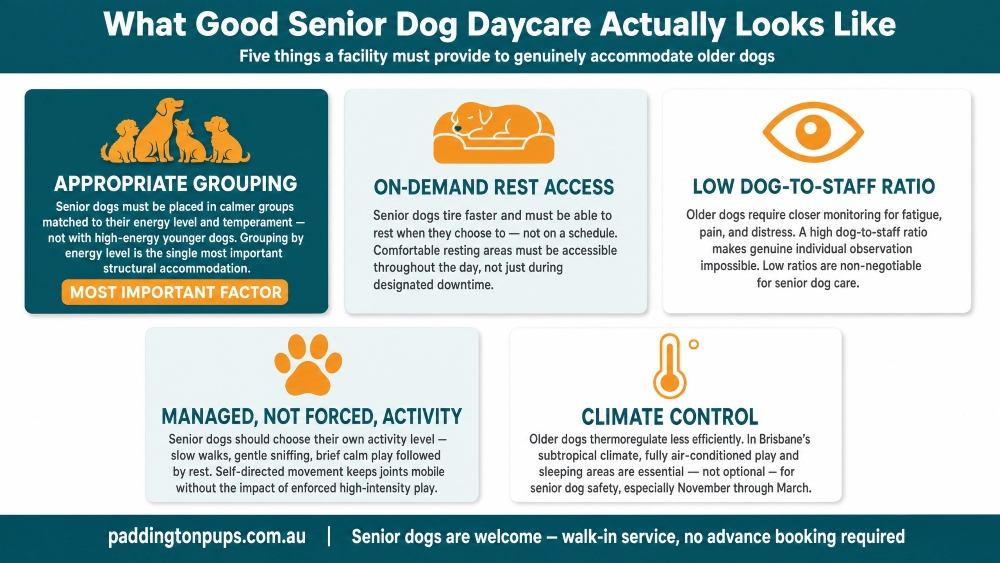
The most important structural accommodation for senior dogs is how they are grouped. A facility that places all dogs together regardless of age, energy level, and size is not providing appropriate senior care. An older dog placed in a high-energy play group with younger dogs is managing a constant source of overstimulation and potential physical risk.
At Paddington Pups, dogs are grouped across four separate play areas by temperament, size, and energy level. Senior dogs are placed in calmer groups where the pace of play matches their capacity. They are not excluded from social interaction; they are included in social interaction that suits them.
This distinction is critical. It is the difference between daycare that genuinely accommodates ageing dogs and daycare that simply accepts them.
Why Is Continuous Access to Rest Essential?
Senior dogs tire faster and need to be able to rest when they choose to, not when a schedule allows them to. A facility that runs continuous group play without meaningful rest areas and downtime periods is inappropriate for older dogs regardless of grouping.
At Paddington Pups, comfortable resting areas are accessible to dogs throughout the day. Senior dogs can choose to engage during active periods and withdraw to rest when they need to, which is how an older dog’s energy should be managed, through choice rather than compulsion.
Why Do Low Dog-to-Staff Ratios Matter for Older Dogs?
A low dog-to-staff ratio matters more for senior dogs than for younger ones. Older dogs require closer monitoring for signs of fatigue, pain, or distress. A facility where staff are managing too many dogs simultaneously cannot provide the observational attention that a senior dog’s changing condition warrants.
Paddington Pups maintains a deliberately low dog-to-staff ratio as one of its core operating standards, and this is directly relevant to senior dog care. It is what makes genuine monitoring possible rather than superficial.
What Is Managed, Not Forced, Activity?
Senior dogs benefit from gentle, consistent activity, not enforced high-intensity play. The right daycare environment allows older dogs to engage at the level they choose: a slow walk around the play area, gentle sniffing and social contact with familiar dogs, brief bursts of play followed by rest. This self-directed activity pattern is more beneficial for keeping joints mobile and muscles active than either complete inactivity or forced exertion.
What to Look for When Choosing a Daycare for a Senior Dog
If you are evaluating whether to start or continue senior dog daycare in Brisbane, these are the specific questions worth asking any facility.
While full tours are not always possible for the safety and wellbeing of dogs in the facility, a reputable facility should offer the ability to view their space and meet the team. At Paddington Pups, large parts of the facility are visible to clients on arrival, and the full facility is viewable live through security monitors.
What Activities Are Appropriate for Senior Dogs at Daycare?
The activities that benefit senior dogs at daycare are quite different from those suited to younger dogs, and a good facility structures these appropriately.
Gentle Social Interaction
Calm, familiar social contact with other dogs is one of the most beneficial activities for senior dogs. It provides mental engagement without physical demand. Dogs that know each other well engage in relaxed mutual sniffing, proximity resting, and brief, calm play that is self-limiting. Older dogs naturally moderate their own play when their energy is respected.
Slow, Self-Directed Movement
Short circuits around a play area, investigation of smells, gentle movement between resting spots, this kind of slow, self-directed movement keeps joints mobile and muscles active without the impact of sustained running or jumping. It is the senior dog equivalent of a gentle daily walk and is genuinely therapeutic for ageing joints.
Mental Enrichment
Puzzle feeders, scent games, and gentle interactive activities engage the brain without demanding physical output. These activities are particularly valuable for senior dogs because they provide the cognitive stimulation that maintains mental acuity without adding to joint or cardiovascular load. At Paddington Pups, enrichment activities are part of how we engage dogs at different energy levels throughout the day.
What to Avoid in Senior Dog Daycare
- High-intensity group play with much younger, higher-energy dogs
- Forced activity without rest breaks
- Long sessions without the ability to withdraw and rest
- Rough play or jumping on ageing joints
- Environments where senior dogs cannot escape overstimulation
If a facility cannot describe how these are managed, that is worth factoring into your decision.
How Does Brisbane’s Climate Affect Senior Dog Daycare?
Queensland’s subtropical climate adds considerations for senior dog daycare that Brisbane owners need to factor in.
Older dogs thermoregulate less efficiently than younger dogs. Brisbane’s summer heat, which can persist from November through to March, requires that any daycare environment for senior dogs is properly temperature-managed. At Paddington Pups, play and sleeping areas are fully air-conditioned, which is particularly relevant for older dogs who cannot regulate heat as effectively as they once could.
Humidity also affects older dogs with respiratory conditions and some heart conditions more significantly than younger, healthier dogs. If your senior dog has a specific health condition that is affected by heat or humidity, discuss this with the facility team and with your vet before committing to summer daycare attendance.
Queensland’s mild winters, by contrast, are ideal for senior dogs. Gentle temperatures allow outdoor movement without cold-related joint stiffness. Many Brisbane senior dog owners find winter the easiest season for their older dog at daycare.
When Should a Senior Dog Reduce or Stop Daycare?
Daycare remains appropriate for most senior dogs when the facility accommodates their needs correctly. There are situations, though, where reducing or pausing attendance is the right decision.
Consider reducing daycare frequency if:
- Your dog is consistently more fatigued than usual after daycare days, with prolonged recovery time
- A vet assessment reveals a new health condition that requires more rest
- Your dog is showing signs of significant anxiety about attending, such as reluctance at drop-off, that is new behaviour not previously present
Consider pausing daycare if:
- Your dog is recovering from surgery or illness and the vet has recommended restricted activity
- A mobility decline means your dog cannot manage the daycare environment safely even in a low-energy group
- Your dog is showing signs of significant cognitive decline that makes the daycare environment confusing or distressing
In most cases, these are temporary adjustments rather than permanent stops. A dog recovering from surgery may return to daycare once cleared by their vet. A dog whose mobility has declined but who remains cognitively sharp may continue to benefit from daycare with more frequent rest access and additional monitoring.
At Paddington Pups, our team is always willing to discuss what level of daycare attendance suits your senior dog’s current condition. If you have concerns, contact us before making a unilateral decision to stop, as often there is an adjusted approach that continues to serve the dog well.
Getting Started or Continuing with Senior Dog Daycare at Paddington Pups
Senior dogs are welcome at Paddington Pups. Our doggy daycare is a walk-in service with no advance booking required. New customers register through our website before their first visit, and every new dog completes a first-day assessment that helps us understand their temperament and place them in the most appropriate group.
If your senior dog already attends Paddington Pups, let our team know if their health or mobility has changed recently. That information allows us to adjust how we manage their day and ensure the experience continues to suit them as they age. For more comprehensive advice on managing an ageing dog, review our guide to caring for older dogs at home or learn about the science of canine ageing.
For dog boarding enquiries for senior dogs, please contact our team directly to discuss your dog’s specific needs and any accommodations that would support their comfort during a stay.