If you are reading this because your puppy is five months old, or eight months old, or even older, and you have only just learned that the “critical socialisation window” closes around 16 weeks, take a breath. You have not ruined your dog.
This is one of the most common sources of guilt and anxiety among new dog owners, and it is almost always disproportionate to the actual situation. Puppies adopted later, rescued as young adults, kept home during illness, raised through a lockdown, or simply not socialised as thoroughly as a training book recommended are not doomed to a life of fear and reactivity. The window matters, there is no point pretending otherwise, but what happens after it closes matters just as much, and there is a great deal a Brisbane owner can still do.
This guide is for exactly that situation: a puppy or young dog who missed some or all of the ideal socialisation period, and an owner who wants to know what is genuinely still possible.
What Actually Happens When the Socialisation Window Closes?
The period from roughly three to sixteen weeks of age is when a puppy’s brain is most receptive to new experiences without an automatic fear response. Exposure during this window to people, dogs, environments, sounds, and surfaces tends to be processed as “normal” rather than threatening. This is why early, well-managed puppy preschool produces dogs that handle novelty calmly as adults.
After sixteen weeks, the brain does not switch off its capacity to learn and adapt. What changes is that new experiences are more likely to be filtered through a developing fear response before they are filtered through curiosity. A dog meeting something genuinely new for the first time at six months is more likely to feel uncertain about it than a puppy meeting the same thing at eight weeks. This is a difference in degree, not a hard boundary. It is the reason socialisation after the window takes more patience and a slower pace, not the reason it stops working. The Australian Veterinary Association provides comprehensive guidelines on navigating these developmental stages.
It is also worth being clear about something the window framing often obscures: a puppy that had several positive early experiences but not comprehensive exposure is in a considerably better position than a puppy with no early socialisation at all. Few owners managed perfect, textbook socialisation during the early window regardless of when they started. Most dogs are somewhere in between.
Why Do Brisbane Puppies Miss the Socialisation Window?
You are far from alone in this situation, and understanding why it happened removes some of the guilt that tends to get in the way of moving forward productively.
Adoption or rescue timing: Many puppies and young dogs come into Brisbane homes well after sixteen weeks, particularly through rescue organisations, council pounds, or breeders who rehome slightly older puppies. Their early experiences before adoption are often unknown.
Vaccination delays: Some puppies have had a slower vaccination schedule due to health issues, meaning supervised group socialisation opportunities were not available during the ideal window.
Illness or injury: A puppy recovering from surgery, illness, or injury during the critical period may have had restricted activity precisely when socialisation should have been happening.
Owner circumstances: Genuine life circumstances, such as a family health crisis, a house move, or a demanding work period, can mean socialisation simply was not prioritised during those crucial early weeks, even with the best intentions.
Not knowing sooner: Many first-time puppy owners simply did not know about the critical window until well after it had passed. This is common and understandable. Nobody is born knowing canine developmental psychology.
None of these situations reflect poorly on you as an owner. They reflect the reality that puppies arrive in homes under a huge range of circumstances, and the textbook timeline does not always align with real life.
How Can You Socialise an Older Puppy or Young Dog?
Socialising a dog after the ideal window requires the same fundamental principles as early socialisation: positive, controlled exposure at a pace the dog can handle. However, it requires more patience, smaller steps, and closer attention to the dog’s stress signals.
Start With Where Your Dog Actually Is
Before building a plan, get a clear, honest picture of your dog’s current comfort level. Spend a week simply observing: how do they react to strangers on a walk? To other dogs at a distance? To new sounds, surfaces, and environments? Are they curious or do they shut down? Do they recover quickly from a startle or stay unsettled?
This baseline tells you where to start. A dog who is generally confident but has had limited exposure to specific things, such as other dogs, needs a different approach than a dog showing broad anxiety across many situations.
Go Slower Than You Think You Need To
The single biggest mistake owners make when socialising an older puppy or under-socialised dog is moving too fast, because the urgency of “catching up” creates pressure to push through discomfort. This consistently backfires. Forcing exposure before a dog is ready does not build confidence, it builds a negative association that makes the next attempt harder, not easier.
The right pace is one where your dog remains under threshold throughout, interested or mildly curious rather than overtly stressed. If you see signs of stress like lip licking, yawning, turning away, a tucked tail, or stiffening, you have moved too fast. Increase distance, reduce duration, and try again another day.
Build a Structured Exposure Plan
Rather than random encounters, work through categories systematically:
Use Food and Play Strategically
Pairing new experiences with something the dog already loves is the core mechanism that builds positive associations at any age. A dog who is mildly uncertain about something new but receives high-value treats and calm encouragement during the exposure learns to associate that uncertainty with good outcomes. Over repeated, well-managed exposures, the uncertainty itself fades.
Track Progress, Not Perfection
Socialising an older puppy is rarely a straight line. There will be good days and harder days, and progress that seems to stall before suddenly accelerating. Keep a loose mental note of trends over weeks rather than judging each individual outing. Are they generally more relaxed around new dogs than they were a month ago? Is their recovery time after a startle getting shorter? These trend-level observations matter more than any single interaction.
How Does Professional Support Help Under-Socialised Dogs?
This is where most owners genuinely benefit from help, because managing graduated exposure consistently and reading subtle stress signals accurately is a skill that takes experience to develop.
How Playcare Supports Under-Socialised Dogs
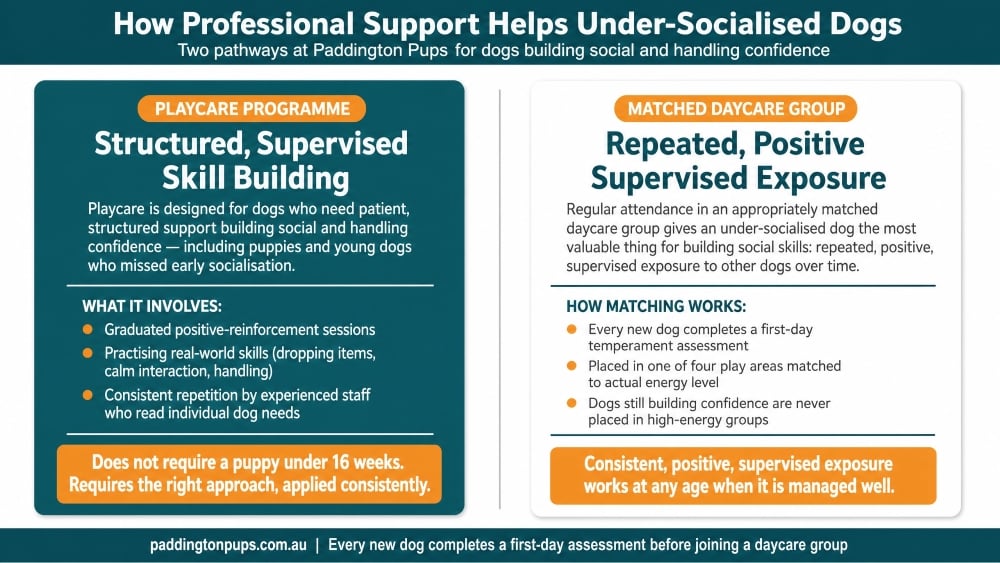
At Paddington Pups, our Playcare programme is specifically suited to dogs who need more structured, supervised support building social and handling confidence. This makes it a particularly good fit for puppies and young dogs who missed comprehensive early socialisation.
We have seen this in practice. One recent Playcare participant, a young dog named Poppy, arrived with previously unidentified resource guarding and reluctance around sharing toys or having people approach her while she held something. After just one week of structured Playcare sessions practising dropping items in exchange for treats and calm interaction, our team could not only retrieve and play with her toys, but also touch her mouth while she held something. Her owner reported she was noticeably more excited to attend daycare once Playcare became part of her routine.
This is what professionally structured, patient, positive-reinforcement work looks like for a dog building social and handling skills later than the textbook ideal. It does not require a puppy under sixteen weeks. It requires the right approach, applied consistently, by people experienced in reading what an individual dog needs.
How a Well-Run Daycare Group Supports Catch-Up Socialisation
Beyond Playcare specifically, regular attendance in an appropriately matched doggy daycare group gives an under-socialised dog the single most valuable thing for building social skills: repeated, positive, supervised exposure to other dogs over time.
At Paddington Pups, every new dog completes a first-day assessment before being confirmed as a regular daycare attendee. This is particularly useful for dogs who missed early socialisation, because it gives our experienced team a clear read on the dog’s current comfort level and ensures they are placed in one of our four play areas matched to their actual temperament and energy, not a generic group. A dog still building confidence is not thrown into a high-energy group where the pace overwhelms them. They are matched to a setting where they can engage at a level that suits where they currently are. If you are unsure whether daycare or preschool is right for your dog’s age, our preschool vs daycare guide can help clarify the options.
Dogs that attend consistently over weeks and months in an appropriately matched group show genuine, measurable improvement in social confidence. This is not because the window reopened, but because consistent, positive, supervised exposure works at any age when it is managed well.
When Should You Involve a Trainer or Behaviourist?
For most under-socialised dogs, structured exposure combined with professional daycare support is sufficient to build meaningful confidence over time. However, there are situations where additional professional input is the right call:
- Your dog shows significant fear responses, such as trembling, hiding, or attempting to flee, rather than mild uncertainty
- Fear responses are escalating into reactivity, such as barking, lunging, or snapping at triggers
- Progress has stalled or reversed despite several weeks of consistent, careful exposure work
- Your dog shows signs of fear or aggression toward family members or in the home, not just toward novel stimuli outside it
A certified positive reinforcement-based trainer or animal behaviourist can assess your specific dog and build a tailored desensitisation plan. The Association of Pet Dog Trainers Australia (APDT) is a reliable resource for finding qualified professionals in Brisbane . Our team at Paddington Pups can also advise on appropriate referrals if you need one.
The Most Important Thing to Remember
A missed socialisation window is a genuine factor in a dog’s development, not a life sentence. Dogs are adaptable animals, and the brain’s capacity to learn new associations does not disappear at sixteen weeks. What changes is the pace and patience required, not the possibility of meaningful, lasting progress.
The owners who see the best outcomes with under-socialised dogs are not the ones who panic and try to compress months of missed exposure into a few intense weeks. They are the ones who accept where their dog currently is, move at a pace the dog can handle, and consistently reward calm, confident behaviour.
Getting Started at Paddington Pups
If you have an older puppy or young dog who missed comprehensive early socialisation and you would like support building their confidence, our team is here to help. Every new dog completes a first-day assessment so we can understand exactly where your dog is starting from and match them to the right group or programme.
New customers can register through our website. If your dog has specific anxiety, fear responses, or behaviours like resource guarding that you would like our Playcare team to work on, mention this at registration so we can tailor their introduction accordingly. We are always happy to talk through your specific dog’s situation before their first visit. Contact our team with any questions.