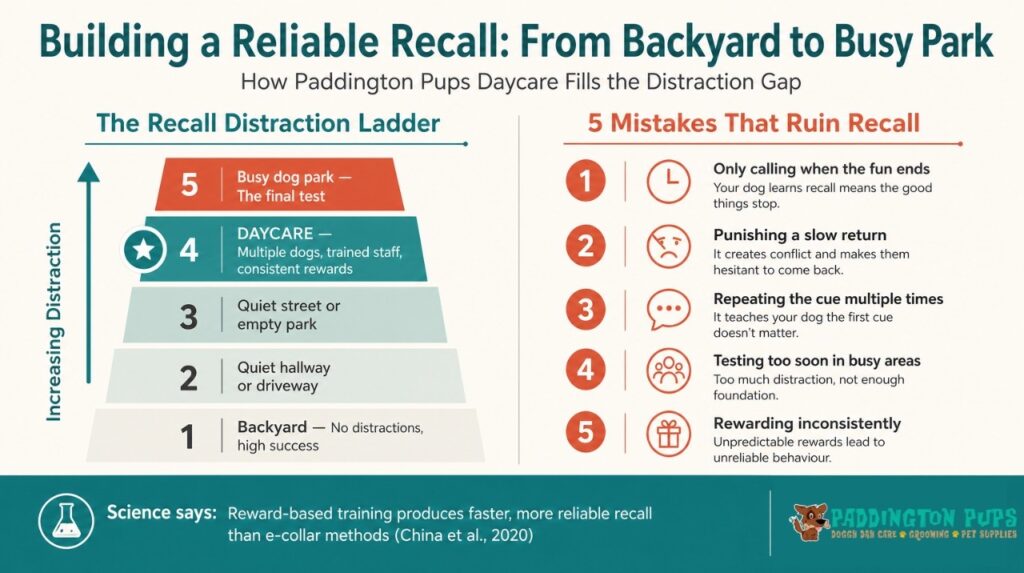
You call your dog’s name at the park. They glance up, decide the smell in the grass is more interesting, and carry on with their afternoon. Meanwhile, you are standing there calling louder, wondering why the recall that works perfectly in the backyard has completely fallen apart the second there is something better on offer.
Recall training is the fix for exactly this gap. It is arguably the most valuable thing you can teach a dog, but also one of the hardest to perfect because it requires a dog to choose you over their immediate environment. This guide covers how to build a reliable come at home, the science behind reward-based methods, why the behaviour tends to break down around distractions, and how a structured daycare environment gives your dog the extra practice that turns a shaky recall into a genuinely dependable one.
What Is Recall Training and Why Does It Matter?
Recall training is the process of teaching your dog to come back to you immediately and reliably, no matter what is happening around them, whenever you give the cue. It matters more than almost any other command because it is the one most likely to keep your dog safe. Whether that means calling them away from a busy road, another dog showing tension, or wildlife on a bushwalk, a strong recall is a critical safety tool.
A reliable recall also gives your dog more freedom. Dogs with a dependable come can enjoy supervised off-leash time at the park or the beach. Dogs without one are stuck on the leash indefinitely, not because their owner is being overly cautious, but because the risk of them not coming back is simply too high.
It is also one of the few commands where being mostly reliable is not good enough. A dog who comes back nine times out of ten still poses a real risk the tenth time, particularly near roads or off-leash areas shared with wildlife. That is part of why recall deserves more dedicated practice than most other commands, rather than being treated as something a dog will simply pick up along the way.
How Do You Teach a Reliable Recall at Home?
To teach a reliable recall, you must start by making your cue mean something wonderful, then build up distance and distraction gradually. The foundation of a strong recall is always built in a quiet environment before being tested anywhere else.
Build value in your cue.
Say your dog’s name and “come” in a warm, upbeat tone. Reward generously every single time they respond, even if they were already walking toward you anyway. The cue needs a long history of good things happening before it can compete with an exciting distraction at the park.
Practise the come-to-reward habit constantly.
Call your dog to you several times a day for no particular reason. Reward them, then let them go back to whatever they were doing. This teaches your dog that coming when called does not mean the fun is over, which is one of the biggest reasons recall breaks down later.
Use a long line before going off-leash.
A long training lead lets your dog range further while you retain the ability to guide them back if they do not respond. This step matters because a recall practised only on a short leash has not really been tested at all.
Keep an emergency cue in reserve.
Many owners find it useful to teach a second, rarely used word purely for genuine emergencies. Keep this cue fresh by only ever rewarding it with the very best treats you have. Because it is never used casually, it does not get worn down the way an everyday cue sometimes can.
Does Reward-Based Training Actually Work Better for Recall?
When dogs struggle with recall, owners are sometimes advised to switch to aversive tools like electronic collars (e-collars) to force compliance. However, recent scientific research demonstrates that positive reinforcement is actually more effective for teaching a reliable recall.
A major 2020 study published in Frontiers in Veterinary Science specifically tested the efficacy of e-collars versus reward-based training for dogs with known off-lead recall problems . The researchers divided 63 dogs into three groups: one trained by experienced e-collar trainers, one trained by the same trainers without the e-collar, and one trained by professional positive reinforcement trainers.
The results were clear. The positive reinforcement group achieved significantly better responses to the “Come” command after a single instruction. Furthermore, the dogs trained with rewards had shorter response latencies, meaning they came back faster than the dogs trained with e-collars. The researchers concluded that training with positive reinforcement was more effective at addressing the target behaviour, while posing fewer risks to dog welfare.
This aligns with guidance from the RSPCA Knowledgebase, which strongly recommends a reward-based approach. Rewarding your dog every time they come when called, especially in the early stages, builds a willing and enthusiastic response rather than one based on fear or avoidance.
Why Does Recall Break Down Around Distractions?
Recall breaks down around distractions because a dog’s response to any cue depends heavily on what else is competing for their attention at that moment. A dog who comes reliably in the lounge room is responding in an environment with almost nothing else going on. Add another dog, an exciting smell, or a jogger, and the same cue is suddenly competing against far more interesting options.
This is not a sign that training has failed. It is a sign that the dog has not yet had enough successful practice at that particular level of distraction. Recall needs to be built up in stages. You must start in the backyard, move to a quiet street, then a park during a quiet time, before ever testing the command somewhere busy and exciting.
Skipping stages is the single biggest reason recall training stalls. It is tempting to test your dog’s recall at the busiest, most exciting park you can find, but that is the equivalent of expecting someone to run a marathon in their first week of training. Small, winnable steps build a recall that actually holds up, while one overwhelming failure can set weeks of progress back.
How Does Dog Daycare Strengthen Recall Training?
Doggy daycare gives your dog dozens of extra, low-stakes recall repetitions every visit, in exactly the kind of busy, social environment where recall is hardest to practise safely at home. At Paddington Pups, our team calls dogs by name constantly throughout the day. Whether that means transitioning between play areas, calling a dog over for a quick check, or gathering the group before a rest break, every one of those moments is a small recall repetition reinforced consistently by trained staff.
Grouping dogs by size, energy, and temperament in our four separate play areas also matters here. A dog practising recall in a chaotic, overstimulating group has far less chance of success than one practising in a group matched to their own energy level, where the level of distraction is manageable rather than overwhelming.
This matters because recall proofing depends on winnable repetitions, not just repetitions. A dog called away from an overwhelming group learns that ignoring the cue is an option. A dog called from a well-matched, calmer group succeeds more often, building the same habit owners are working on at home.
One of our clients at Paddington Pups had a dog with a solid recall at home that completely disappeared around other dogs. After a few months of regular daycare visits, where our staff consistently called him away from play, rewarded him, and let him return to the group, his owner noticed he started responding to recall at the local dog park too. This had never happened before daycare became part of his routine.
Daycare is not a substitute for the training you do at home, but it provides something a backyard simply cannot: dozens of real, socially distracting repetitions a week, with a consistent, trained adult reinforcing the same response every time.
When Should You Start Recall Training?
You can start recall training as soon as a puppy joins your household, ideally before they have had much chance to learn that ignoring you has no consequences. Adult dogs and rescues can absolutely build a reliable recall too, though it may take longer if they have had years of practice not responding.
Most dogs show solid backyard recall within a few weeks of consistent practice. However, a recall that holds up reliably around real distractions, other dogs, food scraps, or wildlife often takes several months of steady work across different environments. Progress rarely feels linear. A dog might recall beautifully for two weeks, then ignore you completely the first time a rabbit runs past. That is a normal part of the process rather than a setback worth worrying about.
Older dogs who have never had formal recall training are not a lost cause either. It simply means starting from the same low-distraction beginning as a puppy would, rather than assuming years of habit will disappear after a single good session. Patience at this stage pays off far more than trying to rush an adult dog past steps a puppy would be given time to master.