You come home to a chewed shoe, a corner of the couch cushion missing, or a skirting board that has seen better days. It is frustrating, sometimes expensive, and it is easy to feel like your dog is simply being naughty or doing it out of spite.
In reality, destructive chewing almost always has a clear, underlying cause. Once you understand what is driving the behaviour, the solution usually becomes much clearer too. This guide covers the science of why dogs chew destructively, how to manage the environment at home, and why a structured daycare routine can make a genuine difference for dogs whose chewing comes from boredom or excess energy rather than teething alone.
What Causes Destructive Chewing in Dogs?
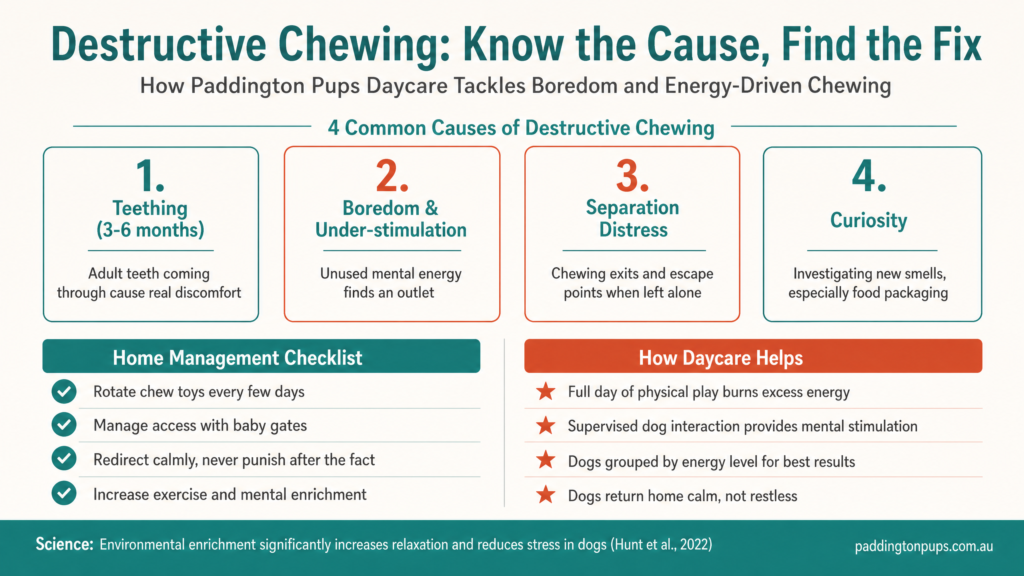
Destructive chewing is typically driven by one of four underlying causes: teething discomfort, under-stimulation, separation-related distress, or simple curiosity.
Puppies chew heavily between three and six months of age as their adult teeth come through. The pressure of chewing genuinely relieves that discomfort. In older puppies and adult dogs, destructive chewing is more often linked to energy that has not been used up. This can be physical energy from a lack of exercise, or mental energy from a lack of anything interesting to do.
A 2025 review in Frontiers in Veterinary Science highlighted that chewing is a functionally significant behaviour that positively impacts a dog’s physical and psychological health . However, when dogs lack appropriate outlets for this natural behaviour, or when they become frustrated and bored, that chewing drive is easily redirected toward furniture and household items.
Some dogs also chew specifically when left alone, targeting doorframes, window sills, or crate bars. A 1999 study published in Applied Animal Behaviour Science demonstrated that destructive behaviour directed at the environment (particularly exit points) is a core sign of separation-related problems, distinct from simple disobedience or boredom.
Diet can play a smaller role too. A dog on a restricted diet or one lacking a particular nutrient may be more inclined to investigate and chew things that smell like food. This is far less common than boredom or teething as a cause, but it is worth ruling out if your dog’s chewing seems focused specifically on food packaging.
Is Destructive Chewing Different From Normal Chewing?
Yes, destructive chewing is different from normal chewing, though the line between them is not always obvious. Chewing itself is a completely normal, healthy behaviour that helps dogs explore their world, relieve teething discomfort, and keep their jaws and teeth in good condition. It only becomes a problem once it is directed at the wrong things, becomes excessive, or starts to injure your dog or damage your home.
The goal is not to stop chewing altogether. The goal is to redirect it toward appropriate items and work out what is driving the behaviour when it strays toward furniture or shoes.
A useful way to tell the two apart is to look at what and when your dog chews. A puppy who mouths a variety of safe toys throughout the day is behaving completely normally. A dog who repeatedly targets door frames the moment you leave the house, or who destroys items only when left alone, is showing a pattern that points to a specific underlying cause rather than general exploration.
How Do You Stop Destructive Chewing at Home?
To reduce destructive chewing at home, focus on managing the environment, providing better chewing outlets, and addressing the underlying cause rather than just reacting after the damage is done.
Think of chew toy rotation and environment management as the foundation. Addressing the underlying cause is the part that actually resolves the problem long-term.
How Does Dog Daycare Help With Destructive Chewing?
Doggy daycare tackles two of the most common causes of destructive chewing directly: unused physical energy and boredom. A dog who has spent the day playing, socialising, and being mentally engaged in a supervised group setting comes home genuinely tired. They are not just physically worn out for an hour before bouncing back, but settled in a way that a quick walk before work often does not achieve.
At Paddington Pups, our four separate play areas group dogs by energy level, size, and temperament. High-energy dogs get a proper outlet for the drive that often turns into chewing at home. Structured play, supervised interaction with other dogs, and a full day of mental engagement all use up the same energy that would otherwise be spent on your furniture come evening.
Daycare also helps with the boredom side of the equation specifically. A dog left alone at home for long stretches with nothing to do is exactly the profile most likely to chew destructively. Environmental enrichment is proven to reduce problem behaviours. A 2022 pilot study in Animals found that environmental enrichment activities for dogs resulted in a significant increase in relaxation behaviours and a significant reduction in alert and stress behaviours . Regular daycare visits break up long, understimulating days and give your dog exactly this kind of engaging enrichment.
One of our clients at Paddington Pups had an adult dog who was steadily destroying furniture while home alone during the day. After starting two daycare visits a week alongside the toy rotation their vet had recommended, the owner noticed far less chewing on the days their dog came home tired from daycare rather than restless.
Daycare is not a fix for every cause of destructive chewing. A dog whose chewing is driven by genuine separation anxiety may need additional, targeted support alongside more activity. However, for the very common cases driven by boredom and pent-up energy, a couple of daycare visits a week can noticeably reduce the damage on the days in between.
When Does Destructive Chewing Need Extra Attention?
Destructive chewing needs closer attention when it is focused specifically around exit points like doors and windows, happens only when your dog is left alone, or is accompanied by other signs of distress such as pacing, drooling, or vocalising before you leave. This pattern points toward separation-related distress rather than simple boredom or teething. It is worth speaking with your vet before assuming more toys or exercise alone will solve it.
Chewing that seems to come out of nowhere in an adult dog who has never had the issue before is also worth a vet visit. Sudden changes in behaviour can occasionally point to a health issue rather than a purely behavioural one. Most destructive chewing, though, responds well to a combination of better management, more appropriate outlets, and enough physical and mental activity to actually tire your dog out.
Age also plays a role in how much attention chewing needs. A teething puppy’s chewing will generally settle on its own by around six months as their adult teeth finish coming through. In contrast, boredom or anxiety-driven chewing in an adult dog tends to persist, sometimes for years, until the underlying cause is actually addressed.
What Mistakes Make Destructive Chewing Worse?
A few common responses tend to make destructive chewing harder to resolve rather than easier. Avoiding these pitfalls is essential for changing the behaviour.
- Punishing your dog after finding the damage. Dogs do not connect a correction with something that happened while you were out. This only risks making your dog anxious around you without addressing the chewing itself.
- Leaving the same one or two toys out permanently. Dogs lose interest in toys that never change. This makes appropriate chewing options far less appealing than whatever is nearby and novel.
- Assuming more toys alone will fix boredom-driven chewing. Toys help, but they rarely substitute for the exercise and social engagement a genuinely understimulated dog needs.
- Ignoring a pattern focused on exits or triggered by your departure. This is one of the clearest signs of separation-related distress, and it needs a different approach to boredom-driven chewing.
- Expecting daycare or exercise alone to fix an anxiety-driven chewer. Physical tiredness helps enormously with boredom-driven chewing, but a dog distressed by being alone needs that specific issue addressed too, not just more activity.
The RSPCA’s guidance is clear that punishing or stopping chewing without understanding the cause tends to create more problems rather than fewer. Working out why your dog is chewing is always the sensible first step. If chewing is severe, sudden, or clearly tied to your dog being left alone, a chat with your vet is worth having before trying to manage it alone. Bringing It All Together
Destructive chewing is rarely about a badly behaved dog. It is almost always a sign that teething discomfort, boredom, or excess energy needs somewhere better to go. Managing the environment, rotating appropriate chew toys, and redirecting rather than punishing will get most dogs a long way toward better habits.
For dogs whose chewing is fuelled by boredom or pent-up energy specifically, a structured daycare routine can genuinely help. It gives your dog the physical outlet and mental engagement that turns a restless, destructive day at home into a calm evening instead.