When Is the Right Time to Start Daycare with a Rescue Dog?

One of the most common questions Brisbane rescue dog owners ask is whether daycare is a good idea for their newly adopted dog, and if so, when to start. The answer is not as simple as a fixed number of weeks. It depends on where your dog is in their adjustment, and understanding that adjustment is the key to making daycare a genuinely positive experience rather than an overwhelming one.
 
This guide explains the adjustment phases rescue dogs typically move through, what to watch for at each stage, and how to know when your dog is genuinely ready to benefit from at Paddington Pups.

When Is the Right Time to Start Daycare with a Rescue Dog?

 
The honest answer is: not in the first two to three weeks.
 
In the early days after adoption, a rescue dog is operating under significant uncertainty. Everything in their environment is new and unprocessed: new people, new smells, new sounds, and no established expectations about what happens next. Adding a group daycare environment on top of that adjustment adds more to manage, not less. For most rescue dogs, the early weeks are a time for quiet, routine, and gradual confidence-building at home.
 
The right window for most rescue dogs is somewhere in the four-to-eight week range, once the following signs are present:
  • They have established a predictable home routine and are comfortable within it
  • They are eating and resting consistently
  • Their baseline anxiety has reduced noticeably from the first week
  • They are showing interest in the world around them rather than shutting down or hiding
  • They have had some positive off-lead socialisation with at least a few familiar dogs
Why daycare genuinely helps at this stage:
Dogs that have a predictable, positive experience away from home on a regular basis develop a different relationship with being apart from their owner. They accumulate evidence that being away is manageable and that their person always comes back. Over time, this meaningfully reduces the anticipatory anxiety that builds before an owner leaves and the distress that follows. For more on managing this, see our .
 
For a rescue dog building confidence in their new life, a well-structured daycare day provides exactly this: a positive, supervised environment away from home that strengthens the dog’s ability to cope with separation while also providing social engagement, exercise, and mental stimulation.

What Happens at Paddington Pups for Rescue Dogs?

At Paddington Pups, every new dog goes through a first-day assessment before being confirmed as a regular daycare attendee. For rescue dogs, this assessment is particularly valuable. It gives our experienced team an opportunity to observe how the dog responds in a group environment, what their social style is, and which of our four play areas is the most appropriate starting point.
 
A rescue dog that is still building confidence is not placed in a high-energy group where the pace is overwhelming. They are matched to a group where they can engage at their own comfort level. Our specialised is also excellent for rescue dogs needing more structured, small-group interaction with focused staff attention. Playcare has helped dogs like Poppy, who arrived with unidentified resource guarding behaviours, develop confidence and social ease within just a few weeks.
 
If your rescue dog has shown resource guarding, social uncertainty, or reactivity, let our team know at registration. That information shapes how we manage their first visits and ensures the experience builds confidence rather than adding to stress.
 

What Are the Adjustment Phases a Rescue Dog Goes Through?
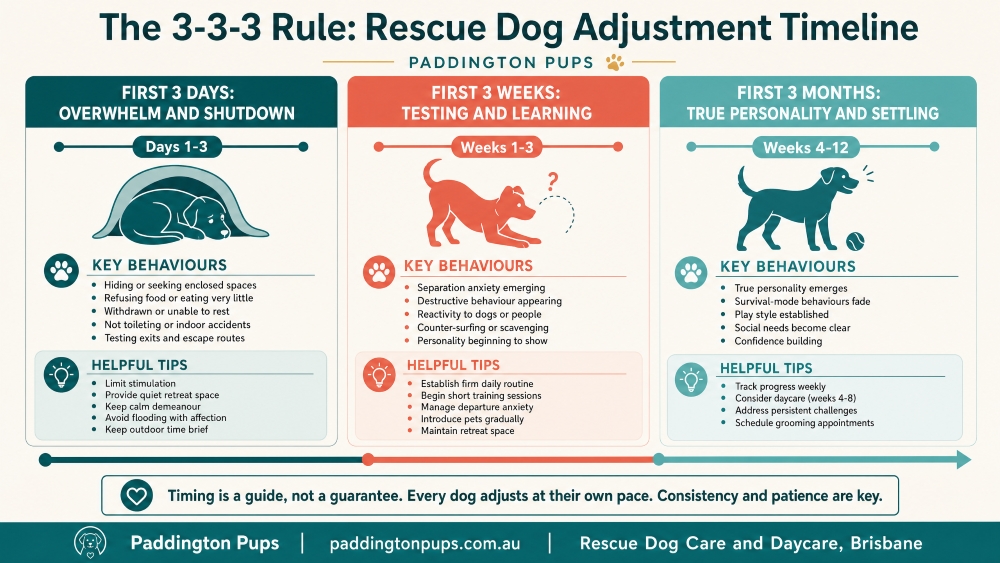
To know when your rescue dog is ready for daycare, it helps to understand the adjustment timeline they are moving through. The “3-3-3 rule” is a widely used framework among rescue workers and adoption counsellors that describes the typical phases after arriving in a new home.
 
The timing is a guide, not a guarantee, but the progression is consistent enough to be genuinely useful.
paddington pups rescue dog 333 infographics

The First 3 Days: Overwhelm and Shutdown

In the first three days, most rescue dogs are in a state of sensory and emotional overwhelm. Common behaviours include hiding or seeking enclosed spaces, refusing food or eating very little, being either very withdrawn or very unsettled, not toileting or toileting indoors despite being housetrained, showing little or no personality, and testing exits and escape routes.
 
What helps: Limit stimulation and new experiences. Provide a quiet retreat space the dog can choose to use. Keep a calm, matter-of-fact demeanour. Resist the urge to flood them with affection or visitors. Keep outdoor time structured and brief.
 

The First 3 Weeks: Testing and Learning

After the initial shutdown phase, most rescue dogs begin to come out of themselves and start to understand their new environment. This is also the phase where more challenging behaviours often emerge, because the dog is now comfortable enough to test what the rules are.
 
Common behaviours include separation anxiety beginning to show, destructive behaviour, reactivity toward other dogs or people that was not visible in the first few days, counter-surfing or scavenging, and the first signs of genuine personality emerging.
 
What helps: Introduce routine firmly and consistently. Begin short, positive training sessions. Start working on departure anxiety using short, calm absences. Introduce other pets gradually and in controlled contexts. Continue to give them access to their retreat space.
 

The First 3 Months: True Personality and Real Settling

By the end of the first three months, the dog you adopted is beginning to emerge. The survival-mode behaviours of the early weeks have largely given way to the dog’s genuine temperament. Their preferences, play style, social needs, and personality are now visible.
 
This is also the phase where any persistent anxiety or behavioural challenges that did not resolve with time and consistency need to be addressed with more targeted support, whether that is professional training, veterinary input, or an adjusted management approach.

How Do You Know If Your Rescue Dog Is Ready for Daycare or Still Adjusting?

One of the most common sources of confusion for new rescue owners is working out whether what they are seeing is normal adjustment or something that needs clinical intervention. provides helpful guidance on understanding these early adjustment periods.
 
Assessment
What It Looks Like
What It Means for Daycare
Ready for Daycare
Eating and resting consistently. Showing interest in the world. Baseline anxiety reducing. Comfortable with short separations.
Begin the daycare assessment process. Start with one day and build gradually.
Still Adjusting
Anxiety present but gradually improving. Routine still being established. Occasional regression after disruptions.
Continue home routine. Revisit daycare readiness in 1-2 weeks.
Needs Professional Support
Anxiety not improving after 6-8 weeks. Severe destructive behaviour when alone. Escalating reactivity. Inability to eat or rest when owner is away.
Consult a vet or certified behaviourist before introducing daycare.

How Should You Set Up Your Home to Help Your Rescue Dog Settle Faster?

The environment you create in the first weeks shapes how quickly a rescue dog reaches the point of being ready for daycare. A few specific adjustments make the transition significantly smoother.
 
Create a safe retreat space immediately. Before the dog arrives, designate a quiet area, such as a crate, a pen in a low-traffic room, or a corner with their bed, that is theirs and is not disrupted by household activity. Dogs that have access to a retreat consistently show lower anxiety than those that are always in the middle of household activity.
 
Keep departure and arrival routines low-key. The way you leave and return sets the dog’s emotional register around separations. Long, emotional goodbyes elevate anxiety before you have even left. Calm, brief departures teach the dog that leaving is an unremarkable event. The same applies to returns: calm, quiet greetings rather than high-excitement reunions reduce the contrast between your presence and absence.
 
Remove high-value resources from shared spaces initially. Rescue dogs often have an uncertain relationship with resources because their access to food and possessions was unpredictable in the past. Remove bones, chews, and high-value toys from shared household spaces in the first weeks.
 
Introduce other household pets carefully. Use the same neutral-territory, gradual approach that applies to any new dog meeting, beginning at a distance with parallel exposure before moving to direct contact. For detailed steps, see our .
 

How Do You Build Long-Term Support for a Rescue Dog Beyond the First 90 Days?

The first 90 days establish the foundation. What happens beyond that determines how fully a rescue dog settles into their new life.
 
Consistent routine is the single most powerful tool. A rescue dog that knows exactly when they eat, when they walk, when their owner leaves, and when they return regulates their anxiety around that predictability. Disruptions to the routine, even temporary ones, can temporarily set back progress, but this is normal and can be managed by returning to the routine quickly.
 
Training builds communication and confidence simultaneously. Short, positive training sessions give rescue dogs a language for interacting with their owner that does not depend on guessing what is expected. A can provide invaluable guidance for rescue dogs with specific challenges .
 
Regular professional grooming from an early stage. For rescue dogs that were not handled regularly in their previous life, early introduction to builds a positive association with handling. Paddington Pups’ groomers are experienced with anxious dogs and take extra time with dogs that are still building their confidence around new experiences.
 

Getting Started at Paddington Pups

When your rescue dog is ready for daycare, the process at Paddington Pups is straightforward. before the first visit, and every new dog completes a first-day assessment. Our walk-in daycare model means you can start with one day, see how your rescue dog responds, and build from there at a pace that suits them.
 
If you also need boarding services down the track, our provides helpful guidance for that transition.
If you have questions about whether your rescue dog is ready for daycare, or about how we accommodate dogs that are still building social confidence, before the first visit. We are always happy to talk through what we are seeing and what approach will work best for your specific dog.

FAQs

Can I bring my rescue dog to daycare in the first week?

We generally recommend waiting until weeks four to eight. The first two to three weeks are a critical settling-in period where your dog needs quiet, routine, and minimal new experiences. Introducing daycare too early can add to their stress rather than help. Once they are eating, resting, and showing interest in the world around them, they are much more likely to have a positive first daycare experience.

Yes, this is completely normal. The stress and confusion of moving to a new environment can cause a temporary regression in toilet training. Treat them like a puppy for the first few weeks: take them out frequently, praise them for toileting outside, and do not punish accidents inside.

If possible, spend the first few days at home with them to help them settle. When you do start leaving them, begin with very short absences of just a few minutes and gradually build up the time as they show they can cope without distress.

Yes, when introduced at the right time. A well-structured daycare day builds your dog’s evidence that being away from you is safe and temporary. Over time, this reduces the anticipatory anxiety around separations. The key is introducing daycare after the initial adjustment phase, not during it.

Schedule a general wellness check within the first week or two, even if they were cleared by the rescue organisation. This establishes a relationship with your local vet and ensures there are no underlying health issues contributing to any behavioural challenges.
Scroll to Top